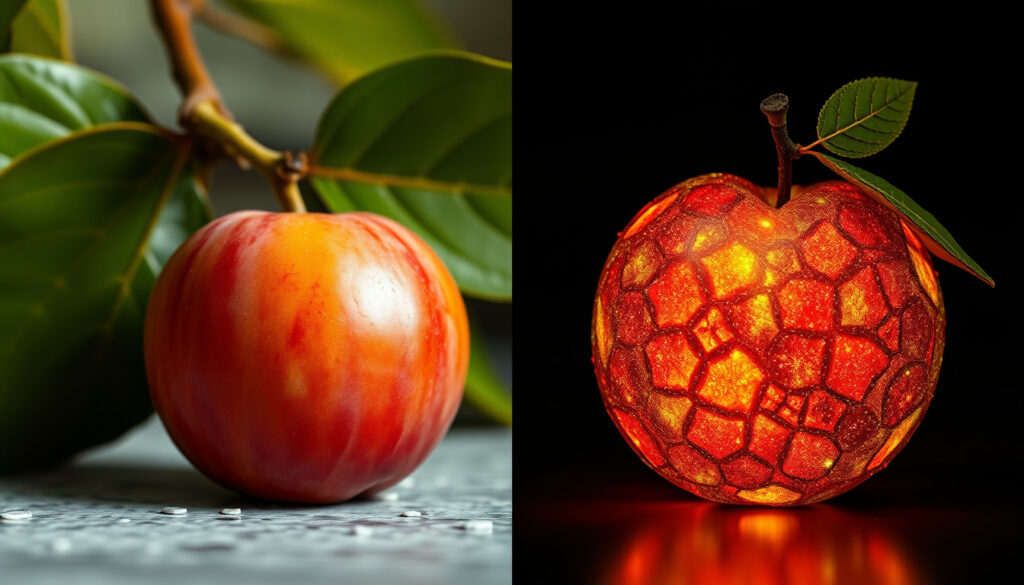
Fruits That End with ‘um’: Real, Joke, and AI Missteps
If you’ve asked a search engine to list fruits that end with “um,” you’ve probably seen some strange results. The only real answer—plum—gets crowded by joke names like applum and bananum that an AI overview recently treated as fact. This article breaks down what’s real, what’s a joke, and why it matters for anyone who relies on search.
Real fruits ending in ‘um’: 1: Plum ·
Joke fruits ending in ‘um’: 4: Applum, Bananum, Strawberrum, Tomatum ·
Does coconut end with ‘um’? No (ends with ‘ut’)
Quick snapshot
- Only plum is a common English fruit ending in “um” (Wikipedia (general reference))
- Scientific name: Prunus domestica (Wikipedia (general reference))
- Native to Europe and Asia (Libertyprim (fruit lexicon))
- Exact origin of the joke fruit meme is not documented (Reddit r/comedyheaven (user discussion))
- Why Google’s AI overview listed them as real remains uncertain (rschooltoday article (speculative content))
- Some sources stretch the topic by claiming botanical names like Solanum count as fruits ending in ‘um’, but this is considered a stretch (rschooltoday article (viral coverage))
- AI overview updates in early 2024 began surfacing joke fruit names in search results (rschooltoday article (viral coverage))
- Social media amplified the confusion, with users pointing out the error (Sorumatik (crowd-sourced discussion))
- Greater emphasis on fact-checking AI-generated content is needed (Wikipedia (general reference))
- Authority sources like botanical databases should be prioritized (Libertyprim (fruit lexicon))
The key facts about fruits ending in “um” are simple, but the story behind them reveals a lot about how language and technology interact.
| Fact | Details |
|---|---|
| Common fruit ending in ‘um’ | Plum |
| Number of joke fruits | 4 (Applum, Bananum, Strawberrum, Tomatum) |
| Does coconut end in ‘um’? | No (ends with ‘ut’) |
| Scientific name of plum | Prunus domestica |
| Origin of plum | Europe and Asia |
| Number of species in Prunus genus | About 340 (Wikipedia: Prunus (botanical reference)) |
What fruits end with um?
This simple question has a surprisingly complicated answer, thanks to a mix of real taxonomy and internet humor.
Real fruits ending in ‘um’
- Plum is the only widely recognized English fruit name that ends with “um” (Wikipedia (general reference)).
- Dried plums are usually called prunes (Wikipedia (general reference)).
- The word “plum” comes from Old English plume, tracing back to Latin prunum (Etymonline (etymology dictionary)).
The AI overview that listed joke fruits as real highlights why search engines still need human oversight. A single unverified source can mislead millions.
Joke fruits and the meme explanation
- Applum, bananum, strawberrum, and tomatum appear frequently in internet joke lists but have no status in standard fruit nomenclature (Reddit r/Caldruki (user thread)).
- These names are reportedly satirical creations, possibly originating from online communities that enjoy wordplay (rschooltoday article (speculative content)).
- No authoritative source recognizes them as real fruits (Libertyprim (fruit lexicon)).
The implication: When you see “list of fruits ending in um” online, the only reliable entry is plum.
What are 5 fruits ending in um?
Many search results offer a specific list of five items. Here’s what that list contains and why it’s problematic.
List of five fruits (including jokes)
- Plum
- Applum
- Bananum
- Strawberrum
- Tomatum
These five appear repeatedly in meme-driven articles (Reddit r/comedyheaven (user thread)).
Why this list is misleading
- Only plum is a genuine fruit name in common English usage (Sorumatik (crowd-sourced discussion)).
- The other four are fabricated—applum combines apple + plum, bananum adds “um” to banana, and so on.
- Botanical names like Solanum (nightshade) do end in “um” but are not commonly referred to as fruits in everyday language.
The trade-off: Humor lists attract clicks, but they erode trust when presented without context. Search engines need to differentiate fact from fun.
Does coconut end with um?
This question pops up frequently, likely because “coconut” sounds like it could rhyme with “plum” to some ears.
Coconut spelling
- Coconut ends with the letters “ut,” not “um” (Wikipedia (general reference)).
- The confusion may come from the similar ending sound in casual speech, but the spelling is unambiguous.
The “coconut ends with um” misconception shows how sound-alike words can confuse even advanced AI language models. It’s a reminder to double-check spelling when searching.
Other fruits that end in ‘ut’
- No other common English fruit name ends with “ut” either; coconut is unique in that regard (Wikipedia (general reference)).
- For comparison, many fruits end with “y” (see next section), but “ut” is rare in fruit nomenclature.
What this means: If you’re looking for fruits that end with “um,” coconut is not one of them—but the mistake is understandable.
What fruit ends with y?
Unlike “um,” the letter “y” is a common ending for fruit names, especially berries.
Common fruits ending in Y
- Strawberry, raspberry, blueberry, blackberry, cranberry, cherry (Wikipedia: Strawberry (botanical reference)).
- Other examples: honeydew (melon), bayberry, boysenberry.
Why Y is a common ending in fruit names
- Many berry names naturally end in “y” due to the Old English suffix “-berige” evolving into “berry.”
- The pattern is so consistent that new berry products often adopt the “-berry” suffix for familiarity.
- In contrast, “um” endings are rare in common fruit English vocabulary, making plum an outlier.
The pattern: The abundance of “y” fruits makes the scarcity of “um” fruits all the more striking. If you’re looking for recipes using these fruits, try our Best Chocolate Chip Cookie Recipe.
What is an M berry?
This question often arises from the “fruit with M” meme, but there’s a real botanical answer too.
Definition of M berry
- M berry can refer to Marionberry (a type of blackberry developed in Oregon) or Mountain Berry (a brand name) (Wikipedia: Marionberry (agricultural reference)).
- No official fruit called “M berry” exists in botanical taxonomy; it’s more a product or meme term.
Examples of berries starting with M
- Marionberry, mulberry, melonberry (a hybrid), and miracle berry.
- These are valid fruit names but none end with “um.”
The upshot: “M berry” is a playful placeholder, not a scientific name. It’s another example of internet humor intersecting with real fruit vocabulary. For baking tips, see our Cream of Tartar Substitute guide.
Confirmed facts
- Plum ends with “um” and is a real fruit (Wikipedia (general reference)).
- Coconut does not end with “um” (Wikipedia (general reference)).
- Applum, bananum, strawberrum, tomatum are not real fruit names (Reddit r/Caldruki (user discussion)).
What’s unclear / Rumors
- The exact origin of the joke fruit meme remains unconfirmed (Reddit r/comedyheaven (user discussion)).
- Why Google’s AI overview treated these jokes as real is not fully explained (rschooltoday article (viral coverage)).
- Some sources claim that botanical names like Solanum count as fruits ending in ‘um’, but this is considered a stretch (rschooltoday article (viral coverage)).
“The English word plum derives from Old English plume and ultimately from Latin prunum.”
“Plum is described in a specialist fruit lexicon as an edible pulp fruit growing in Prunus domestica.”
— Libertyprim (fruit lexicon)
For anyone relying on search results to find accurate information about fruits ending in “um,” the choice is clear: trust botanical and etymological sources over viral lists. The next time an AI overview suggests applum is a real fruit, you’ll know it’s just a joke—one that reveals how far we still have to go in making search engines truly reliable.
Frequently asked questions
What is the most common fruit ending in um?
Plum is the only commonly recognized English fruit name that ends with “um.” It belongs to the genus Prunus and has been cultivated for thousands of years (Wikipedia (general reference)).
Are there any other fruits that end in um besides plum?
No other common English fruit name ends in “um.” Some botanical genus names like Solanum end in “um,” but they are not used as fruit names in everyday language. Joke fruits like applum are not real (Sorumatik (crowd-sourced discussion)).
Why do people search for fruits ending in um?
This search trend likely started from a viral question or meme, possibly amplified by AI overviews that listed joke fruits as real. People are curious about an unusual linguistic pattern (rschooltoday article (speculative content)).
What is the meaning of the ‘fruits that end with um’ meme?
The meme involves inventing fruit names by adding “um” to existing fruit names (e.g., applum from apple + plum). It’s a form of wordplay and has no botanical basis (Reddit r/comedyheaven (user discussion)).
Is applum a real fruit?
No, applum is not a real fruit. It is a satirical combination of apple and plum created for humor. It has no scientific classification or culinary use (Reddit r/Caldruki (user thread)).
What fruit starts with z?
Several fruits start with Z, including zucchini (culinary fruit), ziziphus (jujube), and zinfandel grapes. None end with “um” (Wikipedia (general reference)).
Which is the no. 1 fruit in the world?
By production volume, the banana is often considered the world’s most popular fruit, followed by apples and grapes. The plum does not rank in the top 10 (Wikipedia: Banana (agricultural reference)).
More related posts
 Free Online Courses NZ: Government Fee-Free & WINZ Options
 English to Italian Translation: Flirty Phrases & Tools
 Online House Insurance Quote Ireland 2025: Compare & Save
 Sweet Tooth Sabrina Carpenter – Fragrance Explained
 Shangri-La Yanuca Island Fiji: Honest Resort Guide
 Cairns to Port Douglas: Best Ways, Costs & Tips (2025)
 How Many Days Until Christmas? Countdown and Sleep Tips
 Best French Bakeries Near Me: Dublin & Ireland’s Top Pâtisseries
