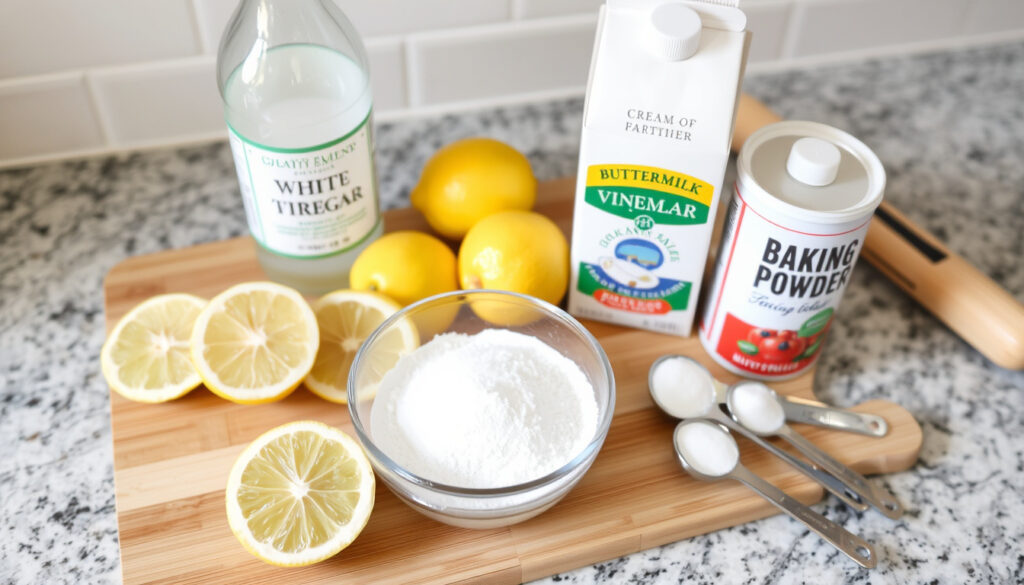
5 Best Cream of Tartar Substitutes for Baking and Cooking
Few baking mishaps throw off a recipe faster than realizing you’re out of cream of tartar. But that tiny jar of white powder—a byproduct of winemaking—does more than stabilize egg whites, and knowing the right substitute and exact ratio can save your bake without sacrificing texture or taste.
Cream of tartar substitute options: 6 ·
Common uses: stabilizing egg whites, activating baking soda ·
Lemon juice ratio: 2:1 by volume ·
Baking powder alternative: 1 tsp cream of tartar + ½ tsp baking soda = 2 tsp baking powder
Quick snapshot
- Acidic substitute — use 2 tsp per 1 tsp cream of tartar (The Spice House (specialty spice retailer))
- Best for meringue and cookies (The Spice House (specialty spice retailer))
- Neutral flavor — use 1 tsp per 1 tsp cream of tartar (Simply Recipes (trusted home-cooking site))
- Good for meringue and cakes (Simply Recipes (trusted home-cooking site))
- Contains both acid and base — use 2 tsp per 1 tsp cream of tartar when baking soda is also present (The Spice House (specialty spice retailer))
- Best for cookies and snickerdoodles
- Acceptable in some recipes, but may alter texture and stability (King Arthur Baking (flour-mill experts))
- Not recommended for meringue or soufflé (King Arthur Baking (flour-mill experts))
Here are the key facts about cream of tartar and its substitutes.
| Chemical name | Potassium bitartrate |
| Source | Byproduct of winemaking |
| Primary function | Acid to stabilize egg whites and activate baking soda |
| Most common substitute | Lemon juice (2:1 ratio) (The Spice House) |
What is Cream of Tartar and What Makes It So Important?
What is cream of tartar chemically?
- Cream of tartar is potassium bitartrate, a natural acid that forms on the inside of wine barrels during fermentation. King Arthur Baking (flour-mill experts) calls it “an added safeguard” that strengthens whipped egg whites.
- It’s a pure acid, which makes it ideal for balancing the alkalinity of baking soda and for providing the tang in classic snickerdoodles.
What can I use if I don’t have cream of tartar?
- Common substitutes include lemon juice, white vinegar, and baking powder. The right option depends on whether you need acid for egg whites or leavening.
Why is it used in baking?
- When added to egg whites, cream of tartar lowers the pH, helping the proteins bond into stable, stiff peaks. The Spice House (specialty spice retailer) notes that lemon juice and vinegar serve the same chemical function.
- In recipes with baking soda, cream of tartar provides the acid needed to release carbon dioxide for leavening. Without it, the baking soda alone won’t create lift.
Bottom line: Cream of tartar is a versatile acid that both stabilizes egg whites and activates baking soda. If you’re out, any kitchen acid can fill in — but the ratio matters.
Because cream of tartar is simply an acid, swapping in lemon juice or vinegar is a direct chemical trade. For bakers, that means the same stable meringue — if you measure correctly.
The pattern: cream of tartar’s acidity is what makes it essential, and any acidic ingredient can fill that role if used in the right proportion.
What Is the Best Substitute for Cream of Tartar in Meringue?
How to use lemon juice as a substitute in meringue
- Simply Recipes (trusted home-cooking site) recommends using four times the amount of lemon juice as cream of tartar. For ¼ teaspoon cream of tartar, use 1 teaspoon lemon juice.
- King Arthur Baking (flour-mill experts) suggests starting with ⅛ to ¼ teaspoon lemon juice per egg white for a pinch of cream of tartar.
- Add the lemon juice gradually once the egg whites are foamy to avoid overacidifying.
Using vinegar in meringue
- White vinegar works at the same ratio as lemon juice: 1 teaspoon vinegar per ¼ teaspoon cream of tartar. Simply Recipes (trusted home-cooking site) states that vinegar and lemon juice are interchangeable in this role.
- Vinegar has a neutral taste and won’t add a lemony flavor to delicate meringue.
What is a good substitute for cream of tartar?
Lemon juice and white vinegar are top choices for meringue, while baking powder works for cookies and cakes. The ratio changes based on the recipe.
Bottom line: For meringue, lemon juice or white vinegar are the gold-standard substitutes. Use a 4:1 ratio (liquid acid to cream of tartar) for the same stable, glossy peaks.
Both lemon juice and vinegar are acidic enough to drop the pH of egg whites to around 5.0 — the sweet spot for protein bonding. Without that acid, your meringue is more likely to weep and deflate.
The implication: for meringue, adapting the ratio is straightforward, so using lemon juice or vinegar is a safe and effective swap.
What Is the Best Cream of Tartar Substitute for Baking?
Substituting cream of tartar in cookies
- For cookies that use cream of tartar to activate baking soda, you can replace ½ teaspoon cream of tartar with 1 teaspoon lemon juice or white vinegar. The Spice House (specialty spice retailer) confirms this ratio works in most drop-cookie recipes.
- If the recipe also contains baking soda, swap both for baking powder: ¾ teaspoon baking powder replaces ½ teaspoon cream of tartar + ¼ teaspoon baking soda (Simply Recipes).
Substituting cream of tartar in snickerdoodles
- Snickerdoodles rely on cream of tartar for their signature tang and chewy texture. King Arthur Baking (flour-mill experts) notes that while you can omit it, the cookies may become flat and lose their characteristic flavor.
- The easiest swap: use 1½ teaspoons baking powder per ½ teaspoon cream of tartar called for (and reduce the baking soda if present).
Substituting cream of tartar in cakes
- For cake recipes that call for cream of tartar and baking soda, replace both with baking powder at a 1:1 ratio by volume relative to the combined amount. The Spice House (specialty spice retailer) gives the example: 2 teaspoons baking powder replaces 1 teaspoon cream of tartar + ½ teaspoon baking soda.
- Buttermilk or yogurt can also be used — reduce the other liquid in the recipe by ¼ cup for every ½ cup of buttermilk added.
Three commonly recommended substitutes, one clear pattern: the acid-base balance determines success. Here is a side-by-side comparison of the top substitutes for baking.
| Substitute | Ratio (per 1 tsp cream of tartar) | Best Use | Flavor Impact |
|---|---|---|---|
| Lemon juice | 2 tsp | Meringue, cookies | Mild lemon |
| White vinegar | 1 tsp | Meringue, cakes | Neutral |
| Baking powder | 2 tsp (if recipe also has baking soda) | Snickerdoodles, cakes | Neutral |
Bottom line: For most baked goods, lemon juice and vinegar are direct substitutes for cream of tartar’s acid function. Baking powder works when the recipe already includes baking soda — just remember to double the volume.
How to Substitute Cream of Tartar in Any Recipe
Follow these steps to swap cream of tartar without second-guessing the ratio.
- Identify the role of cream of tartar in your recipe. Does it stabilize egg whites (meringue, soufflé) or activate baking soda (cookies, cakes)? The answer dictates which substitute to choose.
- Choose your liquid acid for egg-white recipes. Use lemon juice or white vinegar at a 4:1 ratio — 1 teaspoon of acid per ¼ teaspoon cream of tartar. Add it when the whites are foamy (Simply Recipes).
- For baking-soda recipes, swap both for baking powder. Replace ½ teaspoon cream of tartar + ¼ teaspoon baking soda with ¾ teaspoon baking powder (Simply Recipes).
- If you’re out of baking powder too, use buttermilk or yogurt. Reduce the other liquids by ¼ cup for every ½ cup of buttermilk added. This works best in muffin and cake batters.
- Test and adjust. The first time you substitute, watch the texture. If meringue doesn’t stiffen, add a few more drops of acid. If cookies spread too much, add an extra tablespoon of flour.
Liquid substitutes add moisture. If you swap 2 teaspoons of lemon juice for cream of tartar in a dry cookie dough, the extra liquid can alter spread. Compensate by reducing another liquid by the same volume.
What this means: substituting cream of tartar is simple in principle, but moisture and ratio changes can affect the final product, so adjustments are key.
What Happens if You Skip Cream of Tartar?
Effects on egg white stability
- King Arthur Baking (flour-mill experts) confirms that egg whites can still whip to stiff peaks without cream of tartar, but the peaks are less stable and may collapse more easily during folding or baking.
- Skipping it in meringue for pies or pavlova often leads to weeping (liquid seeping out) after baking.
Effects on snickerdoodle texture
- Snickerdoodles get their chewy, slightly tangy character from cream of tartar. Without it, they bake up flatter and lack the signature crackle-top appearance. The Spice House (specialty spice retailer) notes that many bakers use cream of tartar specifically for this texture.
- If you skip it, increase the baking powder by ½ teaspoon per cup of flour to help with lift.
The implication: leaving cream of tartar out is safe in most recipes, but you’ll lose the structure and tang it provides. For meringue and snickerdoodles, a substitute is strongly recommended.
Is Cream of Tartar Just Baking Soda?
Differences between cream of tartar and baking soda
- Cream of tartar is an acid (potassium bitartrate); baking soda is a base (sodium bicarbonate). They are chemical opposites. Simply Recipes (trusted home-cooking site) explains that store-bought baking powder is mixed at a ratio of one part baking soda to two parts cream of tartar.
- They cannot be used interchangeably — substituting baking soda for cream of tartar will not stabilize egg whites and can create a soapy taste.
How they work together
- When combined, cream of tartar and baking soda react with moisture to produce carbon dioxide gas, which leavens baked goods. This is why cream of tartar is a key ingredient in homemade baking powder.
- If your recipe calls for both, you can swap them out together for double-acting baking powder at a 1:1 volume ratio relative to the total of the two (The Spice House (specialty spice retailer)).
Is cream of tartar really necessary?
In many baked goods, you can skip cream of tartar, but the texture and stability may suffer. For meringue and snickerdoodles, a substitute is strongly recommended for best results.
Bottom line: Cream of tartar and baking soda are opposites — one acid, one base. Never replace cream of tartar with baking soda alone. Use baking powder or a liquid acid instead.
If you swap cream of tartar for baking powder, you lose the ability to control the acid level independently. For bakers who like to fine-tune tang or stability, keeping cream of tartar on hand is worth the pantry space.
The catch: while baking soda and cream of tartar are opposites, they work together for leavening, but replacing one requires careful adjustment.
Confirmed Facts vs. What’s Unclear
Confirmed facts
- Lemon juice and white vinegar are effective substitutes for cream of tartar in stabilizing egg whites (The Spice House).
- Baking powder can replace cream of tartar in leavening recipes that already include baking soda (Simply Recipes).
- Skipping cream of tartar in meringue reduces stability (King Arthur Baking).
What’s unclear
- Exact substitution ratio for buttermilk varies by moisture content.
- Effectiveness of yogurt as a substitute in high-altitude baking is not well documented.
Expert Perspectives on Cream of Tartar Substitutes
“Cream of tartar is an added safeguard that increases the stability of whipped egg whites and helps set up meringue for success.”
— King Arthur Baking (flour-mill experts)
“For stabilizing egg whites, vinegar or lemon juice should be used at four times the amount of cream of tartar.”
— Simply Recipes (trusted home-cooking site)
“If a recipe calls for both cream of tartar and baking soda, both can be replaced with 2 teaspoons of baking powder.”
— The Spice House (specialty spice retailer)
For home bakers, the decision comes down to what’s in your fridge. Lemon juice and vinegar are the most reliable cream of tartar substitutes for meringue and cookies, while baking powder works when the recipe already includes baking soda. The trade-off is clear: liquid acids add a hint of flavor and moisture, while baking powder is a dry swap that keeps your dough consistent. For snickerdoodles and meringue, a substitute is far better than skipping the ingredient entirely.
For bakers seeking an alternative, a reliable cream of tartar substitute can save a recipe when this pantry staple runs out, and cream of tartar substitute provides an excellent overview of common kitchen swaps.
Frequently asked questions
Can I substitute cream of tartar with cornstarch?
No. Cornstarch is a thickener, not an acid. It won’t stabilize egg whites or activate baking soda. Use lemon juice or vinegar instead.
What is a substitute for cream of tartar in playdough?
Lemon juice or vinegar at a 1:1 ratio works. Playdough recipes use cream of tartar to preserve texture — the acid keeps the dough from spoiling.
Can I use baking soda instead of cream of tartar?
No. Baking soda is a base and will not stabilize egg whites. Combined with an acid it can leaven, but alone it will ruin the recipe.
What is a substitute for cream of tartar in macarons?
Use lemon juice or white vinegar at ¼ teaspoon per egg white. King Arthur Baking (flour-mill experts) recommends adding it once the whites are foamy.
How much vinegar should I use to substitute cream of tartar?
For stabilizing egg whites, use 1 teaspoon of vinegar per ¼ teaspoon of cream of tartar. For leavening, use the same ratio if the recipe also calls for baking soda.
Can I omit cream of tartar from a recipe?
You can, but texture and stability may suffer. Meringue may weep, snickerdoodles may flatten. A substitute is recommended for best results.
Is cream of tartar the same as citric acid?
No. Both are acids, but cream of tartar (potassium bitartrate) has a milder tang. Citric acid is more sour and is often used in canning. You can substitute citric acid at a 1:1 ratio, but the flavor will differ.
What is a substitute for cream of tartar in soufflé?
Lemon juice or white vinegar at ½ teaspoon per 2 egg whites works well. Adding acid helps the soufflé rise evenly and hold its structure.
More related posts
 Pork Belly Recipe NZ: Oven, Slow Cooker, Crispy Crackling
 NBI Clearance Online Renewal: Step-by-Step Guide for OFWs
 Best Dyson Vacuum Cleaner 2026: Top Models Compared & Reviewed
 Super Rugby Results 2026: Fixtures, Table & Live Scores
 1111 Angel Number Meaning: What Seeing 11:11 Really Means
 White Miso Paste NZ: Buying Guide, Substitutes, and Health Tips
 Trade Me Dogs to Adopt: How to Find and Adopt a Dog in NZ
 Cookie Time Christmas Cookies 2025: Prices, Flavors & Where to Buy
