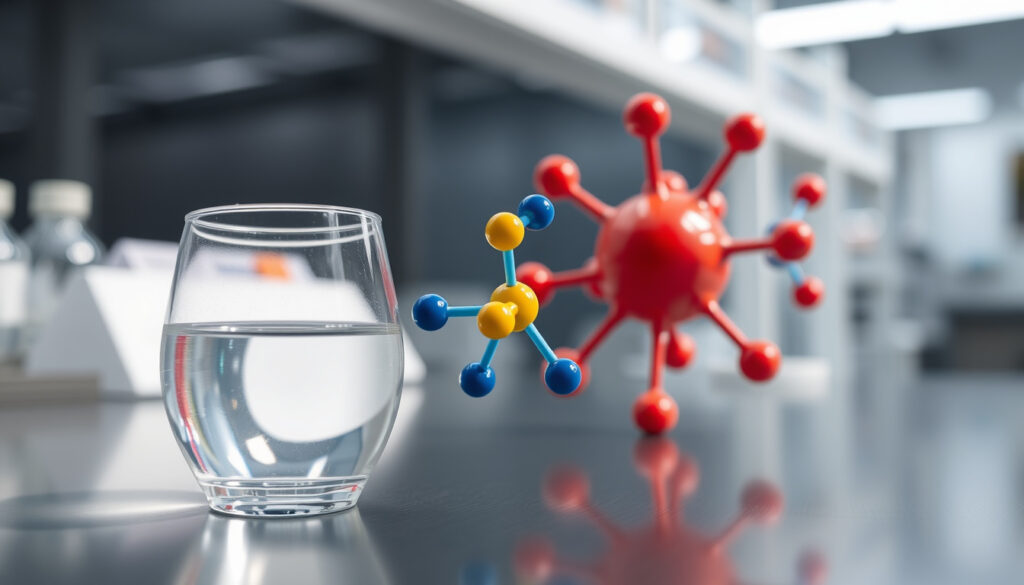
What Is a Molecule? Simple Definition, Examples & Differences
Anyone who’s ever wondered what makes up the air we breathe or the water they drink has already bumped into the idea of a molecule. These tiny clusters of atoms are the fundamental building blocks of matter — from oxygen to the DNA that carries genetic instructions.
Number of known molecules: Over 100 million (PubChem, 2024) ·
Smallest molecule: Diatomic hydrogen (H2) ·
First molecule definition proposed: 1811 by Amedeo Avogadro ·
Water molecule formula: H2O
Quick snapshot
- Molecules are groups of two or more atoms held by chemical bonds (IUPAC Gold Book (international authority on chemical nomenclature)).
- All compounds are molecules, but not all molecules are compounds (Chemistry Talk (educational chemistry site)).
- Water (H2O) and oxygen (O2) are both molecules (BBC Bitesize (UK educational platform)).
- Whether single atoms of noble gases (He, Ne) qualify as molecules depends on the definition used — IUPAC says “more than one atom,” other sources call them monatomic molecules (IUPAC; Wikipedia (community-edited reference)).
- The exact boundary between a molecule and an ionic crystal lattice is debated in solid-state chemistry. (IUPAC)
- 1811: Amedeo Avogadro proposes the distinction between atoms and molecules, laying the foundation for modern chemistry (Wikipedia (community-edited reference)).
- Computational chemistry now simulates millions of molecules for drug discovery, making molecular understanding more practical than ever (EBSCO Research Starters (academic database)).
Five key facts about molecules show the range from definition to scale.
| Property | Value |
|---|---|
| Definition | Two or more atoms held together by chemical bonds |
| Smallest known molecule | Diatomic hydrogen (H2) |
| Largest known molecule | DNA (can contain billions of atoms) |
| Number of known molecules | Over 100 million (PubChem) |
| First use of term | 1811 by Avogadro (French: ‘molécule’) |
The implication: molecules range from the simplest H2 to DNA chains that store entire genomes, yet they all share the same bonding principle.
What is a molecule in simple definition?
A molecule is a group of two or more atoms chemically bonded together, forming the smallest unit of a substance that still has that substance’s properties.
What is a molecule in chemistry?
- IUPAC defines a molecule as “an electrically neutral entity consisting of more than one atom” (IUPAC Gold Book – see link above).
- BBC Bitesize puts it simply: two or more atoms chemically bonded together (BBC Bitesize – see link above).
- BYJU’S adds that a molecule is the smallest unit of a compound that retains the compound’s chemical properties (BYJU’S (online learning platform)).
A molecule isn’t just a random clump of atoms — it’s a stable, bonded cluster that defines the chemical identity of a substance.
What is a molecule in science?
- In physics, molecules are studied for their kinetic behaviour, energy levels, and interactions via forces such as van der Waals.
- In biology, molecules like DNA, RNA, and proteins are macromolecules that carry genetic information and catalyse reactions.
- Massive Bio notes that a molecule is the smallest unit of a chemical compound that retains the compound’s properties (Massive Bio (biotechnology education resource)).
What is a molecule in physics?
- Physics treats molecules as quantum systems with vibrational and rotational states. The IUPAC definition uses a potential energy surface depression deep enough to confine at least one vibrational state (IUPAC Gold Book – see link above).
What is a molecule in biology?
- Biological molecules include water, carbohydrates, lipids, proteins, and nucleic acids. These macromolecules can contain thousands of atoms and perform specific cellular functions.
What is a molecule Class 9?
- In middle school science (Class 9 level), a molecule is introduced as a cluster of two or more atoms held together by chemical bonds — the simplest example being O₂ and H₂O.
The pattern: across all fields, the core definition of a molecule as bonded atoms remains stable, while the emphasis shifts based on context.
What is a molecule made of?
What are atoms?
- Atoms are the basic building blocks of matter. Study.com defines an atom as “the smallest part of matter that has all the characteristics of a chemical element” (Study.com (educational resource)).
- A molecule consists of two or more atoms — they are the parts that make up the whole.
How do atoms bond?
- Atoms bond by sharing or transferring electrons. A covalent bond (shared electrons) forms most molecules, like the double bond in O₂.
- Ionic bonds (electron transfer) create salts, which in solid form are not individual molecules but lattices — though in gas phase they can exist as molecules.
- Metallic bonds are another type, found in metals where electrons flow freely among atoms.
Types of chemical bonds
- Covalent bond: Atoms share electrons (e.g., H₂O, CH₄).
- Ionic bond: One atom donates an electron to another (e.g., NaCl in the gas phase).
- Metallic bond: Delocalised electrons hold metal atoms together.
The pattern: the type of bond determines the molecule’s shape, polarity, and reactivity — a key insight for predicting how substances behave.
A student learning about covalent bonds today will use that knowledge to understand everything from why oil and water don’t mix to how proteins fold.
Is an atom a molecule?
Difference between atom and molecule
- An atom is a single unit of an element (e.g., H, O). A molecule is two or more atoms bonded together (e.g., H₂, H₂O).
- BBC Bitesize explains that when atoms are from different elements, the molecule can also be called a compound (BBC Bitesize – see link above).
- Study.com clarifies that a compound is a substance made of two or more different elements chemically joined (Study.com – see link above).
When does a single atom become a molecule?
- Noble gases like helium and neon exist as single atoms. By the strict IUPAC definition (more than one atom), they are not molecules. However, some sources call them monatomic molecules.
- Diatomic elements (O₂, N₂, H₂) consist of two identical atoms bonded — they are certainly molecules.
- Wikipedia notes that a molecule may be homonuclear (same element) or heteronuclear (different elements) (Wikipedia – see link above).
The catch: the answer depends on which definition you adopt. Most classroom science treats molecules as having at least two atoms, making a solitary helium atom just an atom — not a molecule.
What is a molecule vs. compound?
Difference between molecule and compound
- Chemistry Talk states: “All compounds are molecules, but not all molecules are compounds” (Chemistry Talk – see link above).
- A molecule of an element (e.g., O₂) contains only one type of atom, so it is not a compound. A molecule of water (H₂O) has two types of atoms — it is both a molecule and a compound.
- EBSCO confirms that substances composed of more than a single element are referred to as molecular compounds (EBSCO Research Starters – see link above).
Examples of molecules that are not compounds
- Oxygen gas (O₂): molecule, but not a compound (same element).
- Nitrogen gas (N₂): molecule, not a compound.
- Chlorine gas (Cl₂): molecule, not a compound.
- Water (H₂O): molecule and compound.
- Carbon dioxide (CO₂): molecule and compound.
Three key comparisons clarify the differences across atom, molecule, and compound.
| Property | Atom | Molecule | Compound |
|---|---|---|---|
| Definition | Smallest unit of an element | Two or more atoms bonded together | Molecule with two or more different elements |
| Example | H (hydrogen atom) | H₂, O₂, H₂O | H₂O, CO₂, NaCl (gas phase) |
| Can be alone? | Yes (noble gases) | Only if bonded (He is not a molecule by IUPAC) | Always requires bonding |
| Chemical properties | Retains element’s properties | Retains substance’s properties | Props differ from constituent elements |
The pattern: a compound is always a molecule, but a molecule isn’t always a compound. The distinction comes down to whether the atoms are from different elements.
What are examples of molecules?
Common molecules (water, oxygen, carbon dioxide)
- Water (H₂O): Two hydrogen atoms bonded to one oxygen atom. YourDictionary calls it a molecule made from hydrogen and oxygen atoms (YourDictionary (reference platform)).
- Oxygen (O₂): Two oxygen atoms bonded — a diatomic molecule, but not a compound.
- Carbon dioxide (CO₂): One carbon and two oxygen atoms — a compound commonly produced by respiration.
- Methane (CH₄): One carbon and four hydrogen atoms — the simplest hydrocarbon.
- Glucose (C₆H₁₂O₆): A sugar molecule — an organic compound essential for energy.
- For a deeper look at how molecules behave in everyday life, see our article on Cream of Tartar Substitute (a common kitchen compound).
Large biological molecules (DNA, proteins)
- DNA molecules can contain billions of atoms arranged in a double helix. They carry genetic information.
- Proteins are macromolecules made of amino acid chains; they act as enzymes, structures, and signals.
- Massive Bio states that molecules are formed when two or more atoms are chemically bonded together, and macromolecules are just larger versions of the same concept (Massive Bio – see link above).
The trade-off: small molecules like water are easy to visualise, while macromolecules like DNA challenge our intuition because they are thousands of atoms long.
A common error in classrooms is calling table salt (NaCl) a molecule. In solid form it is an ionic lattice — only in the gas phase does it form discrete NaCl molecules. The definition matters for understanding solubility and bonding.
Confirmed facts vs. open questions
- Molecules consist of atoms held by chemical bonds (IUPAC).
- Water is a molecule (H₂O) and a compound (BBC Bitesize).
- Atoms are smaller than molecules (Study.com).
- Compounds are a subset of molecules (Chemistry Talk).
- O₂ and N₂ are molecules but not compounds (BBC Bitesize).
- Whether monatomic species (He, Ne) are molecules is a matter of convention — some definitions require two or more atoms.
- The exact boundary between a molecule and a crystal lattice (e.g., ionic compounds) is debated in solid-state chemistry.
- The definition of ‘molecule’ for polymers and macromolecules can blur the line between a single molecule and a cluster.
Quotes from authoritative sources
“A molecule is a group of two or more atoms that are held together by attractive forces known as chemical bonds.”
“Molecules are the smallest units of compounds that can exist.”
“A molecule is made of two or more atoms chemically bonded together.”
— BBC Bitesize (UK educational platform)
The pattern across all three sources: the core definition is consistent — molecules are bonded atom groups. The nuance comes when deciding what counts as a “bond” and how many atoms are needed.
For a deeper dive into the topic, check out a detailed guide on molecules that expands on the definition and types of molecules.
Frequently asked questions
Can a molecule be seen under a microscope?
Most molecules are too small to be seen with an optical microscope. Advanced techniques such as atomic force microscopy can visualise large molecules like DNA, but individual small molecules require electron microscopy or X-ray crystallography.
What is the smallest molecule?
The smallest molecule is diatomic hydrogen (H₂), consisting of two hydrogen atoms bonded together. Helium (He) is monatomic and by some definitions not considered a molecule.
How are molecules formed?
Molecules form when atoms share or transfer electrons through chemical bonds. This can happen naturally (e.g., O₂ in the air) or through chemical reactions in a lab.
What is a molecular formula?
A molecular formula shows the exact number of atoms of each element in a molecule. For example, H₂O means two hydrogen atoms and one oxygen atom.
Are all molecules stable?
No. Some molecules are highly reactive and exist only briefly, such as free radicals. Stability depends on the strength of the bonds and the molecule’s energy state.
What is the difference between a molecule and a crystal?
A molecule is a discrete group of bonded atoms. A crystal is a repeating 3D lattice of atoms, ions, or molecules. Ionic compounds like NaCl form crystals, not individual molecules in solid state.
What is a polar molecule?
A polar molecule has an uneven distribution of charge, creating a positive end and a negative end. Water (H₂O) is a classic example because oxygen attracts electrons more than hydrogen.
How do molecules move in solids vs gases?
In solids, molecules vibrate in fixed positions. In gases, they move freely and rapidly, colliding with each other and container walls. Liquids fall in between — molecules slide past one another.
For a student staring at their first chemistry textbook or a curious adult revisiting basic science, the real takeaway is that molecules are the language matter uses to build structure. Whether it’s the water in your glass or the DNA in your cells, everything starts with atoms choosing to bond. The choice for educators and learners is clear: start with simple examples (H₂, H₂O) and build up to the exceptions (noble gases, ionic lattices), or face confusion when the rules don’t match everyday language.
Explore more about molecular structures in Are Lab-Grown Diamonds Real? which examines how carbon atoms arrange into diamond and graphene.
More related posts
 5 Best Cream of Tartar Substitutes for Baking and Cooking
 How to Make Oobleck: Easy 2-Ingredient Recipe
 Outdoor Furniture Sale NZ: Deals at Mitre 10, Bunnings & IKEA
 Transfer Money to Armenia: Compare Fees & Services
 Takapuna Surf Club Photos: Menu, Reviews, Booking Guide
 What Is the Capital of China? Beijing vs Shanghai Facts
 Ed Sheeran Sapphire Lyrics – English Punjabi Hindi Full
 Find a Job at MSD: Merck Careers & NZ Government Jobs Guide
