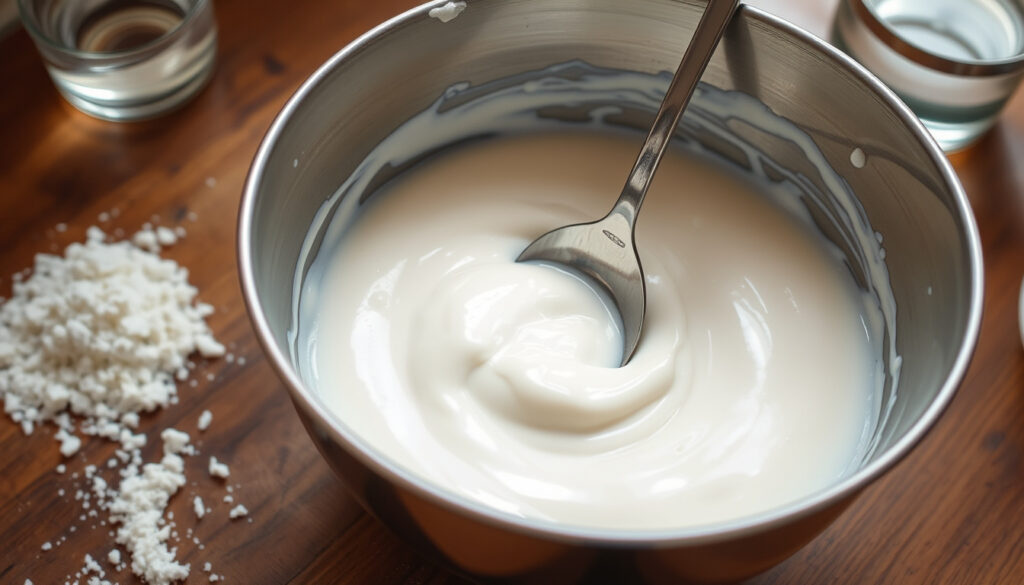
How to Make Oobleck: Easy 2-Ingredient Recipe
Oobleck hardens under your fist and then melts through your fingers—a single substance that defies everyday physics. With just cornstarch and water, you can mix up this classic demonstration of a non-Newtonian fluid in under five minutes.
Ingredients needed: 2 (cornstarch and water) ·
Classic ratio: 2 parts cornstarch to 1 part water ·
Preparation time: Under 5 minutes ·
Shelf life at room temp: 1-2 days if covered
Quick snapshot
- Oobleck is made from cornstarch and water (U.S. Naval History and Heritage Command educational resource)
- The 2:1 ratio of cornstarch to water is the standard starting point (Science Bob science educator)
- Oobleck is a non-Newtonian fluid (Cox Science Center and Aquarium science education center)
- Exact ideal ratio varies with humidity and cornstarch brand (Un Sophisticook recipe blog)
- Effectiveness of substitutes for cornstarch in maintaining non-Newtonian behavior (Un Sophisticook recipe blog)
- Preparation time: under 5 minutes (Science Bob science educator)
- Shelf life: 1-2 days if stored covered at room temperature (Science Bob science educator)
- Try adding food coloring for a vibrant twist (Cox Science Center science education center)
- Experiment with different ratios to see how the behavior changes (Cox Science Center science education center)
Five key facts about oobleck, from ingredients to shelf life, reveal a simple recipe with a few important variables.
| Fact | Value |
|---|---|
| Number of main ingredients | 2 |
| Core ratio (cornstarch:water) | 2:1 |
| Preparation time | Under 5 minutes |
| Shelf life (covered, room temp) | 1-2 days |
| Best substitute for cornstarch | Cornflour (UK) / arrowroot powder (not identical) |
How do I make oobleck?
What ingredients do I need?
- Cornstarch (also called cornflour in the UK)
- Water (tap water works fine)
- Optional: food coloring for color
Oobleck requires exactly two main ingredients: cornstarch and water. The U.S. Naval History and Heritage Command educational resource uses a 2-cup cornstarch to 1-cup water ratio as an example recipe. Science Bob, a well-known science educator, notes that a typical mix is about 1/2 cup of water per 1 cup of cornstarch, and emphasizes adding water slowly rather than all at once.
What is the correct ratio of cornstarch to water?
- Classic ratio: 2 parts cornstarch to 1 part water by volume
- Science Bob recommends starting with 1 cup cornstarch to 1/2 cup water
- Adjust as needed: add more water if too dry, more cornstarch if too watery
The standard starting point is a 2:1 ratio of cornstarch to water. Science Bob explains that there are no exact formulas, but this ratio works well. Cox Science Center and Aquarium science education center instructs adding 2 cups of cornstarch to a bowl and 1 cup of water to a separate bowl before combining. Little Bins for Little Hands kids’ activity resource describes the best consistency as “thick but still able to slowly flow back into the bowl.”
The ideal oobleck feels solid when you squeeze it and melts when you release it. That’s the sign you’ve hit the right ratio — and the moment the non-Newtonian magic kicks in.
How do I mix the ingredients?
- Pour cornstarch into a bowl.
- Slowly add water while stirring with a spoon or your hands.
- Adjust by adding more water or cornstarch until the desired consistency is reached.
- Test: roll a handful into a ball — it should hold shape, then melt between fingers when released.
Food.com recipe site warns to add water slowly because the full cup may not be needed. Un Sophisticook recipe blog recommends starting with half the water and adjusting upward. The best test, according to Science Bob, is whether a handful can be rolled into a ball and then “melts” between the fingers when released.
The implication: getting the ratio right takes a little trial and error, but the payoff is immediate — you’ll see a substance that defies everyday expectations, and your family gets a hands-on science lesson in under five minutes.
Is oobleck made with cornstarch or baking soda?
Can I use cornflour instead of cornstarch?
- Yes — cornflour (UK) and cornstarch (US) are the same product.
- Both are fine cornstarch derived from corn.
If you’re in the UK, “cornflour” is exactly what you need. It’s the same ingredient as US cornstarch. Messy Play Kits activity resource confirms that traditional oobleck uses only water and cornstarch, and that liquid watercolors can be added for color.
Can I use baking soda?
- Baking soda is not a substitute for cornstarch in oobleck.
- Baking soda recipes produce a different texture and require different ratios.
Baking soda recipes exist, but they don’t replicate the classic non-Newtonian behavior of cornstarch-based oobleck. The standard oobleck recipe uses cornstarch, not baking soda. Cox Science Center science education center suggests adding food coloring to the water before pouring into cornstarch for a fun visual effect.
The catch: if you’re aiming for that signature solid-liquid duality, stick with cornstarch. Baking soda may be a pantry staple, but it won’t deliver the same physics lesson for your children.
How long does oobleck last?
Can you leave oobleck overnight?
- Oobleck can be stored in an airtight container at room temperature for 1-2 days.
- It will separate and dry out if left uncovered overnight.
Oobleck isn’t a permanent creation. If left uncovered, the water evaporates and the cornstarch dries into a hard crust. Little Bins for Little Hands kids’ activity resource advises storing oobleck in a sealed container at room temperature.
How should I store oobleck?
- Store in an airtight container or zip-top bag.
- Keep at room temperature — do not refrigerate.
- Do not flush down drains; dispose in the trash.
Proper storage keeps oobleck playable for a day or two. Un Sophisticook recipe blog notes that the mixture may need more cornstarch after storage if it has become too runny.
How can I revive dried-out oobleck?
- Add a small amount of water and stir.
- Add more cornstarch if it becomes too watery.
If your oobleck has dried out, add water a teaspoon at a time and mix. If it’s too runny, sprinkle in more cornstarch. The fix is the same as getting the initial ratio right.
Oobleck is a one-time experiment for most families. Storing it for a second day is possible, but the real value is in the hands-on experience — not in keeping it around indefinitely.
The trade-off: you can extend oobleck’s life by a day or two with careful storage, but the material is designed to be made fresh for each play session, keeping the science lesson immediate and engaging.
What are the best substitutes for cornstarch in oobleck?
Can I make oobleck with flour?
- Flour and water makes a thick paste, not a true non-Newtonian fluid.
- Flour-based mixtures do not exhibit the same solid-liquid behavior.
Flour is a common substitute attempt, but it produces a different material. Science Bob science educator explains that the key to oobleck’s behavior is the suspension of cornstarch particles in water. Flour particles are smaller and behave differently, creating a paste rather than a shear-thickening fluid.
Can I make oobleck with glue and borax?
- Glue and borax make slime — a polymer, not a non-Newtonian fluid.
- Slime behaves differently: it stretches and bounces rather than hardening under pressure.
Glue and borax produce a classic slime, not oobleck. Messy Play Kits activity resource includes both oobleck and slime recipes, making clear they are distinct. Cornstarch is the key ingredient for the solid-liquid behavior that makes oobleck unique.
The pattern: if you want the real oobleck experience — the one that hardens when you punch it and flows when you hold it — nothing substitutes for cornstarch. Arrowroot powder may come close, but it’s not identical.
What we know and what we don’t
Confirmed facts
- Oobleck is made from cornstarch and water (U.S. Naval History and Heritage Command educational resource)
- The 2:1 ratio of cornstarch to water is the standard starting point (Science Bob science educator)
- Oobleck is a non-Newtonian fluid (Cox Science Center and Aquarium science education center)
- Preparation time is under 5 minutes (Science Bob science educator)
- Shelf life is 1-2 days if stored covered at room temperature
What’s unclear
- Exact ideal ratio varies with humidity and cornstarch brand (Un Sophisticook recipe blog)
- Effectiveness of substitutes for cornstarch in maintaining non-Newtonian behavior
What the experts say
Tip the cornflour into a bowl and slowly stir in the water.
— BBC Good Food editors (recipe developer)
Making oobleck is a great science and sensory project combined into one.
— PBS Parents guide (educational resource)
These two perspectives — one from a trusted recipe source, the other from a children’s education channel — reinforce that oobleck is as much a learning tool as a fun activity. BBC Good Food and PBS Parents both emphasize the simplicity and the sensory experience.
For parents and educators, the takeaway is clear: oobleck delivers a memorable science lesson in under five minutes, with ingredients you already have. The only real question is whether you’ll keep it for a second day — or just make a fresh batch.
Related reading: Easy 4-Ingredient Scones Recipe – Quick & Fluffy · The Best Chocolate Chip Cookie Recipe – Easy, Soft & Chewy
facebook.com, instructables.com, instagram.com, facebook.com, youtube.com
For those who enjoy hands-on science experiments, similar slime recipes offer another fun way to explore non-Newtonian fluids.
Frequently asked questions
What is the science behind oobleck?
Oobleck is a non-Newtonian fluid because its viscosity changes under stress. When you apply force (squeeze, punch), the cornstarch particles lock together, making it behave like a solid. When you release the force, the particles flow freely again, like a liquid. This is called shear-thickening behavior.
Is oobleck a solid or a liquid?
It’s neither — it’s a non-Newtonian fluid. It acts like a solid under pressure (like a punch) and like a liquid when at rest (it flows slowly). This duality is what makes it so fascinating.
Can you add food coloring to oobleck?
Yes. Add a few drops of food coloring to the water before mixing it with cornstarch. Cox Science Center science education center recommends this approach for even color distribution.
How do you clean up oobleck?
Let it dry, then scrape it off surfaces. Do not pour oobleck down the drain — it can clog pipes. Dispose of it in the trash once it dries out.
Can I use oobleck for a school science project?
Absolutely. Oobleck is a classic demonstration of non-Newtonian fluids. You can show how it behaves under different forces, test the ratio, and explain the science behind it.
Why is my oobleck too runny?
Add more cornstarch, a tablespoon at a time, until it reaches the desired consistency. Little Bins for Little Hands kids’ activity resource advises adjusting by adding more cornstarch if it feels too watery.
Why is my oobleck too stiff?
Add a small amount of water, a teaspoon at a time, and stir until the mixture becomes pliable again. Un Sophisticook recipe blog recommends starting with half the water and adjusting upward to avoid stiffness.
More related posts
 Jelly Roll Wild Ones – Release Charts and Lyrics Guide
 Podcasts for Learning English: Best Free Picks for 2025
 Safest Country in the World 2025: Iceland Tops Peace Index
 What Does DW Mean? Definition, Slang, and Medical Uses
 Ed Sheeran NZ 2026: Loop Tour Dates, Tickets & Openers
 Free Online Courses NZ: Government Fee-Free & WINZ Options
 Red Eye TV Series: Worth Watching, Season 2, Cast & More
 Pork Belly Recipe NZ: Oven, Slow Cooker, Crispy Crackling
