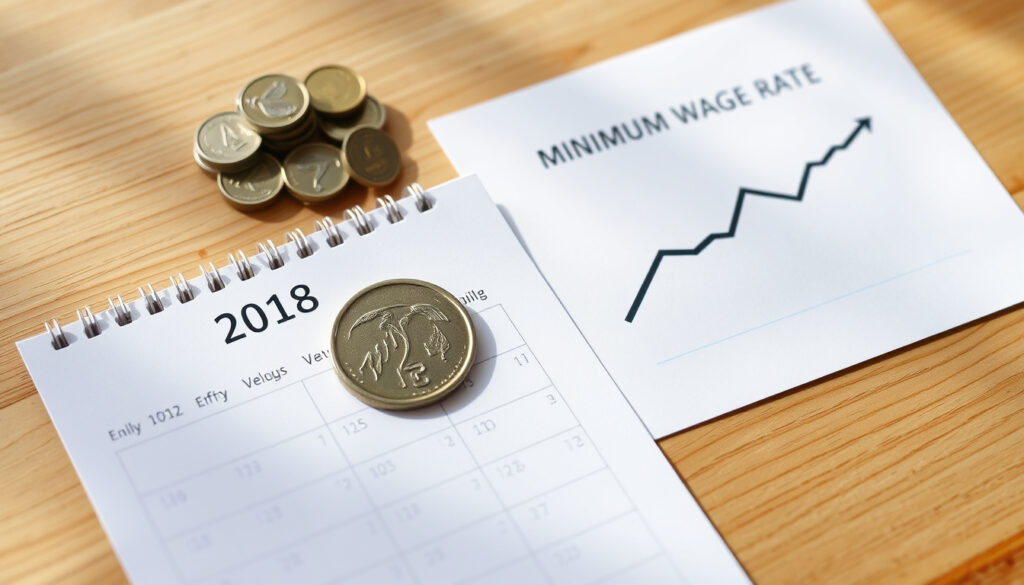
Minimum Wage NZ 2018: What Wa the Rate and How It Changed
If you worked in New Zealand in 2018 and earned minimum wage, your pay packet looked a bit different than it does today. That year, the government lifted the adult minimum wage to $16.50 an hour, a 75-cent jump from 2017.
2018 adult minimum wage (from 1 April 2018): $16.50 per hour ·
2018 training/starting-out wage: $13.20 per hour ·
Increase from 2017: $0.75 per hour ·
Effective date: 1 April 2018
Quick snapshot
- Adult minimum wage $16.50/hour from 1 April 2018 (Wikipedia – Minimum wage law)
- Training and starting-out wage $13.20/hour (Business.govt.nz – official guidance)
- Exact number of workers directly affected by the 2018 increase is not specified in official summaries
- Impact of regional cost-of-living differences on the real value of the 2018 wage
- 1 April 2018: adult minimum wage jumps from $15.75 to $16.50, a 4.8% increase
- In 2019 the rate rose to $17.70/hour, and by 2026 it will reach $23.95/hour (MBIE – official announcement)
The table below captures key minimum wage data for 2018 and surrounding years.
| Label | Value | Source |
|---|---|---|
| 2018 Adult minimum wage | $16.50 per hour | Wikipedia – Minimum wage law |
| 2018 Training minimum wage | $13.20 per hour | HITO – The Training Wage |
| 2017 Adult minimum wage | $15.75 per hour | |
| 2019 Adult minimum wage | $17.70 per hour | |
| 2020 Adult minimum wage | $18.90 per hour | IZA Discussion Paper 14302 |
| 2026 Planned adult minimum wage | $23.95 per hour |
What was the minimum wage in NZ in 2018?
The adult minimum wage from 1 April 2018 was $16.50 per hour. That marked a 75-cent increase from the previous year, a 4.8% rise. The training and starting-out minimum wage sat at $13.20 per hour, which is 80% of the adult rate — a formula the government continues to use today.
What was the training and starting-out wage in 2018?
Two sub-minimum rates applied in 2018: the starting-out wage for 16–19 year‑olds in certain training, and the training wage for employees 20 or older completing at least 60 credits a year in an industry training programme. Both were set at $13.20 per hour (HITO – The Training Wage). There was no minimum wage for employees under 16.
When did the 2018 minimum wage take effect?
The increase took effect on 1 April 2018, as is standard for New Zealand’s annual adjustments. The 2017 rate of $15.75 had been in place since 1 April 2017.
Bottom line: In 2018, a full‑time worker on the adult minimum wage earned $660 per 40‑hour week before tax — $30 more than the year before, or an extra $1,560 annually if they worked every week.
The implication: the 75-cent lift was a modest but meaningful step for low‑income households.
What was the minimum wage in NZ in 2017?
The 2017 adult minimum wage, effective from 1 April 2017, was $15.75 per hour. The training minimum wage was $12.60 per hour. That year’s increase was 50 cents, smaller than the 75‑cent jump that followed in 2018.
Why the difference? The 2018 increase was part of the then‑government’s plan to lift the minimum wage relative to average earnings. In 2017 the overall economic outlook was more cautious, with wage growth still subdued after the post‑GFC recovery.
What was the training wage in 2017?
In 2017 the training/starting‑out rate was $12.60 per hour — again, 80% of the adult minimum wage. For a trainee working 40 hours, that meant $504 per week gross.
How did the 2017 rate compare to previous years?
From 2014 to 2017 the adult minimum wage rose from $14.25 to $15.75, an average annual increase of about 3.4%. The 2018 increase was deliberately larger, reflecting a policy shift toward faster minimum wage growth (IZA Discussion Paper 14302 – research on NZ minimum wage).
Bottom line: The 2017 rate was the baseline for the 2018 jump; workers coming off the $15.75 rate saw a bigger than usual lift the next year.
What this means: the 2017 figure underscores how incremental the earlier path was before the acceleration.
Between 2014 and 2018, the minimum wage climbed 15.8%. For the lowest‑paid workers, that meant an extra $2.25 an hour — about $90 per week — over four years.
What was the minimum wage in 2019 in NZ?
On 1 April 2019 the adult minimum wage jumped to $17.70 per hour, a $1.20 increase from 2018. The training minimum wage rose to $14.16 per hour. That $1.20 bump was the largest single‑year increase in nominal terms up to that point.
What was the training wage in 2019?
The 2019 training and starting‑out wage was $14.16 per hour, maintaining the 80% ratio.
How much did the minimum wage rise in 2019?
The increase was $1.20 (7.3%), significantly above the 0.75‑cent (4.8%) rise of 2018. The government at the time said the larger increase was intended to give low‑income workers a more meaningful boost as the economy grew.
Bottom line: The 2019 increase accelerated the pace of wage growth, pushing the annual earnings of a full‑time minimum‑wage worker above $36,000 for the first time.
The pattern: the 2019 hike confirmed a new trajectory of faster-than-inflation wage gains.
What was the minimum wage in New Zealand in 2020?
The adult minimum wage rose to $18.90 per hour from 1 April 2020, a $1.20 increase. The training and starting‑out wage climbed to $15.12 per hour. Despite the economic uncertainty caused by COVID‑19, the government proceeded with the planned increase.
What was the starting‑out wage in 2020?
The starting‑out and training wage remained at 80% of the adult rate, so $15.12 per hour.
How did COVID‑19 affect the 2020 minimum wage adjustment?
Some business groups argued for a delay, but the government maintained the increase, citing the need to support low‑income workers during the pandemic. The policy trade‑off was clear: higher wages for some, but potential pressure on small‑business payrolls.
Bottom line: The 2020 increase showed the government’s commitment to minimum wage growth even in a crisis, but the long‑term employment effects remain debated.
The catch: the pandemic context made the 2020 raise a political statement as much as an economic one.
Is minimum wage going up in 2026 in NZ?
Yes. From 1 April 2026, the adult minimum wage will increase to $23.95 per hour, up from $23.50. The starting‑out and training minimum wages will rise to $19.16 per hour, keeping the 80% relationship (MBIE – official announcement).
What will be the minimum wage in 2026?
The adult minimum wage: $23.95 per hour. For someone working 40 hours a week, that’s $958 gross per week — $18 more than the 2025 rate, or $936 extra per year before tax.
Why is the minimum wage increasing in 2026?
The annual adjustment is part of the government’s standard process, informed by recommendations from the Ministry of Business, Innovation and Employment (MBIE) and consultation with unions and employers. The goal: keep the minimum wage in line with broader wage growth and cost‑of‑living pressures.
Bottom line: The 2026 increase continues a long‑run trend. Since 2018 the adult minimum wage has risen by 45%, from $16.50 to $23.95 — an extra $7.45 per hour in eight years.
The implication: by 2026, a full‑time worker on the minimum wage will take home nearly $1,000 a week before tax, but affordability in high‑cost cities remains an open question.
New Zealand’s minimum wage has grown faster than average wages over the past decade. For low‑paid workers, the gap between the minimum and the living wage has narrowed — but not closed.
Minimum wage timeline (2014–2026)
- : Adult $14.25; training $11.40
- : Adult $14.75; training $11.80
- : Adult $15.25; training $12.20
- : Adult $15.75; training $12.60
- : Adult $16.50; training $13.20
- : Adult $17.70; training $14.16
- : Adult $18.90; training $15.12
- : Adult $20.00; training $16.00
- : Adult $23.15; training $18.52
- : Adult $23.95; training $19.16 (MBIE – official announcement)
What this means: the timeline shows a steady upward march that accelerated after 2018.
What we know and what’s not clear
Confirmed facts
- 2018 adult minimum wage $16.50 per hour
- 2018 training wage $13.20 per hour
- 2017 adult minimum wage $15.75 per hour
- 2019 adult minimum wage $17.70 per hour
- 2020 adult minimum wage $18.90 per hour
- 2026 adult minimum wage increase to $23.95 per hour
What’s unclear
- Future minimum wage rates beyond 2026 are not yet announced.
- Impact of inflation on future adjustments is uncertain.
- Exact number of workers affected by the 2018 increase is not specified in official summaries.
- How much of the wage growth has been eroded by housing and living costs in different regions.
- Whether the 80% training/starting-out ratio will be maintained indefinitely.
- Impact of the 2018 increase on small business employment has not been fully quantified.
The pattern: while the rates are clear, the real‑world effects remain debated.
“The 2018 increase was about ensuring that those on the lowest wages could share in the country’s economic success.”
— Minister for Workplace Relations (2018), as reported in government statements
“After the April rise, median private sector pay in New Zealand sat at $24.34 per hour, meaning the minimum wage was still far below typical earnings.”
— Stats NZ (2018), private sector wage data
“The training wage is a trade‑off: it encourages employers to take on trainees, but it also means a lower floor for workers still learning.”
— HITO, commentary on the training wage
For the worker who earned the minimum wage in 2018, the 75‑cent lift meant an extra $30 a week — real money for groceries or rent. For policymakers, the trajectory that started with that increase has never reversed: each year since has pushed the minimum higher, faster than inflation in most years. By 2026, a full‑time worker on the adult minimum will take home nearly $1,000 a week before tax. The question is whether that wage will keep pace with the cost of living in Auckland or Christchurch — and whether the training wage remains a fair stepping stone or a permanent discount for young workers. For New Zealand’s lowest‑paid, the next fight is not about the rate itself, but about whether a single income can still cover the basics.
Related reading: Best Payroll System for Small Business · New Zealand Public Holidays 2026
Frequently asked questions
Does the minimum wage apply to all employees in New Zealand?
Yes, with some exceptions. The minimum wage applies to all employees aged 16 and over who are not covered by training or starting-out exemptions. Employees under 16 do not have a statutory minimum wage.
What is the difference between the adult minimum wage and the training wage?
The adult minimum wage (in 2018: $16.50/hour) applies to most workers 16+. The training wage (2018: $13.20/hour) applies to employees 20+ who are completing at least 60 credits per year in an industry training programme. The starting-out wage applies to 16–19 year‑olds in certain training.
How often does the minimum wage increase in New Zealand?
Usually once a year, effective from 1 April. The government announces the new rate in late January or February after reviewing economic conditions and consulting stakeholders.
What was the minimum wage in 2015 in NZ?
The adult minimum wage from 1 April 2015 was $14.75 per hour. The training wage was $11.80 per hour.
What is the living wage in NZ and how does it compare to the minimum wage?
The living wage is an independently calculated hourly rate that aims to meet basic needs. In 2018 the living wage was approximately $21.00 per hour, well above the $16.50 minimum. By 2025 the living wage had risen to around $27.80, while the minimum wage was $23.15.
Are there any exemptions to the minimum wage in New Zealand?
Yes. Employees under 16 have no minimum wage. The training and starting-out wages allow lower rates for eligible workers. Some interns and volunteers are also exempt.
What is the minimum wage for 16 and 17 year‑olds in NZ?
16‑ and 17‑year‑olds who are not in training or starting‑out employment receive the full adult minimum wage. If they are in eligible training, the starting‑out wage may apply.
More related posts
 Allianz Travel Insurance NZ: Contact, Cover & Claims Guide
 New Zealand Home Loan Rate Cuts 2026: Westpac 4.99%
 NZ Herald Breaking News: Political Lean, Cost & Audience
 Transfer Money to Armenia: Compare Fees & Services
 Best Radar Detector NZ – Top Picks and Legal Guide
 PAW Patrol Christmas Movie: Where to Watch
 Suzuki Vitara for Sale NZ: New & Used Prices & Reviews
 Pure Tūroa Snow Report: Live Conditions at 2,322 m
