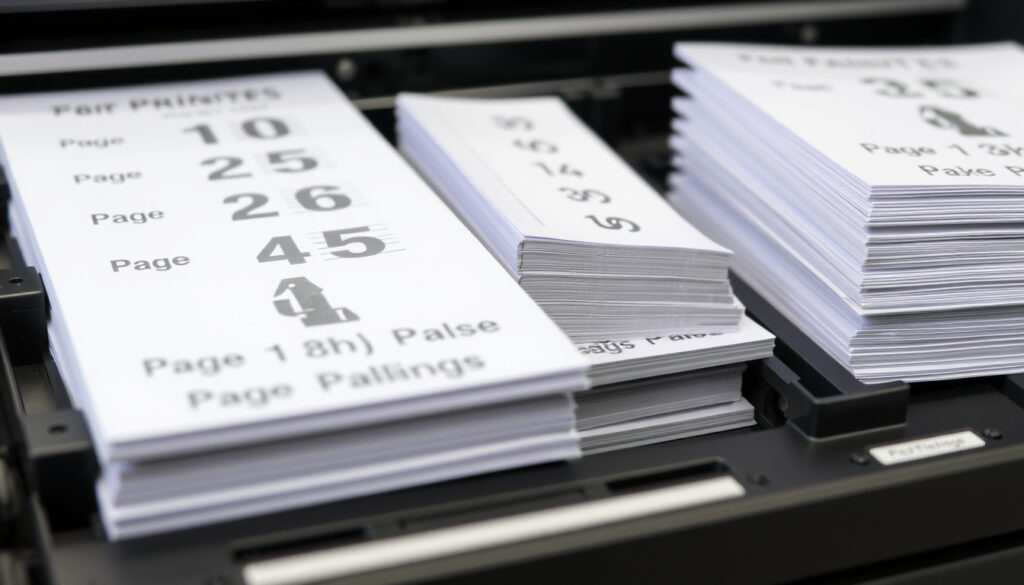
What Does Collate Mean When Printing? Complete Guide
Anyone who has printed a multi-page document and found pages scattered everywhere knows the frustration. That jumbled stack is exactly what the collate setting is designed to prevent.
Collate setting location: Typically found in print dialog under ‘Copies & Pages’ ·
Default state: Collate is often enabled by default in most printer drivers ·
Page per copy: Collate prints complete sets (e.g., Copy 1: pages 1-5, Copy 2: pages 1-5) ·
Uncollated output: Uncollated prints all copies of page 1, then all copies of page 2, etc. ·
Common use case: Collate is used for multi-page documents like reports, booklets, proposals
Quick snapshot
- Collate means printing complete sets in order (Printing Center USA)
- Uncollated prints all copies of each page together (Printing Center USA)
- Collate is not the same as double-sided printing (SmartTechFL)
- Collate setting is found in the printer dialog under Copies & Pages (PaperCut)
- Exact menu label for collate varies by printer manufacturer and driver version (PrintSafari)
- Whether collate is enabled by default depends on the operating system and application (PrintSafari)
- No timeline applicable — this is a settings guide, not a chronological event
- Modern printers continue to include built-in collate options (PrintSafari)
- Cloud print workflows may label collate differently across platforms (PrintSafari)
The table below summarizes the key distinctions between collated and uncollated output.
| Label | Value |
|---|---|
| Definition | Collate prints complete document sets in sequential page order. |
| Alternate term | Some printer drivers call it ‘group’ printing. |
| Impact on speed | May slow down printing slightly due to reordering, but time saved from manual sorting is greater (PaperCut). |
| Common software support | Available in Adobe Acrobat, Microsoft Word, most printer drivers. |
| Relation to duplex | Collate and duplex are independent settings; can be used together (SmartTechFL). |
What Does Collate Mean When Printing?
Collate, in the printing world, means the printer outputs complete sets of a multi-page document in sequential order. For example, if you print 3 copies of a 5-page document with collate enabled, you get Copy 1 with pages 1 through 5, then Copy 2 with pages 1 through 5, and so on. The word “collate” itself comes from the Latin collatio, meaning to collect and combine in proper order (Printivity).
Collate vs Uncollated: The Core Difference
Two settings, two completely different stacks on your desk:
- Collated: Each copy is a complete, ready-to-read set. For a 10-page newsletter and 5 copies, collating outputs five sets of pages 1-10 in order (Gold Image Printing).
- Uncollated: All copies of page 1 print first, then all copies of page 2, and so on. The same job yields pages 1 x5, then pages 2 x5 — a stack that needs reassembly (Printing Center USA).
The trade-off: collated output saves you manual sorting time, while uncollated printing can be marginally faster for large volumes where page order doesn’t matter, such as bulk flyers or handouts (PrintSafari).
A Simple Example of Collated Printing
Imagine you’re printing 10 copies of an 8-page booklet for a team meeting:
- Collated on: You pull 10 complete booklets from the tray, each with pages 1 through 8 in correct reading order. No sorting needed (Printivity).
- Collated off: You get 8 stacks of paper — one stack of page 1 (10 copies), one stack of page 2 (10 copies), and so on. You’ll spend 5-10 minutes assembling each booklet by hand.
Should I Collate When Printing?
The choice depends on what you’re printing and who will use it. Here’s a decision framework based on document type.
When to Use Collate (Recommended)
Collating is best for multi-page documents that will be distributed, bound, or fastened:
- Booklets and brochures: All booklets should be printed collated for easy binding without manual sorting (Printivity).
- Proposals and reports: 20+ page documents for clients require collation so each recipient grabs one complete set (PaperCut).
- Classroom handouts: Multi-page worksheets or study guides benefit from collation, especially for groups.
- Stapled or bound output: Collating eliminates the step of re-ordering pages before stapling.
When to Turn Collate Off
Uncollated printing makes sense in specific scenarios:
- Single-page handouts: If you’re printing 50 copies of a 1-page flyer, collation makes no difference — you just get 50 identical pages either way.
- Bulk multi-page documents where order doesn’t matter: For example, draft copies for internal review where each reader only needs specific pages (Centex Printing).
- Large volumes: Uncollated can be faster on some printers because the printer doesn’t need to reorder pages between copies (PrintSafari).
The pattern: collate for finished, professional documents; skip it for internal drafts and single-page jobs.
Collate vs Uncollated: The choice comes down to whether you want ready-to-distribute sets (collate) or a stack of identical pages for bulk distribution (uncollated). For any multi-page document with more than one copy, collate usually wins.
Does Collate Mean Double-Sided?
This is one of the most common misconceptions about printing. The short answer: no. Collate and double-sided (duplex) are completely separate settings that control different things.
Collate is Not the Same as Duplex
- Collate controls the order of pages across multiple copies — it arranges page sequences.
- Duplex controls whether the printer uses both sides of each sheet — it prints on front and back.
As SmartTechFL explains, “Collation handles the page order, while double-sided printing uses both sides of the paper” (SmartTechFL). You can use either one independently or combine them.
Combining Collate and Double-Sided Printing
When you select both options, the printer produces double-sided sets in the correct order. This is ideal for booklets, manuals, and stapled reports (SmartTechFL). For example, printing 5 copies of a 10-page report with collate and duplex on yields five complete, back-to-back sets ready for binding.
Some printer menus label collate as “group” vs “collate,” which adds to the confusion. A “group” option often does the same thing as collate, but the exact label varies by manufacturer (PrintSafari).
Why this matters: thinking collate means double-sided could lead you to enable the wrong setting, wasting paper and time on misfolded output.
What Happens If I Don’t Collate?
Without collate enabled, the printer groups all copies of each page together rather than producing complete sets. The result is a stack of paper that requires manual sorting before it can be used.
Uncollated Output Example
For 3 copies of a 5-page document without collate, your output tray contains:
- 3 copies of page 1 (stacked together)
- 3 copies of page 2
- 3 copies of page 3
- 3 copies of page 4
- 3 copies of page 5
To create complete 5-page sets, you must manually gather one page from each stack in order — a tedious process for more than a few copies.
Manual Sorting Required
For small jobs (2-3 copies of a 2-3 page document), manual sorting takes under a minute. But for large jobs — say, 20 copies of a 50-page manual — the sorting time jumps to 20+ minutes, not counting the risk of misordering pages.
The implication: for any job with 3+ copies of a 3+ page document, enabling collate almost always saves time and prevents sorting errors.
What Are Common Collating Mistakes?
Even experienced users run into confusion around collate settings. Here are the most frequent pitfalls.
Confusion With Duplex Settings
As covered above, many users mistakenly think collate equals double-sided printing. This leads to either printing without collation when it’s needed or failing to enable duplex when paper savings are desired. Always check both settings independently.
PDF Print Collate Issues
PDF viewers like Adobe Acrobat and browser print dialogs often have a collate checkbox. If unchecked, a 10-page PDF printed in 5 copies will output all pages 1, then all pages 2 — not what you want if each copy is for a different recipient. Always verify collate is checked before hitting print.
Incorrect Printer Driver Settings
Printer drivers may label collate as “group” or “collate” depending on the manufacturer. Using the wrong option leads to misordered output. For example, some HP drivers use “Group” to mean collated, while others use it to mean uncollated (PrintSafari). Check your printer manual for exact labels.
The catch: if your collate setting is grayed out, it may be because you’re printing only one copy — collation only applies when multiple copies are specified.
What Does Collate Mean When Printing Double Sided?
When both settings are selected, collate and duplex work together to produce double-sided, ordered sets. This is standard for booklets, manuals, and any document that will be stapled or bound.
Collate + Duplex Setup Steps
Setting up collated, double-sided printing in common software:
- Open the print dialog (Ctrl+P or Cmd+P).
- Under “Copies,” set the number of copies you want.
- Check the “Collate” box (or select “Collated” from the dropdown).
- Under “Two-Sided” or “Duplex,” select “Long-Edge Binding” (for portrait documents) or “Short-Edge Binding” (for landscape).
- Preview before printing to confirm page order is correct.
Most modern printers support this combination automatically, but menu labels vary by brand (HP, Canon, Brother, etc.) (PrintSafari). If in doubt, print a test page with one copy first.
The trade-off: collated duplex printing is slower than uncollated single-sided, but it saves paper and produces finished documents without manual assembly. For offices printing training manuals or client proposals, the setup is well worth the extra seconds.
Expert Perspectives on Collate
“Collate means the printer prints Copy 1 in order, from pages 1 to 20, then Copy 2 the same way, allowing you to grab all 10 copies of your document.”
— PaperCut (industry print management software)
“Collate printing means when printing more than one copy of a multi-page document, pages are printed in the correct order from the first page to the last page.”
— Toner Giant (retail toner and printer supplies)
“Collate means to collect and assemble printed sheets of paper within a predetermined order or sequence.”
— Gordon Flesch Company (office equipment provider)
Collate is the difference between a pile of loose sheets and a ready-to-distribute document. For anyone printing multi-page reports, the setting is not optional — it’s a necessity. Uncollated output has its place (bulk handouts, internal drafts), but most office workers should leave collate enabled by default.
Printer driver labels may use “group” instead of “collate,” and the setting may be grayed out when printing a single copy. Always confirm your selection in the print preview — what you see is what you’ll sort.
Related reading: What Is a VPN Router? · What Is Wotif?
Frequently asked questions
What does collate mean in printing?
Collate means the printer outputs complete sets of a multi-page document in sequential page order (e.g., Copy 1: pages 1-5, Copy 2: pages 1-5). This eliminates manual sorting of pages after printing.
Is collate the same as double-sided printing?
No. Collate controls page order across copies; double-sided (duplex) controls printing on both sides of the paper. They are independent settings that can be used together or separately.
Should I choose collated or uncollated for a booklet?
Always choose collated for booklets. All booklets should be printed collated so each copy is automatically in reading order and ready for binding without manual sorting.
Can I collate a PDF without printing?
Yes. Adobe Acrobat and some PDF editors have a “Combine Files” or “Organize Pages” tool that lets you collate pages from different PDFs into a single document. This is not the same as the print collate setting.
Why is my collate setting grayed out?
The collate setting is only available when you are printing multiple copies of a document. If the “Copies” field is set to 1, collate will be grayed out. Increase the copy count to make the setting active.
Does collate work with stapling?
Yes, on printers that support stapling. When collate is enabled, the printer can staple each complete set before outputting the next one, giving you finished booklets straight from the tray.
What does uncollated mean in a printer?
Uncollated means the printer outputs all copies of page 1 first, then all copies of page 2, and so on. This requires manual sorting to create complete sets. It’s best for single-page handouts or when page order doesn’t matter.
For anyone printing multi-page documents, collate is the difference between a professional-looking stack and a scrambled mess. Office workers and students should enable collate for any document longer than 3 pages when they need more than one copy, because the few extra seconds it takes to set beats the minutes lost sorting pages by hand.
More related posts
 Super Rugby Results 2026: Fixtures, Table & Live Scores
 Cast of Avatar: Fire and Ash: Full Cast List and Roles
 425°F to Celsius Conversion: Fan, Convection & Air Fryer
 NZTA Waka Kotahi Wildlife Act Ruling: Latest Updates & Analysis
 Transfer Money to Armenia: Compare Fees & Services
 Government First Home Grant Ireland: HTB & FHS Guide
 Nadia Lim Bacon and Egg Pie: Step-by-Step Recipe and Tips
 Pork Chops in Air Fryer: Cooking Times & Temperature Guide
