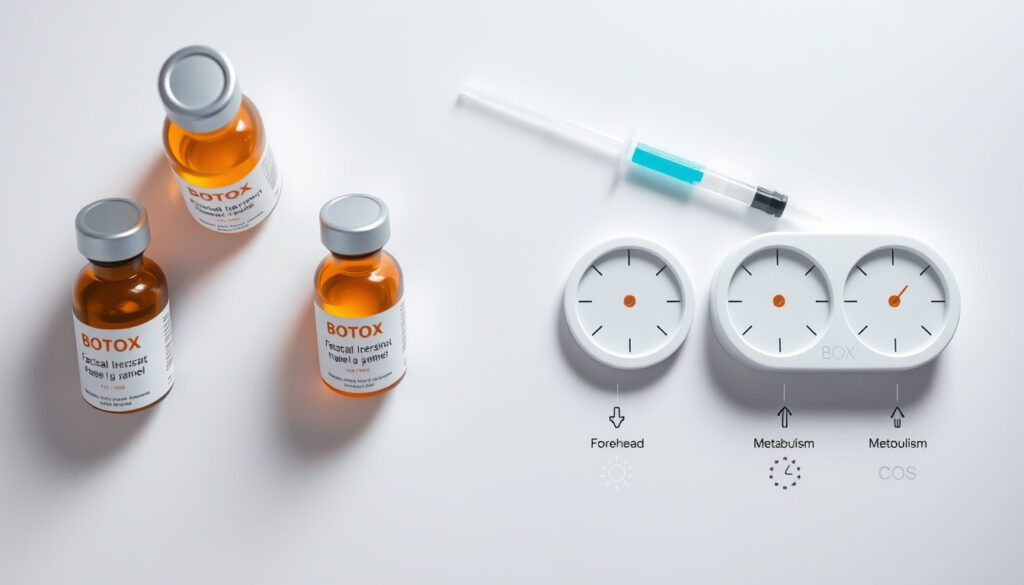
How Long Does Botox Last? Duration by Area & Factors
If you’ve ever watched a forehead smooth out in what feels like the time it takes to blink, you’ve probably wondered whether that frozen look has an expiration date. The short answer is yes — and unlike the dramatic transformations you might see on reality TV, the real timeline is much quieter and more individual than most people expect. Most clinic data points to a window of three to four months for most patients, though where the toxin lands on your face matters just as much as the dose itself.
Typical Duration: 3-6 months ·
Forehead Effects: Up to 6 months ·
Around Eyes: 3-4 months ·
Onset Time: 3-7 days ·
Retreatment: Every 3-4 months
Quick snapshot
- Forehead: 4-6 months (American Society of Plastic Surgeons)
- Eyes: 3-4 months (Cleveland Clinic)
- Mouth: 3-5 months (American Society of Plastic Surgeons)
- Metabolism rate affects how quickly the body breaks down the toxin (Weber Facial Plastic Surgery)
- Dosage and injection technique (Weber Facial Plastic Surgery)
- Muscle activity patterns (Weber Facial Plastic Surgery)
- No evidence of accelerated aging from 15-year cohort study (PubMed Central)
- Effects remain reversible (PubMed Central)
- Regular maintenance required (PubMed Central)
- Muscle function gradually returns (Weber Facial Plastic Surgery)
- Retreatment schedules align with natural breakdown (Weber Facial Plastic Surgery)
- Aftercare can influence duration by several weeks (Weber Facial Plastic Surgery)
The table below consolidates the most frequently cited duration metrics from leading medical sources.
| Metric | Value | Source |
|---|---|---|
| Average Effects | 3-4 months | Cleveland Clinic |
| Max Reported | Up to 8 months | Auralia Clinic |
| Onset | 72 hours peak at 2 weeks | American Society of Plastic Surgeons |
| FDA Approval | Cosmetic use since 2002 | U.S. Food and Drug Administration |
How long should Botox last in your forehead?
The frontalis muscle — the one that raises your eyebrows — tends to respond to botulinum toxin type A for roughly four to six months in most patients. The American Academy of Dermatology notes that cosmetic wrinkle treatment with Botox typically lasts three to four months, but forehead results often stretch toward the longer end of that range for patients with moderate expression patterns.
Factors affecting forehead duration
Several variables determine how long those forehead lines stay smoothed. Muscle strength plays a significant role — patients with particularly active frontalis muscles may notice movement returning sooner. Dosage matters too: higher units tend to produce longer-lasting paralysis, though practitioners balance this against the risk of creating an overly frozen appearance.
- Metabolic rate — faster metabolizers may break down the toxin quicker
- Injection depth and placement accuracy
- Individual muscle mass and strength
- Previous injection history (muscles may “learn” to relax over time)
Typical timeline
Clinical studies on onabotulinumtoxinA for lateral canthal lines show meaningful improvement over treatment cycles that align with the three-to-four month expectation. For forehead specifically, the orbicularis oculi and frontalis interaction means effects can last closer to five or six months in patients who don’t frequently furrow their brows. Weber Facial Plastic Surgery reports that expressive patients often see forehead movement return closer to the three-month mark.
What this means: forehead Botox holds longest in patients with relaxed baseline expression patterns, while frequent brow-furrowers can expect sooner return of movement.
How long does Botox last around eyes?
Crow’s feet — the radiating lines at the corners of the eyes — respond to treatment for approximately three to four months on average. The Cleveland Clinic indicates that effects last about three to four months for most patients in this area. The skin around the eyes is thinner than elsewhere on the face, which means smaller changes in muscle activity produce visibly smoother results, potentially enhancing perceived longevity.
Crow’s feet treatment duration
The orbicularis oculi muscle around the eyes is smaller and more delicate than the frontalis muscle of the forehead. Many patients don’t contract this muscle as constantly as they do their forehead, which may help Botox appear to last longer around the eyes even though the nominal duration is similar. Weber Facial Plastic Surgery explains that finer muscles in active areas tend to wear off faster, but the thinner skin in the eye area can mask this effect.
Comparison to other areas
- Forehead: 4-6 months — larger muscle, more sustained paralysis
- Crow’s feet: 3-4 months — smaller muscle, quicker return of movement
- Glabella (between brows): 4-6 months — strong muscles but consistent paralysis
- Bunny lines (nose): 3-5 months — moderate activity zone
The implication: thinner periorbital skin can make three-month effects appear longer-lasting than they actually are, so patients should track actual movement return rather than relying on visual smoothness alone.
What does Botox look like after 10 years?
A 15-year cohort study published in PubMed Central followed 50 patients through 1,098 treatment cycles of consecutive onabotulinumtoxinA injections. The average follow-up duration was 15.04 years, with a range extending from 8 to 26 years. The finding that matters most: there was no evidence of treatment failure or diminished duration of aesthetic outcomes over time.
Cumulative effects
In the long-term cohort, the mean cumulative onabotulinumtoxinA dose was 1,232 units per patient, with a range of 332 to 3,684 units across all treatment sessions. Patients consistently reported high satisfaction with cosmetic onabotulinumtoxinA treatment throughout the study period. The skin appears to adapt rather than deteriorate — a finding that counters some popular concerns about long-term use.
Maintenance needs
The trade-off of long-term Botox use is exactly what you’d expect: results don’t accumulate without ongoing treatment. Stop injections, and muscle function returns to baseline within months. The 15-year cohort included 48 females and 2 males, reflecting the demographic reality of cosmetic toxin use, though the biological mechanisms apply regardless of gender.
The catch: long-term users should plan for indefinite maintenance sessions — the treatment maintains its effectiveness, but that effectiveness depends on continued application.
Does Botox age your face over time?
This question gets asked in clinics and comment sections alike, and the clinical record is clear: there is no evidence that Botox accelerates aging or causes permanent structural changes to the face. The American Society of Plastic Surgeons (the specialty’s primary professional body) affirms that cosmetic wrinkle treatment with Botox typically lasts three to four months and that effects are fully reversible upon stopping treatment.
Long-term studies
Botulinum toxin type A induces selective paralysis of facial muscles, effectively reducing dynamic wrinkles for four to six months, requiring regular sessions for maintenance. The mechanism doesn’t involve any permanent alteration to muscle tissue or skin structure. Research from PubMed Central confirms the reversible nature of these effects across multiple treatment cycles spanning years.
Myth vs. fact
- Myth: Botox stretches skin and causes wrinkles to worsen after stopping.
- Fact: Stopping means your natural muscle movement returns — you return to your baseline, not beyond it.
- Myth: Long-term use causes permanent muscle atrophy.
- Fact: Muscle function returns after the toxin clears, typically within months.
- Myth: Botox users look “frozen” or unnatural after years.
- Fact: The 15-year cohort showed consistent satisfaction — appropriate dosing avoids the frozen look.
What this means: patients who stop Botox simply revert to their natural aging trajectory — the treatment neither accelerates nor decelerates underlying biological aging processes.
Botox Aftercare Guidelines for Long Lasting Results
The hours and days after your appointment matter more than most people realize. Following proper aftercare can extend your Botox duration by several weeks, while careless mistakes can cut your results short by a month or more.
Staying upright for the first four hours and avoiding touching the injection sites can add weeks to your results — small habits with measurable payoff.
Post-injection tips
- Remain upright for at least four hours after treatment — lying flat allows the toxin to migrate from the intended site
- Avoid rubbing or massaging the treated area for 24 hours — pressure can spread the toxin to unintended muscles
- Skip strenuous exercise for 24 hours — increased blood flow may accelerate metabolism of the toxin
- Limit alcohol consumption for 24 hours before and after treatment
What to avoid
- Facial treatments (chemical peels, microdermabrasion) for at least one week
- Blood-thinning medications unless approved by your provider
- Extended sun exposure and heat (saunas, hot tubs) for 24-48 hours
- Makeup application directly over injection sites for several hours
Patients who followed aftercare protocols carefully reported durations closer to five to six months, while those who ignored basic precautions averaged closer to three months.
Pros and Cons
Upsides
- Predictable, reversible results lasting 3-6 months
- Short treatment time (10-15 minutes)
- No downtime required
- 15-year data shows no accelerated aging or treatment failure
- FDA-approved since 2002 for cosmetic use
- High patient satisfaction rates across multiple studies
Downsides
- Results are temporary — ongoing cost commitment
- Requires retreatment every 3-4 months for maintained look
- Possible side effects: bruising, mild headache, temporary drooping
- Effectiveness varies by individual metabolism and muscle pattern
- Skilled injector required — outcomes depend heavily on technique
- Not suitable for patients with certain neuromuscular conditions
What the Experts Say
Cosmetic wrinkle treatment with Botox typically lasts three to four months, regardless of injection site. Patients consistently report high satisfaction with onabotulinumtoxinA treatment across clinical studies.
— Weber Facial Plastic Surgery (specialty facial plastic surgery practice)
Botulinum toxin type A induces selective paralysis of facial muscles, effectively reducing dynamic wrinkles for four to six months, requiring regular sessions for maintenance. Effects remain reversible throughout long-term use.
— PubMed Central (peer-reviewed medical research database)
In a cohort of 50 patients treated over an average of 15 years, there was no evidence of treatment failure or diminished duration of aesthetic outcomes. The 15-year cohort demonstrated consistent satisfaction rates throughout the study period.
— National Institutes of Health (U.S. medical research institution)
Summary
Botox works — and it keeps working. The three-to-six month duration window holds across decades of clinical use, forehead results tend to last slightly longer than eye-area treatment, and 15-year cohort data shows no evidence of accelerated aging or diminishing returns. The trade-off is commitment: this is a maintenance treatment, not a one-time fix. For patients willing to plan around retreatment every few months, the upside is predictable, reversible, and well-documented wrinkle reduction without the risks that come with permanent procedures. Skipping the procedure simply returns you to your natural baseline — not a worse version of it.
Related reading: Red Light Mask NZ: Best Options, Reviews & Safety Guide · ESK Skin Care Reviews: Real Results & User Feedback
health.clevelandclinic.org, pmc.ncbi.nlm.nih.gov, mayoclinic.org
Frequently asked questions
How long does Botox take to work?
Initial effects typically appear within three to five days, with peak results visible around two weeks after injection. The toxin gradually binds to nerve endings during this window, producing the progressive softening of dynamic lines that patients expect.
How long does Botox last on face?
Most patients see results lasting three to four months, though the forehead area can stretch to five or six months in less expressive individuals. The orbicularis oculi and other smaller muscles tend to recover faster than the larger frontalis muscle.
What is the rule of 3 in Botox?
The rule of 3 is a general guideline stating that Botox effects take 3 days to start, 3 weeks to peak, and last 3-4 months total. Some practitioners extend this to a 3-month retreat cycle, making treatments align with natural muscle recovery.
What is the perfect age for Botox?
There is no single perfect age — the decision depends on individual concern, skin quality, and personal preference. Most patients begin in their late 20s to mid-30s for preventive purposes, while others start later when dynamic lines have already formed. The American Academy of Dermatology notes that cosmetic Botox works best for moderate wrinkles rather than deep-set lines.
Why is Gen Z saying no to Botox?
Younger patients increasingly prefer “skinimalism” — a routine focused on prevention through skincare rather than intervention. Social media has amplified both the awareness of Botox and the counter-movement toward natural aging. Some Gen Z patients also cite concerns about long-term dependency and preference for building sustainable skincare habits rather than ongoing clinic visits.
What is the riskiest place for Botox?
The glabella (between the brows) carries the highest risk of complications when improperly injected, including brow ptosis (drooping) and asymmetric results. The upper lip and around the mouth are also high-sensitivity zones where incorrect placement can affect smile mechanics or cause unwanted paralysis of adjacent muscles. Board-certified practitioners with specific anatomical training are essential for these areas.
How long does Botox last in jowls?
Botox is not typically used directly on jowls — the treatment works by relaxing muscles, while jowl formation involves volume loss and skin laxity that Botox cannot address. However, the Nefertiti lift technique (Botox along the jawline and neck muscles) can indirectly improve jowl appearance by relaxing downward-pulling muscles, with effects lasting approximately three to four months.
More related posts
 Pork Belly Recipe NZ: Oven, Slow Cooker, Crispy Crackling
 Hunting and Fishing Cromwell: Hours, Phone & NZ Guide
 Baby Jogger City Turn: Is It Safe, Worth It, How Does It Work
 Phivolcs Aftershocks Cebu Earthquake – Latest Updates and Key Facts
 SPCA Snip and Chip 2026: Voucher Costs, Eligibility & Schedule
 Homes for Sale in Christchurch: NZ, UK & Ireland
 Huggies Nappy Pants Size 5: Weight, Age & Sizing Guide
 Latency vs Bandwidth: Key Differences Explained
