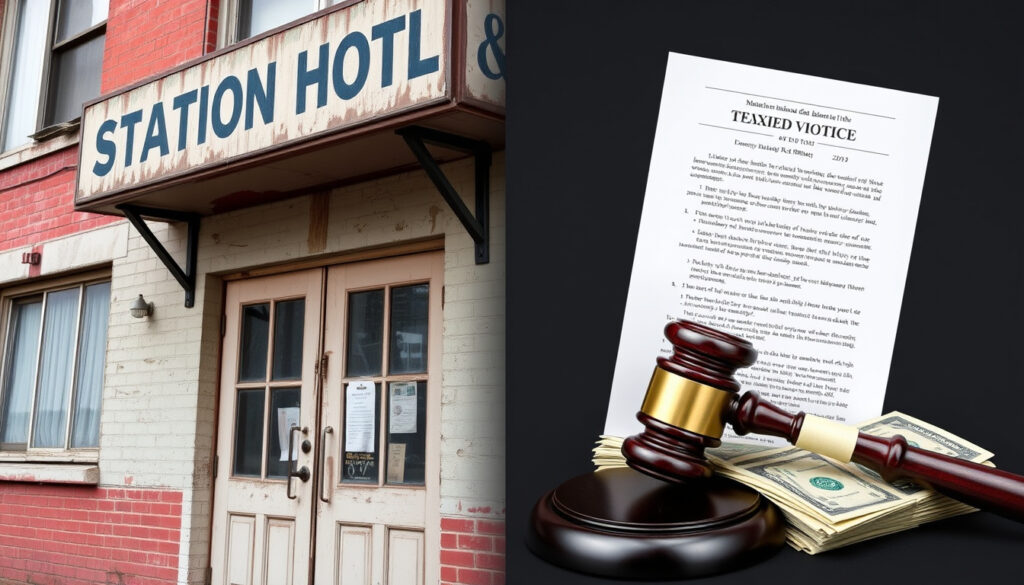
Station Hotel Tenancy Breaches: $240,700 Penalty & Tenant Rights
Few things shake a tenant’s confidence like discovering their landlord has been ignoring the law. The Station Hotel case in Auckland is a stark reminder of what happens when boarding house operators fail to meet their obligations—and this article walks through the specifics.
Total exemplary damages: $240,700 ·
Affected tenants: 64 ·
RTB fine: $27,000 ·
Property type: Boarding house (Station Hotel) ·
Location: Auckland Central
Quick snapshot
- Whether the landlord will eventually pay the full $240,700 after the missed deadline
- Exact nature of all breaches beyond those stated
- Current housing status of the 64 affected tenants
- Breaches occurred prior to 2025 (1News)
- October 28, 2025 deadline for payment (1News)
- Payment received by MBIE on October 29 (1News)
- Comprehensive healthy homes assessment due by December 24, 2025 (1News)
- Three-year restraining order on the operator (1News)
- Potential further enforcement if compliance conditions are not met (1News)
Seven key facts from the Station Hotel case and the broader tenancy landscape in New Zealand.
| Property | Station Hotel (boarding house) |
| Operator | Beach Road Hotel Limited (Prakash Pandey) |
| Total exemplary damages | $240,700 |
| RTB fine | $27,000 |
| Number of tenants | 64 |
| Location | Auckland Central |
| Deadline for payment | October 28, 2025 (received October 29) |
Can a tenant be evicted immediately?
Immediate eviction grounds
- Immediate eviction is allowed only for serious damage or safety threats, as determined by the Tenancy Tribunal.
- For other breaches, the landlord must give notice and apply to the Tribunal.
- A tenant can challenge an unlawful eviction by filing a claim with the Tenancy Tribunal.
Notice periods
- For periodic tenancies, landlords must give 90 days’ notice (or 63 days in certain cases) to end the tenancy.
- Tenants must give 21 days’ notice to end a periodic tenancy.
- Fixed-term tenancies end on the agreed date unless both parties agree to renew.
The implication: Tenants are protected from arbitrary eviction, but must follow proper channels.
On what grounds can a tenant be evicted?
Breach of tenancy agreement
- Non-payment of rent is the most common ground for eviction.
- Damage beyond fair wear and tear, or illegal activity on the property, also qualifies.
- The landlord must first serve a 14-day notice to remedy the breach before applying to the Tribunal.
Anti-social behaviour
- Serious or persistent anti-social behaviour by the tenant or their guests can lead to eviction.
- The landlord must provide evidence and follow the Tribunal process.
Rent arrears
- If rent is at least 21 days overdue, the landlord can apply to the Tribunal for possession.
- The tenant can avoid eviction by paying all arrears before the hearing.
The implication: New Zealand law heavily favours due process. Landlords who attempt self-help eviction—changing locks, removing belongings—face penalties themselves.
What are red flags to watch out for when renting?
Unsafe conditions
- Damp and mould, insecure locks, and faulty wiring are common red flags.
- Failure to meet Healthy Homes standards (heating, insulation, ventilation) is a serious breach.
Lack of maintenance
- A landlord who ignores maintenance requests may be signalling that they do not take obligations seriously.
- Tenants should document all requests and the landlord’s responses.
Unresponsive landlord
- Difficulty reaching the landlord or repeated delays in addressing problems are warning signs.
- Landlords are legally required to provide a written tenancy agreement.
For tenants, the Station Hotel case shows what can go wrong when red flags are ignored. A boarding house that uses dodgy “accommodation contracts” to avoid the Residential Tenancies Act, fails to lodge bonds, and neglects fire safety—those are not just inconveniences but legal violations that can cost the landlord dearly.
The pattern: Tenants who ignore red flags may end up in a costly legal battle.
Is dirty grout normal wear and tear?
RTB guidelines on grout
- In New Zealand, dirt build-up in grout is typically considered normal wear and tear.
- Cracked or missing grout due to neglect may be considered damage for which the tenant can be charged.
- The Tenancy Services’ “Wear and Tear vs Damage” guide provides detailed examples (Tenancy Services guidance).
Two common comparisons, one pattern: the line between wear and tear and damage depends on cause and care.
| Situation | Typical wear and tear | Damage |
|---|---|---|
| Grout appearance | Minor discolouration, light dirt | Large cracks, holes, or mould from neglect |
| Carpet | Fading, light flattening | Stains, burns, or tears |
| Walls | Small scuffs, faint marks | Large holes, graffiti, or water damage from tenant activity |
| General | Natural ageing from ordinary use | Breakage beyond what is reasonable |
The trade-off: landlords cannot charge for normal ageing, but they can deduct from the bond for damage caused by negligence. Both parties should reference the official Tenancy Services guide to avoid disputes.
What is the wear and tear for RTB?
Definition of fair wear and tear
- Fair wear and tear is the natural deterioration that occurs as a result of normal daily living.
- It includes fading from sunlight, minor marks on walls, and gradual carpet wear.
- Landlords are expected to allow for these changes over time.
Examples vs damage
- Damage includes stains from spills that weren’t cleaned, burns from appliances, and holes from furniture.
- Tenancy Services provides a downloadable “Wear and Tear vs Damage” brochure for both parties (Tenancy Services).
Why this matters: The RTB (Tenancy Tribunal) often sees disputes over bond deductions. Clear guidelines help tenants contest unfair claims and help landlords know what they can legitimately charge for.
What is a tenancy of unlimited duration?
What is a periodic tenancy
- A periodic tenancy runs from week to week or month to month with no fixed end date.
- It begins when a fixed-term tenancy expires and the tenant stays with the landlord’s consent.
- Either party can end it by giving the legally required notice.
The 6-year rule
- In New Zealand, after a fixed-term tenancy ends, it may become a periodic tenancy by default if the tenant continues paying rent.
- The landlord must give 90 days’ notice (or 63 days in some cases) to end a periodic tenancy.
- Tenants can end it with 21 days’ notice.
The catch: Tenants should be aware that staying beyond a fixed term automatically triggers a periodic tenancy.
Timeline of events
- Unknown date: Tenancy breaches occurred at Station Hotel, including failures to meet Healthy Homes standards, fire safety, and bond requirements (1News).
- 2025: Beach Road Hotel Limited agreed to pay $240,700 in exemplary damages to MBIE for distribution to affected tenants (1News).
- October 28, 2025: Deadline for payment of the $240,700; RTB also announced a $27,000 fine (1News).
- October 29, 2025: MBIE confirmed receipt of the $240,700 from Beach Road Hotel Limited (1News).
- Post-October 2025: Landlord must arrange independent healthy homes assessment and ensure each room complies by December 24, 2025 (1News).
The timeline shows a rapid escalation from breaches to enforcement.
Clarity check
Confirmed facts
- Landlord failed to pay $240,700 by the October 28 deadline (but paid next day) (1News)
- 64 tenants were affected by serious tenancy breaches (1News)
- RTB fined the operator $27,000 (1News)
- Unlawful acts included Healthy Homes non-compliance, missing BWOF, and failure to lodge bonds (1News)
What’s unclear
- Whether the landlord will face further enforcement for late payment
- Exact nature of all breaches (beyond those listed)
- Current status of the affected tenants
The confirmed facts outweigh uncertainties, but the full impact on tenants remains unknown.
In their words
MBIE later stated that the $240,700 had been received on October 29 from Beach Road Hotel Limited.
— Ministry of Business, Innovation & Employment (1News)
The landlord agreed to a three-year restraining order from committing further unlawful acts.
— Tenancy Tribunal representative, as reported by 1News
The unlawful acts included failing to comply with the healthy homes standards for heating and ventilation.
— Tenancy Services (Healthy Homes compliance page)
For Auckland boarding house tenants and landlords alike, the Station Hotel case is a clear signal: the Residential Tenancies Act applies to all types of rental housing, and the penalties for ignoring it can reach hundreds of thousands of dollars. The operator now faces a tight deadline to fix every boarding room to Healthy Homes standards, or risk further legal action. For tenants, the lesson is to know your rights—and to report breaches early before they affect 64 people at once.
Related reading: Exterior House Painters Auckland · Roof Moss Treatment Auckland
A similar tenancy penalty case involving Kāinga Ora and a Cambridge tenant also highlights how similar tenancy penalty case tenancy disputes can escalate, underscoring the importance of knowing your rights.
Frequently asked questions
How to report a tenancy breach in New Zealand?
Tenants can report breaches to Tenancy Services by calling 0800 83 62 62 or filing an online application for the Tenancy Tribunal. Documentation of the breach (photos, emails, witness statements) is essential. The official Tenancy Services website provides step-by-step guidance.
What is the maximum penalty for a landlord’s breach of the Residential Tenancies Act?
The Tenancy Tribunal can award exemplary damages up to $7,200 per breach for most offences, but for certain serious breaches (such as failing to comply with a Tribunal order) the penalty can be higher. The total in the Station Hotel case—$240,700—is unusually high because it covered multiple breaches affecting 64 tenants (1News).
What are the Healthy Homes standards?
The Healthy Homes standards set minimum requirements for heating, insulation, ventilation, moisture and drainage, and draught stopping in rental properties. All private rentals had to comply by July 1, 2025, and boarding houses by July 1, 2021 (Tenancy Services).
Can a tenant legally withhold rent for a breach?
No. Tenants cannot unilaterally withhold rent even if the landlord is in breach. The legal remedy is to apply to the Tenancy Tribunal, which can order rent reductions or compensation. Withholding rent without Tribunal approval can result in the tenant being in breach themselves.
What is the process for a tenancy tribunal hearing?
A tenant or landlord can apply online to the Tenancy Tribunal. The application fee is $20. The Tribunal will schedule a mediation or hearing. Both parties must present evidence. The decision is legally binding and can be enforced through the District Court if necessary.
How long does a landlord have to fix a breach after notice?
For most breaches, the landlord must remedy the issue within 14 days of receiving a written notice from the tenant. If the breach is serious (e.g., no water or heating), the timeline may be shorter. If the landlord fails to act, the tenant can apply to the Tribunal.
The answers clarify key aspects of tenancy law for both parties.
More related posts
 Secret Lives of Mormon Wives Season 3: Cast Updates & Renewal
 Simon Cowell Plastic Surgery: Confirmed Procedures and Regrets
 How to Tame a Silver Fox on Dailymotion: Watch, Plot & Legality
 Outdoor Furniture Sale NZ: Deals at Mitre 10, Bunnings & IKEA
 iPhone 17 Case NZ: Best Prices & Where to Buy in New Zealand
 Hayley Sproull Partner Split: Latest on Aaron and More
 Westpac Variable Rate Cut 2025: Current Rates & Comparison
 What Is Your Body Lacking When You Get Boils – Key Deficiencies & Prevention
