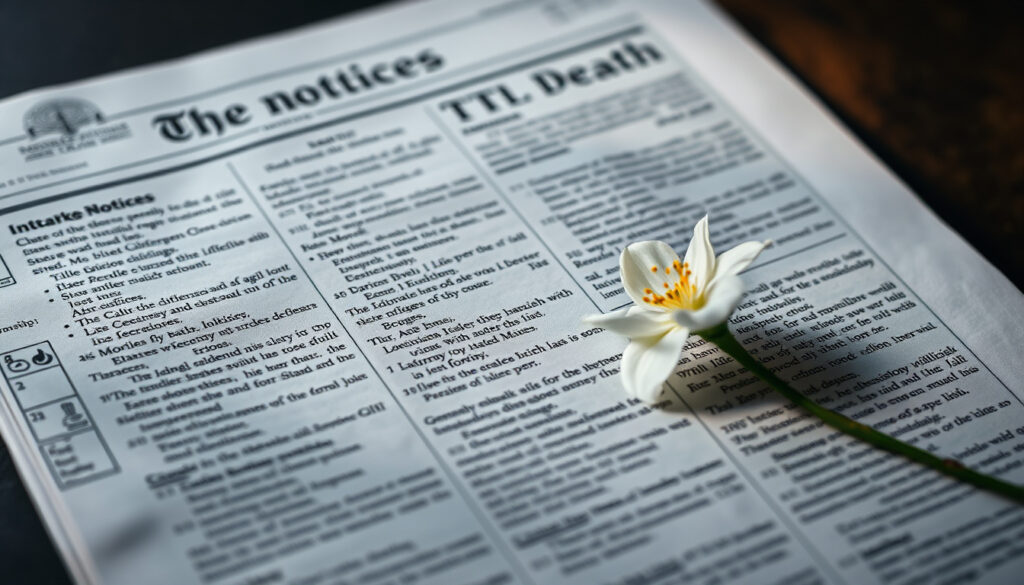
The Post Death Notices: A Complete Guide for Ireland
Anyone who has scanned the back pages of a local Irish paper knows the ritual: a column of names, ages, and funeral times that quietly connects a county in its hardest moments. In Ireland, death notices remain the standard way to tell a community about a death — and, as RIP.ie’s FAQ (funeral notice platform) explains, they are usually published through a funeral director — and knowing how they work makes a hard week easier to navigate.
Average number of death notices published daily in Ireland (regional papers): 50–100 per county ·
Typical length of a death notice: 50–100 words ·
Common sources for death notices: Local newspapers, funeral homes, online directories
Quick snapshot
- Publishing a death notice in a local or national newspaper is customary in Ireland (Citizens Information (State information service))
- RIP.ie publishes notices only through a funeral director, not directly from the public (RIP.ie FAQ (funeral notice platform))
- Every notice on RIP.ie must be associated with a county in Ireland, per the platform’s FAQ. (Citizens Information (State information service))
- The exact submission process varies by region and publication
- Whether every online aggregator verifies notices before listing them
- How long notices remain accessible on aggregator sites
- The death must be registered within 3 months, per Gov.ie and Citizens Information. (The Irish News (Belfast daily))
- The Irish News requires funeral arrangements notices by 6 pm the day before publication (The Irish News (Belfast daily))
- After 5:00 pm, The Irish Times accepts only death notices, via its self-serve portal (Irish Times Family Notices (national notice desk))
- Ask your funeral director to publish the notice on RIP.ie and in local papers, as RIP.ie’s FAQ advises. (Citizens Information Board (statutory information agency))
- Contact the newspaper’s family notices desk by phone or email, as The Irish News allows. (Citizens Information Board (statutory information agency))
- For corrections, the funeral director can change an already published notice (Citizens Information Board (statutory information agency))
Eight facts, one pattern: the Irish system routes most announcements through professionals — registrars, funeral directors, and newspaper desks — rather than through a single public form.
| Fact | Detail |
|---|---|
| Definition | A death notice is a short announcement of a person’s death, typically published in a newspaper or online, including funeral details. |
| Common sources | Local newspapers, funeral homes, and online directories such as RIP.ie and funeral-notices.co.uk, as described by Dublin funeral directors J.P. Ward & Sons. |
| Typical content | Full name, age, date and place of death, funeral service time and location, and family acknowledgements — the format used across Irish notice pages. |
| Registration deadline | Within 3 months of the death (Gov.ie (Irish Government portal)) |
| Who registers | A relative, civil partner, or another qualified informant, per Gov.ie. |
| Who publishes RIP.ie notices | Funeral directors on behalf of families; notices are not accepted directly from the public, per RIP.ie’s FAQ. |
| Print deadlines | The Irish News: 6 pm the day before publication (The Irish News (Belfast daily)); The Irish Times: death notices after 5:00 pm via the self-serve portal (Irish Times Family Notices (national notice desk)) |
| Corrections | The funeral director can make changes to an already published notice if needed (Citizens Information Board (statutory information agency)) |
What is the latest verified information about the post death notices?
The clearest recent shift is procedural: the largest Irish platforms and newspapers have tightened how notices are submitted and verified.
Recent changes in death notice publication
- RIP.ie, Ireland’s main funeral notice platform, says death notices are published through a funeral director and are not accepted directly from the public, per its FAQ.
- Every notice on RIP.ie must be linked to a county in Ireland, per the platform’s FAQ.
- The Irish Times routes after-hours submissions online: after 5:00 pm, only death notices can be submitted, through the paper’s self-serve portal (Irish Times Family Notices (national notice desk))
The practical result is a more formal paper trail. The Irish Times says family notices must be authenticated before publication, and RIP.ie verifies wording and processes an invoice before a notice goes live.
Current platforms for posting notices
- National and local newspapers, in print and online, per the State’s official information service.
- Online directories such as RIP.ie, which funeral directors use on behalf of families (J.P. Ward & Sons (Dublin funeral directors))
- Local radio, used extensively outside Dublin, with announcements usually broadcast twice or three times daily (J.P. Ward & Sons (Dublin funeral directors))
A family rarely chooses just one channel. The normal Irish pattern, as funeral directors describe it, is a combination: a notice in the local paper, a listing on RIP.ie, and sometimes an announcement on local radio.
There is no public self-serve form for RIP.ie. The funeral director is the gateway, so a family’s first call should be to the undertaker — not to the website.
The result: publication has shifted online, but the gatekeeper has not. Newspapers have tightened deadlines, and the largest platform has formalised the funeral director’s role — so the notice a family sees online is, in practice, the one their undertaker submitted.
What should readers know first about the post death notices?
Death notices are the quiet workhorse of Irish community life: short, factual, and designed to be read by everyone who knew the person.
Purpose of death notices
- They inform the community that a death has taken place — the first step after a bereavement, according to Citizens Information.
- They provide the practical details: removal, funeral mass or service, and burial or cremation arrangements.
- They act as a dated public record that families and researchers can return to later.
That combination — news and logistics in a few lines — is exactly why the format has survived. A social media post reaches friends; a death notice reaches a county.
Typical content of a death notice
- Full name, age, and the date and place of death, in the format used across Irish notice pages.
- Funeral service time and location, including removal details.
- Family acknowledgements and, sometimes, requests for donations to a charity.
Most Irish notices run between 50 and 100 words — enough for the logistics, not much more. The longer pieces you sometimes see are obituaries, which are a different format with a different purpose. For a worked example of the obituary style used for a public figure, see our profile of Dame Karen Poutasi: Cause of Death – Obituary and Legacy.
The distinction that matters: a death notice is a factual announcement, not a life story. When a family wants a biography, tributes, or a detailed account of a career, they are commissioning an obituary — and that changes where it runs and how much it costs.
Which official sources confirm key claims about the post death notices?
There is no single official deaths register for publicly announcing a death in Ireland, but there are authoritative sources for the steps around it.
Government and registry sources
- Gov.ie, the Irish Government’s services portal, says a relative, civil partner, or another qualified informant must register the death within 3 months of it occurring.
- Citizens Information says a death notification form is needed to register a death and is usually obtained from the doctor who attended the deceased (Citizens Information (State information service))
- No official Irish government source standardises the wording or placement of death notices; registration and notification are separate steps.
Established media outlets
- The Irish Times says family notices must be authenticated and should be emailed with an address and contact number (Irish Times Family Notices (national notice desk))
- The Irish News accepts funeral arrangements notices by phone or email, with a 6 pm deadline the day before publication (The Irish News (Belfast daily))
- RIP.ie’s FAQ is the closest thing to a national rulebook for online notices: funeral director submission, county association, verification, and invoice before publication.
Because no single official body owns the process, the same death can be announced differently in print, on radio, and online — and none of those versions is officially wrong. The authority sits with each publisher.
The implication: when a family wants certainty about how a notice will look and when it will run, the person to ask is the funeral director, not a government office. The State verifies the death; the market publishes it.
What is still unclear or unverified about the post death notices?
For all its formality, the system still has gaps that families and readers should know about before they rely on a single listing.
Variation in regional practices
- Some local and provincial newspapers are published only weekly, which changes how fast a notice can appear (J.P. Ward & Sons (Dublin funeral directors))
- Local radio is used extensively in areas outside Dublin, but the number of daily broadcasts varies by station.
- Submission rules differ by publication; there is no central standard for Ireland.
For a family in Cork, the practical question is not whether Ireland has a standard notice, but what the local paper accepts by its deadline, and whether the local radio station will read the notice at all. Anyone who has worked through another Ireland-specific process — such as the Government First Home Grant Ireland scheme — will recognise the pattern: national guidance, local rules.
Accuracy and timeliness of online listings
- Not every aggregator verifies the notices it republishes.
- Duplicate or outdated listings can appear when the same notice is syndicated across several sites.
- There is no standard retention period; how long a notice stays online depends on the platform.
The risk is small but real: a notice that was accurate on Monday can be stale by Wednesday, particularly if a funeral time changes after the listing goes live.
For a mourner, an outdated time on an aggregator is not a minor inconvenience — it is a missed funeral. Cross-check the listing with the funeral director or on RIP.ie before travelling.
What are the most common user questions on the post death notices?
The questions families actually ask are practical: where to look, how much it costs, and how late is too late.
How to find a specific death notice
- Search RIP.ie by county — the platform requires every notice to be associated with an Irish county.
- Check the family notices or death notices section of the local paper’s website, as recommended by Citizens Information.
- Listen for local radio announcements, which Dublin funeral directors J.P. Ward & Sons say are broadcast twice or three times daily in many areas outside Dublin.
For a specific date, the county filter on RIP.ie is usually faster than a general web search, because it narrows the results to the region where the notice was published.
Cost and timeline of posting
- RIP.ie publishes a notice after verification and invoice payment, per its FAQ.
- The Irish News requires funeral arrangements notices by 6 pm the day before publication (The Irish News (Belfast daily))
- The Irish Times accepts death notices after 5:00 pm only through its self-serve portal.
The practical sequence is simple: the family agrees wording with the funeral director, the funeral director submits it, the platform verifies it, and the notice appears — usually in the next print edition, and often online sooner.
The pattern: the deadlines that used to govern print now govern the online version too. Families who want a notice for a Monday funeral need to be talking to the funeral director by the previous Friday.
What is confirmed and what is still unclear
Confirmed facts
- Publishing death notices in local and national papers is customary in Ireland, per Citizens Information.
- They include the person’s name and funeral information, as shown on platforms like RIP.ie.
- Online platforms such as RIP.ie collect notices from funeral directors around Ireland (RIP.ie FAQ (funeral notice platform))
- Death registration must happen within 3 months (Gov.ie (Irish Government portal))
What’s unclear
- The exact submission process varies by region and publication.
- Whether all notices are verified for accuracy before listing.
- How long notices remain accessible on aggregator sites.
- Whether local radio schedules are consistent across counties.
The balance matters: for every confirmed fact about Irish death notices, there is an unverified detail that can change plans on the day.
What the sources say
The platforms and State agencies that handle Irish death notices are explicit about how the process works.
“Death notices are published through a funeral director and are not accepted directly from the public.”
RIP.ie FAQ (funeral notice platform)
“It is customary to place a notice in a local or national newspaper when a death has taken place.”
Citizens Information (State information service)
“A relative, civil partner, or another qualified informant must register the death within 3 months of the death occurring.”
Gov.ie (Irish Government portal)
What this means: read the quotes as a chain — the State registers the death, the funeral director publishes the notice, and the newspaper or platform sets the rules in between.
The takeaway
For families navigating a bereavement in Ireland, the path is clearer than it looks: ask the funeral director to publish the notice — they can place it on RIP.ie, submit it to local papers, and amend it later if service details change, as Citizens Information confirms. For readers, the fastest route is the county-based RIP.ie pages or the local paper’s notice section, checked on the day itself. The alternative — relying on an aggregator that may carry stale listings — is how a mourner ends up at the wrong church on the wrong morning.
notices.irishtimes.com, bereavementstartguide.com, historyireland.com, rip.ie, jenningsfunerals.ie
Frequently asked questions
Can anyone submit a death notice?
Not always directly. RIP.ie accepts notices only through a funeral director and not from the public, per its FAQ. Newspapers such as The Irish Times require family notices to be authenticated and ask for an address and contact number (Irish Times Family Notices (national notice desk)). For smaller papers, contact the family notices desk directly.
How long does a death notice stay online?
There is no single rule. Retention varies by platform, and no published national standard exists. Save a copy when you first see it; the funeral director who placed it can confirm how long the relevant platform keeps it visible.
Is there a cost to publish a death notice?
Usually, yes. RIP.ie says publication follows verification and invoice payment, meaning a fee can be invoiced to whoever places the notice. Newspaper rates depend on the title and the length of the notice; the funeral director can confirm the total cost before submission.
What information is typically included in a death notice?
Most Irish notices include the full name, age, date and place of death, funeral service time and location, and family acknowledgements. The format is deliberately short — typically 50 to 100 words — so a whole community can take in the essentials at a glance.
How do I find a death notice from a specific date?
Use RIP.ie’s county-based listings — every notice on the platform must be associated with an Irish county — or search the local newspaper’s notice archive. Local radio announcements outside Dublin can also help for recent notices; Dublin funeral directors J.P. Ward & Sons say these usually air twice or three times daily.
Can death notices be corrected after publication?
Yes. According to the Citizens Information Board, your funeral director can publish the notice for you and can make changes to an already published notice if needed (Citizens Information Board (statutory information agency)). Corrections are easiest before the funeral; after that, a short acknowledgement notice is the usual route.
What is the difference between a death notice and an obituary?
A death notice is a short factual announcement of a death, with funeral details. An obituary is longer, often written by family or a journalist, and includes a life story, achievements, and tributes. The two are easily confused because funeral directors submit obituary notices to RIP.ie on behalf of families (Jennings Funerals).
The through-line: whatever the question, the funeral director is the single most reliable point of contact in the Irish system.
More related posts
 New Balance 574 Classic Review: Sizing, Comfort & Buy
 Freeze Dried Meals NZ – Best Brands for Tramping
 Bay Audiology Lower Hutt: Hearing Services & Costs
 Forza Horizon 6 Release Date: May 19, 2026
 Chicken Salad Recipes NZ – Quick Healthy Kiwi Twists
 Food for Less Otahuhu: Hours, Menu, Reviews & Warning
 Cast of M3GAN 2.0: Returning Stars and New Villains
