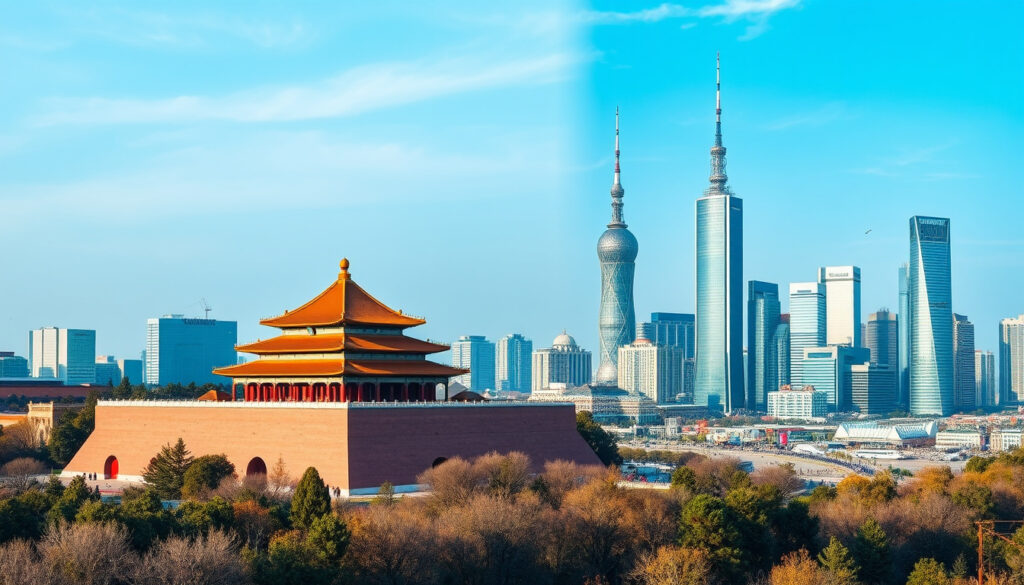
What Is the Capital of China? Beijing vs Shanghai Facts
If you’ve ever heard someone call China “Peking” or debate whether Shanghai should be the capital, you’re not alone — these confusions pop up constantly. The truth is straightforward, but the history behind it is anything but boring. This guide breaks down what you need to know, backed by verified sources and a few surprising facts along the way.
Population: 22 million residents · Capital Status: World’s most populous national capital · Historical Role: Capital for eight centuries · Previous Name: Peking · Key Site: Forbidden City with 9999 rooms
Quick snapshot
- Beijing is the current national capital (Columbia University Asia for Educators)
- Peking is the Wade-Giles romanization of Beijing — same city (China Discovery)
- Shanghai has never been a national capital (The Biggest Cities in China)
- Some sources list four great ancient capitals; others include up to seven cities
- Precise boundary between “major capital” and “regional administrative center” varies by dynasty
- Beijing settled as Jicheng: 11th century BC (The Biggest Cities in China)
- Named Beijing officially: 1403 by Yongle Emperor (YouTube — Beijing and Shanghai Compared)
- PRC founded, Beijing confirmed as capital: October 1, 1949 (Columbia University Asia for Educators)
- Beijing’s status remains stable with no proposals for relocation under the People’s Republic of China
- Xi’an and Nanjing maintain regional significance but lack national capital status
| Attribute | Value |
|---|---|
| Capital City | Beijing |
| Population | 22 million |
| Alternative Name | Peking |
| Key Landmark | Forbidden City (9999 rooms) |
| Capital Duration | Eight centuries |
Is China’s capital Beijing or Shanghai?
Beijing has been China’s capital since October 1, 1949, when Mao Zedong declared the People’s Republic of China in Tiananmen Square. Shanghai, despite being China’s largest city and home to the world’s busiest port, has never held national capital status. The confusion often arises because Shanghai dominates economic headlines and international trade coverage, making it seem like the more important city.
Common misconceptions
A persistent myth suggests Shanghai should be the capital due to its economic clout. While Shanghai contributes heavily to national GDP and serves as a financial hub, capital designation follows political and historical factors rather than economic output. Beijing functions as the center of political power, while Shanghai serves as the center of commerce.
Official status
Beijing serves as the seat of all central government bodies, including the National People’s Congress and the State Council. The nation’s seven largest state-owned banks maintain headquarters there, and foreign embassies are located in the capital city. This contrasts with Shanghai, where decision-making authority flows from Beijing, not the local government.
For investors and business professionals: Shanghai’s economic size doesn’t translate to political authority. Beijing remains where regulatory decisions are made, making it the essential city for any China-focused strategy.
What are the 4 capitals of China?
The four traditional major historical capitals of China are Xi’an, Luoyang, Nanjing, and Beijing, according to Wikipedia’s comprehensive historical capitals overview. These cities served as seats of power for major dynasties across Chinese history, earning the designation “Four Great Ancient Capitals.”
Historical capitals
- Xi’an: Western Zhou as Fenghao, Western Han as Chang’an, Sui as Daxing, and Tang as Chang’an
- Luoyang: Eastern Zhou and Eastern Han periods
- Nanjing: Eastern Jin and Southern Dynasties as Jiankang, early Ming as Yingtian
- Beijing: Later Yan, Liao, Jin, Yuan, Ming, Qing dynasties — spanning over 850 years
Some sources expand this list to include Kaifeng (formerly Bianjing) and Hangzhou, giving a “Seven Ancient Capitals” designation. Kaifeng served as capital during the Northern Song Dynasty and was known historically as Bianjing.
Modern capital
Beijing became the sole national capital for the People’s Republic of China starting in 1949, succeeding Nanjing in that role. Before the Republic era, capitals included Beijing, Wuhan, and Nanjing during different periods of the 1927–1949 timeframe.
Is Peking the capital of China?
Yes — “Peking” is simply the historical Wade-Giles romanization of Beijing. The name emerged from the postal romanization system used before pinyin became the standard in 1958. Today, “Beijing” is the internationally accepted spelling, though “Peking” still appears in some academic contexts and food-related terms like “Peking duck.”
Name history
Before pinyin adoption, foreign travelers and missionaries transliterated Chinese characters using various systems. Wade-Giles produced “Peking,” while postal systems used “Peking” for travel and shipping purposes. The name became so entrenched that European languages still preserve it in phrases like “Peking man” (the archaeological find).
Current usage
The Chinese government and international organizations use “Beijing” exclusively. The 2008 Olympics and 2022 Winter Olympics both used Beijing, cementing the modern spelling in global consciousness. Historical references and some academic works still employ “Peking,” but this represents tradition rather than current practice.
Which is nicer, Shanghai or Beijing?
Both cities offer distinctly different experiences. Beijing feels more authentically Chinese with ancient history woven through its streets — the Forbidden City, Temple of Heaven, and Great Wall access define the city. Shanghai presents a modern, international face with its colonial-era Bund district, futuristic skyline, and cosmopolitan dining scene.
For foreigners
First-time visitors often find Beijing more immediately striking due to its historical density. The palace complexes and traditional hutong neighborhoods create an atmosphere unavailable in Shanghai. Shanghai rewards repeat visitors with its evolving culinary scene and arts community, offering a more familiar urban comfort zone.
Key differences
- Architecture: Beijing traditional courtyard style vs. Shanghai Art Deco and modern skyscrapers
- Language: Beijing residents often speak with the characteristic er sound; Shanghai dialect is notably different
- Food: Beijing cuisine centers on duck and dumplings; Shanghai emphasizes fresh seafood and sweet-savory profiles
For tourists planning a China visit: prioritize Beijing for history and culture, reserve Shanghai for food and nightlife. Trying to “choose” between them misunderstands their complementary roles as China’s cultural and economic capitals respectively.
What place has 9999 rooms?
The Forbidden City in Beijing contains 9,999 rooms — deliberately one less than the mythical 10,000-room threshold to show respect to the Jade Emperor above. Commissioned in 1406 and completed in 1420 under the Yongle Emperor, this palace complex served as the imperial home for 24 emperors across the Ming and Qing dynasties.
Forbidden City symbolism
The number 9 holds special significance in Chinese culture, representing longevity and eternity. The Forbidden City’s nine courtyards and 9,999 rooms were designed to reflect imperial authority over all under heaven. The complex covers 180 acres, with its outer walls standing 10 meters high.
Beijing landmark
Today, the Forbidden City operates as the Palace Museum, receiving over 80,000 daily visitors during peak seasons. UNESCO designated it a World Heritage Site in 1987. Its northern neighbor, Jingshan Park, offers the only elevated view of the entire complex from the coal hill behind the palace.
Most visitors rush the main halls, missing the eastern and western palaces where imperial family life played out. Budget at least four hours to explore beyond the ceremonial spaces — that’s where the human stories emerge.
Beijing vs Shanghai: A comparison
Three key dimensions separate these rival cities, beyond their shared status as China’s most prominent urban centers.
| Dimension | Beijing | Shanghai |
|---|---|---|
| Role | Political center, seat of government | Commercial hub, global port |
| Historical depth | 3,000+ years, capital for 850+ years | 1,000+ years, city status since 1291 |
| Population | 22 million residents | 24 million residents |
| Capital status | National capital since 1949 | Never held national capital status |
| Key draw | Imperial history, ancient architecture | Modern skyline, international dining |
| Government presence | Central ministries, embassies | Regional headquarters, stock exchange |
The pattern here is clear: Beijing accumulates political and cultural significance across centuries, while Shanghai’s prominence tracks with trade and commerce. Neither city could easily replace the other in its designated role.
“There are traditionally four major historical capitals of China: Xi’an, Luoyang, Nanjing, and Beijing.”
— Wikipedia (Encyclopedia)
“Mao Zedong declaring the birth of the People’s Republic of China in 1949 at Tiananmen Square.”
— Andy Roams (Travel Blogger)
The implications stretch beyond geography. China’s capital designation shapes resource allocation, international diplomacy, and domestic policy prioritization. Beijing’s 22 million residents and eight-century legacy as capital create a weight that no economic metric can measure.
Related reading: Four Great Ancient Capitals · Historical capitals timeline
Frequently asked questions
Where is China located?
China occupies eastern Asia along the Yellow Sea, East China Sea, and South China Sea. Its land borders span 14 countries, making it the world’s most populous nation with approximately 1.4 billion people. Beijing sits in the northern portion of the country, roughly equidistant from the coasts.
What is the population of China’s capital?
Beijing has approximately 22 million residents, making it the world’s most populous national capital. The greater Beijing metropolitan area reaches around 21 million, while the administrative boundaries include over 21,000 square kilometers.
How long has Beijing been China’s capital?
Beijing has served as capital for over 850 years across six dynasties: Later Yan, Liao, Jin, Yuan, Ming, and Qing. The city was settled as early as the 11th century BC, with continuous urban presence spanning three millennia. As Beijing, the name dates to 1403 when the Yongle Emperor renamed the former Dadu.
Is Hong Kong the capital of China?
No — Hong Kong is a Special Administrative Region with its own government and legal system separate from mainland China. Beijing serves as the capital of the People’s Republic of China, which governs Hong Kong through the central government. Hong Kong’s status won’t change, as it operates under the “one country, two systems” framework.
What is the Forbidden City?
The Forbidden City served as the imperial palace from 1420 to 1912, housing 24 emperors across Ming and Qing dynasties. It contains 9,999 rooms across 180 acres, designed with the number 9 (representing eternity) dominating throughout. Today it operates as the Palace Museum and UNESCO World Heritage Site, receiving millions of visitors annually.
Beijing or Shanghai for first-time visitors?
First-time visitors typically benefit more from Beijing, which offers concentrated historical sites including the Forbidden City, Temple of Heaven, and Great Wall access. Shanghai suits travelers interested in modern urban culture, dining, and international business. Many visitors combine both cities for a complete China experience.
Historical capitals of China list?
The traditional four great ancient capitals are Beijing, Xi’an, Nanjing, and Luoyang. Extended lists add Kaifeng, Hangzhou, and Anyang for a “Seven Ancient Capitals” designation. Each served as capital during specific dynasties, with Xi’an and Beijing having the longest capitalship duration.
More related posts
 Baby Jogger City Turn: Is It Safe, Worth It, How Does It Work
 Shangri-La Yanuca Island Fiji: Honest Resort Guide
 Translate English to Hindi: Free Voice & Camera Guide
 Ed Sheeran Sapphire Lyrics – English Punjabi Hindi Full
 Super Rugby Results 2026: Fixtures, Table & Live Scores
 425°F to Celsius Conversion: Fan, Convection & Air Fryer
 What Does Collate Mean When Printing? Complete Guide
 Marc Jacobs SUN RX 03: Category 3 UV Protection Explained
