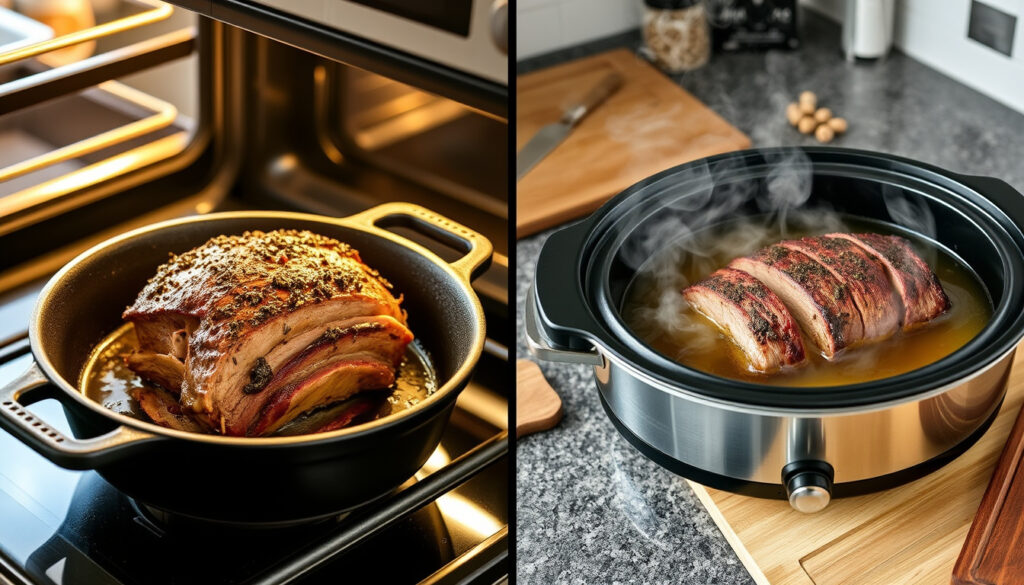
How to Cook Brisket: Oven vs Slow Cooker Guide
Anyone who has had a great brisket knows it’s one of the best cuts of beef, but for the home cook, it can also be one of the most intimidating. The good news is you don’t need an offset smoker to produce tender, flavorful results right in your own kitchen. This guide breaks down the two most accessible methods—oven and slow cooker—with UK oven temperatures, the science behind the cooking, and the mistakes that trip up even experienced cooks.
Optimal oven temperature: 325°F (160°C) · Typical slow cooker time on low: 8–10 hours · Ideal internal finish temperature: 200–205°F · Average cooking time per pound at 225°F: 60–90 minutes · Recommended resting time: 30 minutes minimum
Quick snapshot
- Requires a Dutch oven or covered roaster (Cooked & Loved)
- Cook at 325°F (160°C) for 3–4 hours (Cooked & Loved)
- Develops a good bark and deep flavor (Cooked & Loved)
- Set-and-forget convenience (RecipeTin Eats)
- Low setting for 8–10 hours (RecipeTin Eats)
- Extremely tender and moist results (RecipeTin Eats)
- Collagen breakdown starts at 160°F
- Doneness target 200–205°F
- Weight loss up to 40%
- Rest 30 minutes minimum (My Jewish Learning)
- Slice against the grain (My Jewish Learning)
- Low temp is non-negotiable (My Jewish Learning)
What is the best method for cooking brisket?
Brisket comes from the chest area of the cow and is divided into two cuts: the flat and the point. It is a heavily worked muscle rich in collagen, which makes it naturally tough. The only way to transform that toughness into succulence is low and slow cooking—enough heat and time to break collagen down into gelatin.
The internal temperature must reach at least 200°F (Meat Smoke Fire). A specialist BBQ guide recommends taking brisket to about 95°C and then checking for probe tenderness rather than relying on temperature alone. Resting is crucial, as the carryover cooking ensures the internal temperature holds steady.
Oven method
Oven braising is the most controlled home method for brisket. The dry heat of the oven combined with a covered vessel, like a Dutch oven or roasting pan with a tight lid, creates a humid environment. This allows the surface to brown while the meat steams gently.
Cooking brisket in the oven at 250°F for 5-6 hours before glazing or finishing it uncovered is a common approach (House of Nash Eats). For a faster result at 325°F (160°C), expect 3-4 hours for a 2-3 kg brisket. Always cook fat side up to baste the meat as it renders (Cooked & Loved).
Slow cooker method
The slow cooker is the most hands-off approach. A slow cooker brisket method commonly uses low heat for 8-10 hours, with some recipes also allowing high heat for 5-6 hours (Mayfair Foodie). One UK-style recipe advises browning brisket first before putting it into the slow cooker.
If brisket is still tough after the recommended time, it usually needs longer cooking rather than a higher heat setting (RecipeTin Eats). Flipping the meat halfway through helps promote even cooking.
Oven: richer bark, more control, but requires you to brown the meat first. Slow cooker: set-and-forget convenience, but you lose the bark entirely. For busy home cooks, the slow cooker wins on convenience; for flavor, the oven method takes the lead.
Is brisket better in the oven or slow cooker?
Choosing between the two methods is not about which is superior—it is about what you are optimizing for: time, texture, or flavor depth.
Two items, one pattern: the table below shows how each method handles the same cut of meat differently.
| Aspect | Oven | Slow Cooker |
|---|---|---|
| Temperature range | 250°F–325°F | Low (~200°F) or High (~300°F) |
| Total time | 3–6 hours | 8–10 hours (low) |
| Bark formation | Excellent, if finished uncovered | Minimal to none |
| Moisture | Good with lid and liquid | Very high, nearly braised texture |
| Hands-off factor | Moderate (need to sear, check) | High (brown then forget) |
| Best for | Shredded or sauced brisket | Fork-tender, shreddable meat |
Oven braising advantages
The oven allows for better bark formation because the surface of the meat is exposed to dry heat. Searing the brisket briefly before braising, then covering tightly with foil, creates a roasted crust that does not happen in a slow cooker (Cooked & Loved). The oven also works well for larger briskets that exceed the capacity of a standard slow cooker.
Slow cooker advantages
The slow cooker is more forgiving. It maintains a steady, gentle bath temperature that is nearly impossible to overshoot. The slow cooker brisket recipe from RecipeTin Eats recommends cooking on LOW for 8-10 hours and flipping the meat halfway through (RecipeTin Eats). It is perfect for making brisket overnight or while you are at work.
Which method yields better flavor?
Oven-cooked brisket develops Maillard browning through the searing step and the dry finish. Slow cooker brisket tastes more like pot roast—still delicious, but missing the crusty, smoky dimension. For a home cook who wants the closest approximation to BBQ brisket, the oven wins. For a set-it-and-forget-it weeknight meal, the slow cooker is the better choice.
How to cook beef brisket in the oven in the UK
UK ovens typically use Celsius, and a key conversion is that 325°F equals 160°C for conventional ovens, or 140°C for fan-assisted settings. The steps are straightforward, but getting the details right matters.
Preparing the brisket
Trim the fat cap to about ¼ inch. A BBQ brisket guide advises keeping a layer of fat on the brisket because it helps keep the meat moist (Meat Smoke Fire). Season generously with salt and black pepper at minimum. Some recipes use mustard as a binder for seasoning (Meat Smoke Fire).
Oven temperature and timing
Preheat oven to 160°C/140°C Fan (or 325°F). For a 2-3 kg brisket, cook for 3-4 hours. A covered oven method for brisket commonly uses low heat and long cooking, with examples ranging from 150°C for 5-6 hours to 170°C for about 3-4 hours depending on size and recipe style (Mayfair Foodie).
Step-by-step oven braising process
- Sear the brisket in a hot pan with oil for 2-3 minutes per side until deeply browned.
- Place fat side up in a Dutch oven or covered roasting pan.
- Add liquid like beef stock or beer until it reaches about ¼ the height of the brisket.
- Cover tightly and roast at 160°C (140°C fan).
- Check internal temperature after 3 hours. Target: 200-205°F.
- For bark, uncover for the last 30-45 minutes, basting with the juices.
- Rest for at least 30 minutes before slicing.
UK home cooks face the added challenge of converting temperatures. Stick to 160°C (conventional) or 140°C (fan) for a 2-3 kg brisket, and you will hit the collagen-targeting sweet spot every time.
How to cook brisket in slow cooker
The slow cooker is ideal for busy schedules and produces consistently moist results. The science is the same: low heat over many hours to break down collagen.
Choosing the right brisket cut
Whole packer briskets may not fit a standard slow cooker. You will likely need a flat-cut brisket or to cut the brisket to fit (Stockman Steaks). Trim excess fat when using a slow cooker, as the fat will not render in the same way as in dry heat (Stockman Steaks).
Slow cooker settings and timing
Use LOW for 8-10 hours. Some recipes allow HIGH for 5-6 hours, but LOW is significantly better for tenderness. The enclosed environment of the slow cooker is efficient at holding heat and moisture, but it cannot create bark.
Recipe tips for tender brisket
- Season generously: salt and pepper are essential, with garlic powder or smoked paprika optional.
- Brown the brisket in a skillet first for flavour (Mayfair Foodie).
- Add liquid to cover partially (beef stock, stout, or BBQ sauce).
- Cook on low for 8-10 hours, flipping halfway (RecipeTin Eats).
- Shred or slice after resting.
Why this matters: the slow cooker is the most forgiving method for beginners. You are unlikely to dry out the meat because the closed environment traps all moisture. The biggest risk is undercooking, so use a probe thermometer to confirm the internal temperature has reached at least 200°F.
What are common mistakes when cooking brisket?
Even experienced cooks make these errors. Knowing what to avoid is as important as knowing the steps.
Overcooking or undercooking
A common brisket mistake is pulling it too soon, before collagen and fat have fully broken down (YouTube). The brisket will feel tough and chewy. The internal temperature must reach at least 200°F. Conversely, cooking at too high a temperature will cook the outside before the inside is tender (My Jewish Learning).
Not trimming properly
Too much fat leaves a greasy result; too little leaves the meat dry. The consensus from Meat Smoke Fire is to keep a layer of fat because it helps keep the meat moist (Meat Smoke Fire). For the slow cooker, trim a bit more aggressively since the rendered fat has nowhere to go.
Skipping the rest period
A common brisket mistake is slicing it while it is still hot instead of letting it rest (My Jewish Learning). Resting allows the juices to redistribute. A 30-minute rest is the absolute minimum for a 2-3 kg brisket.
Using too high heat
High heat will make brisket tough. A specialist BBQ guide advises cooking brisket low and slow around 110°C and leaving it alone during the cook (Meat Smoke Fire). This applies to the oven and slow cooker alike.
The most common brisket mistake is also the easiest to avoid: cooking and serving it the same day rather than making it ahead (My Jewish Learning). Brisket improves overnight. Make it a day ahead, slice cold, and reheat in its juices.
Common mistakes in slow cooker brisket vs oven brisket
Each method has specific pitfalls. In the slow cooker, the biggest mistake is not cutting the brisket to fit—you end up stacking it, which means uneven cooking (Stockman Steaks). In the oven, the biggest error is opening the lid too often, which drops the temperature and extends cooking time by hours.
Confirmed facts
- Brisket is a tough cut from the cow’s chest (Meat Smoke Fire)
- Low and slow cooking is essential to break down collagen (RecipeTin Eats)
- Internal temperature must reach at least 200°F for tenderness (Meat Smoke Fire)
What’s unclear
- Exact cooking time depends on brisket size and oven calibration
- Optimal fat trimming amount varies by personal preference
Quotes from experts
“Don’t cook brisket the day you’re serving it. Make it a day or two earlier. It actually tastes better the next day.”
— Joan Nathan, My Jewish Learning
“Brisket can be tricky because it’s not a very tender cut of meat to start with. But when it’s done properly, it’s incredibly flavourful.”
— RecipeTin Eats, Slow Cooker Beef Brisket with BBQ Sauce
Frequently asked questions
Should I trim the fat cap on brisket?
Yes, but do not remove it entirely. Leave about ¼ inch of fat to keep the meat moist during cooking. For slow cookers, trim more aggressively since the rendered fat cannot render away.
Can I cook brisket from frozen?
No. Always thaw brisket completely in the refrigerator for 24-48 hours before cooking. Cooking from frozen will lead to uneven cooking and poor texture.
How do I slice brisket properly?
Slice against the grain. Look at the lines of the meat; they run like straws. Cut perpendicular to those lines. Slicing with the grain makes the meat chewy.
What liquid should I use for braising?
Beef stock, stout beer, or a combination of both are standard. You can also use a mix of stock and wine or canned tomatoes. The liquid should cover about ¼ of the brisket’s height.
Can I cook brisket in a pressure cooker?
Yes, but the texture will differ. A pressure cooker breaks down collagen faster but does not produce the same bark or deep braised flavour. Expect a more stew-like result in 60-90 minutes.
Is brisket the same as silverside?
No. Silverside comes from the hindquarter and is leaner. Brisket is from the chest and contains more fat and connective tissue, which makes it ideal for low and slow cooking.
Do I need to flip brisket in the oven?
Not usually, if cooking fat side up. The rendered fat bastes the meat. If you notice dry spots on the top, basting with pan juices once or twice is sufficient.
For UK home cooks, the decision between oven and slow cooker is clear: if you want the closest thing to a BBQ bark without a smoker, the oven at 160°C (140°C fan) is your best bet. If you want to come home to tender, shreddable brisket with zero babysitting, the slow cooker on low for 8-10 hours will deliver. Either way, respect the internal temperature, let it rest, and slice against the grain—or all your work will be for nothing.
More related posts
 India National Cricket Team: Squad, Schedule, Stats & News
 How Many Days Until Christmas? Countdown and Sleep Tips
 The Best Chocolate Chip Cookie Recipe – Easy, Soft & Chewy
 New Zealand Currency in India: NZD to INR Rates & Salaries
 Harvey Norman Mt Roskill – Store Location, Hours & Sales Deals
 Auckland City vs Boca Juniors: Live Stream, Result & Highlights
 How to Use ChatGPT: A Beginner’s Guide to Getting Started
 Luke Littler Net Worth – 2026 Earnings and Sponsors Breakdown
