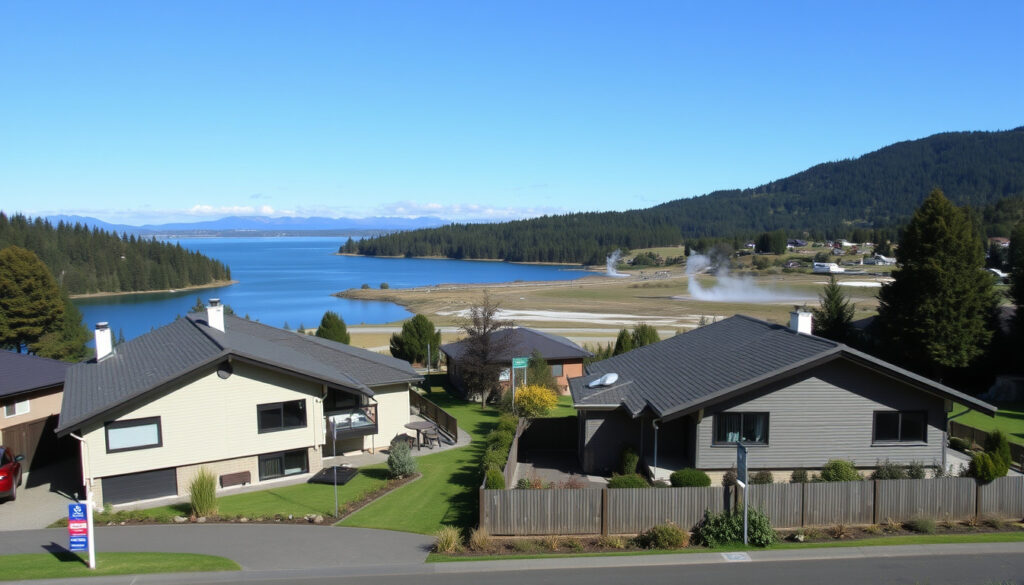
Houses for Sale Rotorua: Listings, Prices & Buyer Guide
Auckland’s median house price of $1,030,000 puts ownership out of reach for many first-home buyers and investors. Rotorua offers a different picture—average property prices around $674,733 as of February 2026, with rental yields of 3.59% that actually beat Auckland’s 2.34%. This guide walks through what’s actually available, how the numbers stack up, and what the rules are for buying here.
Houses for sale on Trade Me: 558 · Houses for sale on OneRoof: 502 · Ray White Rotorua listings: 103 · EVES Bay of Plenty properties: 38 · Realestate.co.nz Rotorua homes: Available
Quick snapshot
- 558 homes listed on Trade Me as of early 2026 (Trade Me Property)
- Rotorua averaged $674,733 in February 2026 (Opes Partners)
- 3.59% median rental yield beats Auckland’s 2.34% (Oaks Living)
- Exact current average prices shift daily—live data varies by listing platform (Opes Partners)
- Rental market softness: rents declined 4.17% year-on-year as of January 2026 (Opes Partners)
- Prices peaked January 2022, bottomed April 2023 (down 17.84%) (Opes Partners)
- Currently 14.50% below peak; up 4.06% from the bottom (Opes Partners)
- December 2025 saw 97 sales, up 21% month-on-month (The Power of 2)
The table below consolidates key Rotorua property market data from multiple listing platforms and research sources.
| Metric | Value | Source |
|---|---|---|
| Trade Me listings | 558 Rotorua homes | Trade Me Property |
| OneRoof listings | 502 houses | OneRoof |
| Ray White Hamurana | 103 properties | Ray White |
| EVES Rotorua | 38 Bay of Plenty homes | EVES Bay of Plenty |
| Realestate.co.nz | Rotorua Bay of Plenty sales | Realestate.co.nz |
| Average property price | $674,733 (Feb 2026) | Opes Partners |
| Most expensive suburb | Tihiotonga ($909,000 avg) | Opes Partners |
| Most affordable suburb | Fordlands ($364,900 avg) | Opes Partners |
| Average rent | $575/week (Jan 2026) | Opes Partners |
| Median rental yield | 3.59% | Oaks Living |
What is the cost of living in Rotorua?
Housing costs
Rotorua’s affordability shows clearly when you stack it against Auckland. According to Numbeo’s cost-of-living comparison, a household in Rotorua spends approximately 22.5% less per month than an equivalent household in Auckland—around 7,600 NZD versus 9,798.7 NZD monthly. That gap translates directly into housing costs: where Auckland demands $360,000 or more as a 40% deposit on properties above $900,000, regional centres like Rotorua typically require $220,000 as a 40% deposit on $550,000 properties. Annual negative cash flow follows the same pattern—$20,000-$25,000 in Auckland versus $9,000-$12,000 in regional markets.
The deposit gap alone—$140,000 difference—represents years of savings for most first-home buyers. For investors, that capital deployed elsewhere or kept liquid creates meaningful flexibility.
Daily expenses
Beyond housing, Rotorua’s position as a tourism hub means services and hospitality are well-developed, while everyday costs run lower than major cities. The city’s geothermal attractions—polynesian spas, tourism infrastructure, natural hot pools—create employment opportunities that support the local economy without requiring Auckland-level salaries. Average rent of $575 per week as of January 2026 reflects a market that, while not cheap by historical standards, remains accessible compared to metropolitan centres.
How much does an average house cost in NZ?
Regional variations
New Zealand’s property market fragments sharply by region. Auckland’s median reached $1,030,000 in March 2026, up 13.9% from $904,000 in February, making it one of the most expensive markets in the country. Regional centres operate in a different universe: properties in investment-grade ranges typically fall between $400,000 and $700,000, dramatically below Auckland levels. The Housing Price Index shows Auckland values have dropped 3.3% over the past year and now sit 5% below their level five years ago, while Rotorua recorded 1.9% quarterly growth—suggesting different trajectories even within the same national market cycle.
Rotorua specifics
Within Rotorua itself, suburb selection creates enormous price variation. Tihiotonga sits at the premium end with average house values of $909,000, while Fordlands offers the most accessible entry point at $364,900 average. Mangakakahi recorded the fastest-growing house prices over 24 months, up 9.42% from February 2024 to February 2026. The city’s average property price of $674,733 sits between these extremes, and Rotorua property prices are down 0.79% over the last 12 months—showing modest cooling even as sales volumes rise. The market’s long-term trajectory shows 5.11% annual appreciation over 20 years, though prices remain 14.50% below the January 2022 peak.
Rotorua’s 20-year growth rate of 5.11% per annum trails Auckland’s historical 6-8%, but the entry price point means investors get more property for their capital and better gross yields of 4.5-6% versus Auckland’s 3-4%.
Is Rotorua a good place to invest?
Investment pros
For investors prioritising yield over capital growth, Rotorua presents a compelling case. The city offers gross rental yields of 4.5-6%, compared favourably to Auckland’s 3-4%. The median rental yield sits at 3.59% based on current prices and rents, while Auckland delivers only 2.34%. Rotorua’s thriving tourism industry and geothermal attractions support tenant demand year-round, providing a buffer that purely residential markets lack. December 2025 saw 97 sales, up 21% month-on-month and 29% year-on-year, suggesting buyer confidence is recovering after the post-pandemic correction.
Rotorua delivers superior yields and lower entry costs, but long-term appreciation will likely trail Auckland. A $550,000 regional property appreciating at 4% annually reaches $811,000 in 10 years—at 7%, it reaches $1.08 million. The gap versus Auckland’s growth trajectory is real, but so is the cash flow advantage during the holding period.
Market trends
The market cycle tells an interesting story. Rotorua house prices peaked in January 2022, then fell 17.84% before bottoming out in April 2023. Since then, prices have risen 4.06% from the bottom—but remain 14.50% below peak. This pattern suggests a market in early recovery rather than at the top of a cycle, which could benefit new entrants. The Housing Price Index increased 0.8% month-on-month in December 2025 and 2.9% over the three-month period ending December 2025, showing consistent upward movement. Nationally, sales increased 8.1% year-on-year as of December 2025; excluding Auckland, sales rose 10.6% year-on-year—indicating regional markets are outperforming metropolitan areas.
Is Rotorua cheaper than Auckland?
Price comparisons
The price gap is stark. Auckland median house prices reached $1,030,000 in March 2026. Rotorua’s average sits at $674,733—a difference of over $355,000 on the median. That gap represents roughly 35% lower entry cost. When you factor in deposit requirements, Auckland buyers need $360,000+ (40% of $900,000+ properties) while Rotorua buyers typically need $220,000 (40% of $550,000). Annual negative cash flow runs $20,000-$25,000 in Auckland versus $9,000-$12,000 in regional centres. Auckland accounts for 37% of New Zealand’s inventory, with nearly a third of listed Auckland homes having sat on the market for five months or longer—Rotorua’s smaller market moves faster, with median days to sell at 38 days excluding Auckland.
Lifestyle trade-offs
The cost difference comes with trade-offs. Auckland offers superior infrastructure—transport networks, healthcare facilities, and educational institutions that significant investment has enhanced in recent years. Rotorua provides a different lifestyle: geothermal attractions, tourism employment, and a smaller community feel. The cost of living runs 22.5% lower, which means a given salary stretches further. For families prioritising space and affordability over metropolitan amenities, Rotorua wins on pure economics. For professionals requiring specific career opportunities or international connectivity, Auckland remains essential.
Auckland delivers superior long-term appreciation (6-8% annually versus 3-5% in regional areas). The $609,000 equity gap that builds over 10 years in Auckland’s favour is real money—but only if buyers can afford Auckland’s entry point and stomach the negative cash flow during holding.
Can a foreigner buy a house in New Zealand?
Rules for overseas buyers
New Zealand maintains restrictions on foreign purchases of residential property under the Overseas Investment Act. Generally, non-residents cannot purchase existing homes—they must purchase new builds or developments marked as eligible for foreign purchase. The overseas investment framework exists to prioritise New Zealand citizens and residents in the residential market, though temporary residents with valid work visas may have different pathways depending on their circumstances.
Residential exceptions
According to LINZ guidance, certain categories of buyers may qualify for residential purchase despite non-resident status: those with residency class visas who intend to occupy the property as their primary home, those purchasing in developments specifically approved for foreign investment, or buyers from countries with reciprocal agreements under specific trade frameworks. New builds offer the clearest pathway, as these are considered to add to housing supply rather than competing with existing stock. Any prospective foreign buyer should engage a property lawyer to verify their specific situation against current LINZ requirements before making offers.
Foreign nationals who can legally purchase in New Zealand will find Rotorua’s entry prices significantly below Auckland. The $674,733 average compares favourably to international equivalents in many markets—but only after confirming eligibility with LINZ guidance and qualified legal advice. For those considering property investment in New Zealand, Valentino Born in Roma Ireland Guide offers a valuable resource.
Rotorua vs Auckland: Side-by-side comparison
Three metrics reveal the fundamental split between these two markets.
| Factor | Rotorua | Auckland |
|---|---|---|
| Average/Median price | $674,733 | $1,030,000 |
| Median rental yield | 3.59% | 2.34% |
| Required deposit (40%) | ~$220,000 | ~$360,000+ |
| Annual negative cash flow | $9,000-$12,000 | $20,000-$25,000 |
| 20-year annual appreciation | 5.11% | 6-8% (historical) |
| Gross rental yields | 4.5-6% | 3-4% |
| Days to sell | 38 days | 39 days |
The pattern holds across every metric: Auckland demands more capital upfront and delivers more appreciation over time, while Rotorua offers lower entry costs and better cash flow. Neither market is universally better—the right choice depends on capital position, investment horizon, and whether cash flow or capital growth matters more to each buyer.
Upsides
- Entry price $355,000 below Auckland
- 3.59% median yield outperforms Auckland’s 2.34%
- 22.5% lower cost of living versus Auckland
- Smaller deposit requirement (~$220,000)
- Tourism-supported rental demand
- Market recovery in progress—prices up 4.06% from April 2023 bottom
Downsides
- Lower long-term appreciation (5.11% vs 6-8% historical Auckland)
- Rents declining 4.17% year-on-year
- Prices still 14.50% below 2022 peak
- Smaller market with less liquidity
- Fewer employment opportunities than major cities
- Tourism-dependent economy creates volatility
Regional properties require $220,000 deposits (40% of $550,000 properties) with $9,000-$12,000 annual negative cash flow.
— Luminate (Property investment analysis)
Auckland accounts for 37% of New Zealand’s inventory, with nearly a third of listed Auckland homes having sat on the market for five months or longer.
— OneRoof (Real estate market intelligence)
Related reading: Houses for Sale Palmerston North: 523 Listings Guide
moneyhub.co.nz, estateagentpower.com, youtube.com, numbeo.com, opespartners.co.nz, nzherald.co.nz
Buyers comparing Rotorua prices to Auckland may find the New Lynn listings particularly insightful for suburban market dynamics.
Frequently asked questions
What devalues a house the most?
The fastest property value destroyers include structural problems (foundation issues, roof damage, asbestos), significant deferred maintenance, unwanted noise proximity (airports, highways, industrial sites), functional obsolescence (poor layout that cannot be fixed cheaply), and over-improvement relative to the neighbourhood. Location factors that buyers cannot see but sense—high crime areas, declining school districts, oversupply of similar properties—create lasting price impacts that cosmetic repairs cannot reverse.
What raises home value the most?
Kitchen and bathroom renovations deliver the highest return on investment in most markets. Curb appeal improvements—landscaping, exterior paint, modern entry doors—matter disproportionately because they set first impressions. Adding functional space (bedrooms, bathrooms, living areas) boosts value more than upgrading finishes in existing spaces. In Rotorua specifically, geothermal features, well-maintained Character homes, and proximity to tourism corridors can command premiums that go beyond standard market comparables.
What is the number one reason a house doesn’t sell?
Overpricing remains the dominant cause. When a property sits on the market for extended periods, buyers assume something is wrong—structural issues, title problems, or defects that the seller knows and is concealing. Each month of unsold time compounds this perception. Correctly priced properties in desirable neighbourhoods move within weeks; overpriced properties in the same areas linger for months, eventually selling for less than properly priced comparables would have achieved. Working with a knowledgeable local agent to establish realistic pricing from day one matters more than any other factor.
What salary do you need to live comfortably in NZ?
Comfort depends heavily on location. In Auckland, household incomes above $150,000 generally provide comfortable living with moderate savings capacity. In Rotorua, the same standard of living requires significantly less—around $90,000-$110,000 for a comparable household, reflecting the 22.5% lower cost of living. Numbeo’s data suggests monthly costs of 7,600 NZD in Rotorua versus 9,798.7 NZD in Auckland. The salary required to save meaningfully while covering housing costs, healthcare, and family expenses varies considerably by family size and lifestyle expectations.
Is property cheaper in New Zealand than the UK?
Comparing directly is complex due to currency differences and income parity, but New Zealand property remains expensive by global standards relative to rents. Auckland’s $1,030,000 median translates to roughly £520,000 at current exchange rates—well above UK regional averages outside London. Rotorua at $674,733 (approximately £340,000) sits closer to UK regional cities like Manchester or Leeds, though New Zealand wages generally trail UK equivalents, making the affordability comparison nuanced. First-home buyers in New Zealand face similar deposit-chasing challenges as their UK counterparts, though NZ’s lending market operates under different regulatory frameworks.
For first-home buyers priced out of Auckland, the path to ownership is clearer in Rotorua—but only if they align their choice with their actual priorities. Investors seeking cash flow will find Rotorua’s 3.59% yield and lower entry costs more attractive than Auckland’s capital growth premium. Those with larger deposits and longer time horizons might accept Auckland’s negative cash flow for eventual equity gains. The market at $674,733 average offers genuine affordability compared to metropolitan alternatives, with rental demand supported by tourism and a recovering sales cycle. The decision hinges on what each buyer actually needs from their property.
More related posts
 Dachshund Puppies for Sale NZ: Cost, Lifespan & Care
 Wild Dog Hunting in Northland: Feral Packs, Safety, Management
 Red Eye TV Series: Worth Watching, Season 2, Cast & More
 500 USD to NZD: Live Rate and Best Conversion Tips
 Lice Egg on Finger: How to Identify, Squish, and Remove – Guide
 GP Central Stoddard Road: Mt Roskill GP Fees & Booking
 Who Won State of Origin 2025? Final Result and Series History
 Luke Littler Net Worth – 2026 Earnings and Sponsors Breakdown
