Yellow Legged Hornet Nest – Identification and Removal Guide
The yellow-legged hornet nest represents one of the most significant invasive species threats to North American agriculture currently under active containment. First confirmed in the United States on November 9, 2023, in South Carolina’s Lowcountry, these paper structures house a Southeast Asian wasp species that has devastated European honey bee colonies since 2004. State agricultural departments now coordinate extensive surveillance efforts to prevent permanent establishment.
Identifying these nests requires understanding their distinct architectural progression. Unlike native wasp species that maintain relatively consistent nest sizes throughout seasons, yellow-legged hornet colonies construct three distinct nest types that expand dramatically from spring through fall. A single mature colony can produce structures reaching 90 centimeters in height while housing approximately 6,000 worker hornets.
Property owners, beekeepers, and agricultural professionals must recognize the visual signatures of these nests to facilitate early reporting. Detection during the embryonic stage—when nests remain small and manageable—provides the only window for effective elimination before colonies reach their destructive potential.
How do you identify a yellow-legged hornet nest?
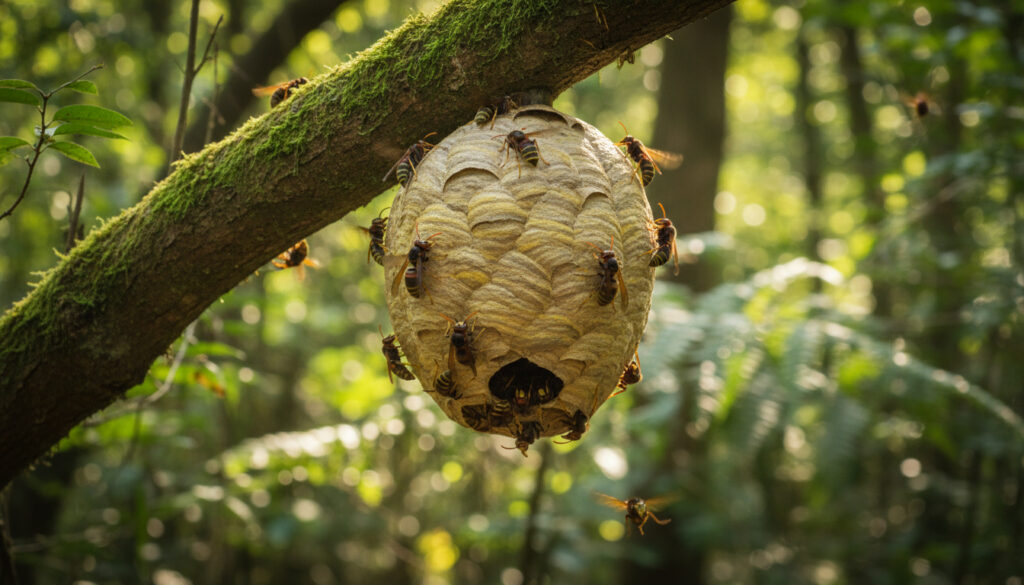
Egg-shaped paper constructions formed from macerated wood pulp, displaying beige or brown coloration with smooth to shell-like textures depending on developmental stage.
Exclusively above-ground placement, typically suspended in tree canopies but occasionally attached to manmade structures, often exceeding 32 feet in height.
Progressive scaling from tennis-ball dimensions (10 cm) in spring to basketball-plus sizes (90 cm height) by late summer.
High agricultural pest status; principal predator of honey bees with documented colony losses in affected regions.
- Egg-shaped paper nests built from chewed wood fibers mixed with saliva
- Three distinct developmental phases: embryo, primary, and secondary
- Final mature structures can contain an average of 6,000 worker hornets
- Typically located in deciduous tree canopies but adaptable to building eaves
- Coloration shifts from light tan in early stages to darker beige or brown when mature
- Smooth exterior texture on young nests becoming increasingly shell-like with age
| Fact Category | Specific Details | Source Type |
|---|---|---|
| Scientific Name | Vespa velutina | Taxonomic record |
| Native Range | Tropical and subtropical Southeast Asia | Invasion biology |
| First U.S. Detection | November 9, 2023 (South Carolina) | State entomology |
| Nest Material | Macerated wood pulp (paper) | Behavioral study |
| Embryo Nest Size | Approximately tennis-ball sized | Agricultural extension |
| Primary Nest Size | Softball to watermelon dimensions | State monitoring |
| Secondary Nest Dimensions | Up to 90 cm height, basketball-plus | Biosecurity datasheet |
| Maximum Height | Exceeds 32 feet in tree canopy | Field observation |
| Worker Capacity | Average 6,000 workers at peak | Population study |
| Interior Structure | Horizontal combs for brood rearing | Nest analysis |
| Foraging Radius | Up to 1,000 meters from nest | Tracking research |
| Seasonal Production | Two nests per mature colony annually | Colony lifecycle data |
Where do yellow-legged hornets build nests and how do they develop?
Three Distinct Construction Phases
Colony establishment follows a predictable architectural progression. Embryo nests emerge in early spring when overwintered queens awaken and begin construction. These initial structures, roughly the size of a tennis ball, feature smooth exteriors and frequently appear on sheltered porches or low vegetation. Queens rear the first generation of workers in these starter homes.
By early summer, colonies transition to primary nests constructed by the emerging worker force. These intermediate structures range from softball to watermelon dimensions and develop the characteristic shell-like appearance. The transition marks the point where nests become visible to casual observers, though they remain significantly smaller than final forms.
Secondary nests represent the mature colony phase, typically visible from late summer through fall. These structures often exceed basketball dimensions and harbor the maximum worker population. By this stage, nests have shifted from growth mode to reproductive production, generating fertile males and future queens.
Canopy Preferences and Structural Requirements
While yellow-legged hornets demonstrate adaptability to manmade structures, they show strong preference for elevated tree placement. Mature nests typically suspend from upper canopy branches, requiring inspectors to scan heights exceeding 32 feet. The Georgia Department of Agriculture notes that this arboreal tendency complicates detection efforts compared to ground-nesting species.
Geographic Expansion Patterns
Following the initial South Carolina detection, monitoring efforts have tracked spread beyond the Lowcountry region. A confirmed nest in York County on December 8, 2024, marked the first documented establishment outside the original detection zone, indicating successful overwintering and colony propagation.
Embryo nests constructed in March and April present the only realistic opportunity for non-professional intervention. During this phase, nests contain only the founding queen and initial brood, making elimination feasible before worker hoarding begins.
Why are yellow-legged hornet nests dangerous to agriculture?
Specialized Predation on Honey Bees
Yellow-legged hornets function as principal pests of managed honey bee colonies through a behavior termed “hawking.” Workers hover near hive entrances, capturing foraging bees in flight to transport back to the nest as protein sources for larvae. This predation pressure can rapidly debilitate colonies, reducing pollination capacity and honey production.
The Clemson University Department of Plant Industry documents increased colony losses across western Europe since the species’ 2004 establishment there, demonstrating the economic threat to commercial beekeeping operations.
Ecosystem Disruption Beyond Apiaries
While honey bees represent the primary documented agricultural concern, foraging behavior encompasses diverse prey. Workers hunt various insects, harvest nectar and ripening fruits, and scavenge animal carcasses or dead fish. This dietary flexibility allows rapid population establishment across varied landscapes, potentially disrupting native insect communities through competitive and predatory pressure.
Invasion Biology and Establishment Risk
The species’ proven ability to thrive in temperate climates outside its native Southeast Asian range indicates significant invasive potential. Long-distance dispersal likely occurs through trade and transportation networks, similar to the European introduction pathway. Once established, colonies produce mated queens annually that overwinter in protected tree cavities or leaf litter, ensuring seasonal recurrence.
How should yellow-legged hornet nests be located and removed?
Systematic Detection Methodologies
Professional eradication efforts employ multi-technique surveillance. Trapping near apiaries captures foraging workers, while visual tracking follows individual hornets from feeding stations toward nest locations. European researchers have refined radio-tracking technology to improve efficiency in dense canopy environments.
Flour dusting provides a low-tech alternative: technicians apply flour to hornets at bait stations, then track the white dust visible against dark vegetation as insects return to the nest. The North Central Integrated Pest Management Center confirms that observation of upward flight into tree canopies typically indicates proximity to the nest entrance. For more information on identifying and removing yellow-legged hornet nests, check out this guide ta bort mossa på stenplattor.
Professional Removal Protocols
Trained inspectors must handle nest removal and disposal. Disturbing nests before professional arrival risks defensive swarming and potential colony relocation to less accessible sites. For embryo nests discovered in early spring, elimination requires ensuring the queen’s death to prevent immediate reconstruction.
Never attempt independent removal of primary or secondary nests. Colonies at these stages contain thousands of workers capable of multiple stings. Professional equipment and protective protocols are essential for safe eradication.
Official Reporting Channels
South Carolina residents should report suspected sightings through the Clemson Department of Plant Industry online portal. Georgia residents must notify the Georgia Department of Agriculture’s Plant Protection Division. Reports should include photographs and precise location data when possible.
Establish perimeter searches within 1,000 meters of any confirmed sighting. This represents the maximum documented foraging distance from the nest, helping authorities establish effective trap placement and monitoring boundaries.
What is the annual life cycle of a yellow-legged hornet nest?
- : Colony senescence begins. Mated queens produced during late summer disperse to overwintering sites while worker populations decline and die off. This phase leaves only dormant queens to survive winter.
- : Complete dormancy period. Mated queens shelter in secluded tree cavities, loose bark, or leaf litter, remaining inactive until temperature thresholds trigger spring emergence.
- : Queen activation and embryo nest construction. Individual queens establish small starter nests, laying eggs that will develop into the first worker generation.
- : Primary nest development. Worker emergence enables rapid expansion into larger, more visible structures as the colony transitions from individual to collective construction behavior.
- : Secondary nest expansion. Workers focus energy on building the final large nest structure while maintaining intensive foraging operations to feed the growing population.
- : Reproductive phase. Colony resources shift from growth to production of fertile males and future queens, preparing for the next year’s cycle.
What facts are scientifically established versus what remains uncertain?
| Established Evidence | Uncertain or Unverified |
|---|---|
| Native to tropical/subtropical Southeast Asia | Ultimate northern expansion limits in North America |
| First U.S. detection: November 2023, South Carolina | Specific vector of initial introduction (cargo, shipping, etc.) |
| Three-stage nest development (embryo, primary, secondary) | Effectiveness of flour-dusting in dense forest canopies |
| Maximum foraging range: 1,000 meters from nest | Long-term ecosystem impacts on native pollinator communities |
| Professional removal recommended for all but embryo nests | Total economic impact projections for U.S. agriculture |
| Confirmed secondary nest in York County, SC (December 2024) | Secondary nest establishment in other southeastern states |
How did yellow-legged hornets establish themselves as an invasive species?
The species originated in tropical and subtropical regions of Southeast Asia, where natural predators and climatic factors historically contained population growth. International trade routes facilitated transcontinental movement, with the first European detection occurring in France during 2004. Over two decades, populations spread across western Europe, demonstrating remarkable adaptability to temperate climates previously considered outside the species’ ecological tolerance.
Wildlife management approaches vary significantly between captive sanctuary environments and open ecosystems. Facilities like Currumbin Wildlife Sanctuary maintain controlled biosecurity protocols that prevent invasive insect establishment, whereas unmanaged landscapes offer unlimited expansion potential. This contrast highlights the challenge facing agricultural regions where open pollination services depend on unmanaged bee populations vulnerable to predation.
North American establishment appears following the European pattern, with initial detections followed by confirmed overwintering and nest construction. The South Carolina and Georgia detections suggest either multiple introduction events or rapid dispersal from initial introduction points, though specific transportation vectors remain undetermined.
What do entomology experts recommend for nest management?
“Public reporting is one of the most effective early-warning tools. Anyone observing suspected nests or hornets ‘hawking’ beehives should report through official channels, including photos when possible.”
Brad Cavin, Coordinator, Clemson University Yellow-Legged Hornet Response Program, Department of Plant Industry
The University of Georgia Bee Program emphasizes accurate identification before reporting, as native species including cicada killers, bald-faced hornets, and paper wasps create similar nest structures. Robert F. Kennedy environmental work has historically emphasized the intersection of agricultural policy and ecosystem protection, reflecting the broader regulatory challenges posed by invasive agricultural pests requiring coordinated state and federal responses.
“For embryo nests, if removal is attempted independently, it is essential to eliminate the queen to prevent additional nest formation; however, contacting pest management professionals and notifying state agricultural authorities is advised before taking action.”
Georgia Department of Agriculture, Official Pest Advisory
What should you do if you discover a yellow-legged hornet nest?
Document the location with photographs from a safe distance, noting the nest size, height, and surrounding vegetation. Immediately report the sighting to your state agricultural department—South Carolina residents through Clemson’s online reporting system, Georgia residents through the Department of Agriculture’s Plant Protection Division. Do not disturb the nest or attempt removal unless it is an embryo-stage structure discovered in early spring, and even then, professional consultation minimizes risk of queen escape. Maintain awareness of hawking behavior near beehives, as this often indicates active predation by a nearby colony requiring urgent location and eradication.
Frequently asked questions about yellow-legged hornet nests
How can I distinguish a yellow-legged hornet nest from a native bald-faced hornet nest?
Yellow-legged hornet nests are typically larger at maturity, reaching basketball-plus sizes compared to the football-sized nests of bald-faced hornets. The invasive species also shows stronger preference for extreme tree canopy height, often exceeding 30 feet, whereas bald-faced hornets frequently nest lower in shrubs or on buildings.
Are yellow-legged hornet nests toxic or dangerous to touch after removal?
No special toxicity exists in the nest material itself, which consists of standard wasp paper made from wood fibers. However, nests may harbor pesticide residues if previously treated, and decaying organic matter within abandoned nests can harbor bacteria. Professional disposal follows standard biohazard protocols for stinging insect nests.
Can yellow-legged hornet nests be recycled or used for any purpose after removal?
No practical applications exist for these nests. Unlike some traditional uses of native hornet nests in folk medicine or art, agricultural authorities mandate destruction of yellow-legged hornet nests to prevent any potential spread of colony fragments or reproductive material.
Do yellow-legged hornets reuse nests from previous years like some bee species?
No. Annual colony cycles result in complete nest abandonment over winter. Only fertilized queens survive, founding entirely new structures each spring. The paper construction deteriorates rapidly through winter weather exposure.
What time of day are yellow-legged hornet nests most active?
Peak foraging activity occurs during daylight hours when workers hunt honey bees and other prey. However, nest entrance traffic continues throughout daylight, with reduced activity during rain or temperatures below 50°F (10°C).
How quickly can a yellow-legged hornet nest grow from embryo to secondary stage?
Under optimal summer conditions, progression from tennis-ball sized embryo nests to full secondary structures can occur within 8-12 weeks, typically between April and September. Rapid expansion accelerates once worker populations exceed 100 individuals.
Should I destroy a yellow-legged hornet nest if I find one in winter?
Winter nests are already abandoned and contain no living hornets. However, reporting the location remains valuable as it indicates successful overwintering in that microclimate, alerting authorities to prioritize spring monitoring in that geographic area.
More related posts
 Emilia Clarke Movies and TV Shows: Full List & Ratings
 Ed Sheeran Sapphire Lyrics – English Punjabi Hindi Full
 Samsung Galaxy M53 5G: Price, Specs & Worth Buying?
 Ed Sheeran NZ 2026: Loop Tour Dates, Tickets & Openers
 Cast of Avatar: Fire and Ash: Full Cast List and Roles
 Taste of Art NZ – Complete Guide to the Culinary Competition
 Immigration NZ Contact 24 Hours: Phone, Email, Hours
 Houses for Sale Palmerston North: 523 Listings Guide
