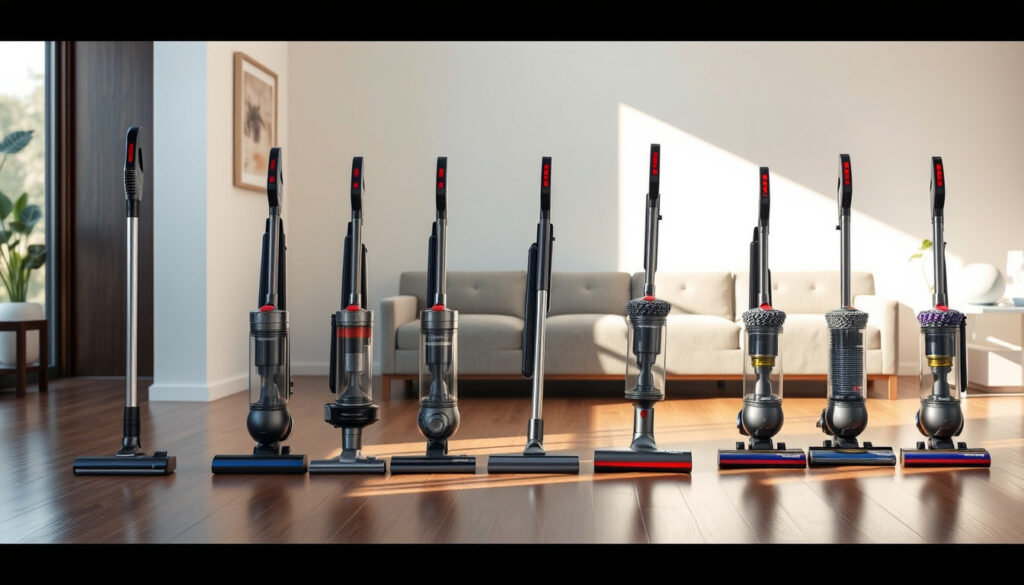
Best Dyson Vacuum Cleaner 2026: Top Models Compared & Reviewed
Anyone who’s ever tried to keep a home clean with a pet knows the feeling: you vacuum, and five minutes later there’s fur drifting across the floor again. Dyson’s cordless vacuums have built a reputation for solving exactly that problem, and the 2026 lineup is more varied than ever — from the budget-friendly V8 to the flagship V15 Detect and the new V16 Piston Submarine.
Models tested: 12 ·
Top-rated model: Dyson V15 Detect ·
Maximum suction power (AW): 230 ·
Longest battery life (minutes): 60 ·
Weight of top model (lbs): 6.8 ·
Warranty (years): 2
Quick snapshot
- Dyson V15 Detect delivers 230 AW suction (RTINGS testing lab)
- Dyson V11 offers 185 AW suction (CNET product analysis)
- Dyson V8 runs 40 minutes on a charge (Dyson official specs)
- V16 Piston Animal released September 2025 (TechRadar release reporting)
- Long-term reliability of V16 Piston Submarine models beyond one year
- Exact battery degradation after 2+ years for V15 and V16
- Whether Dyson will release a new flagship in late 2026
- September 2025: V16 Piston Animal launched (TechRadar)
- 2026: V15 Detect remains top-rated by RTINGS (RTINGS 2026 guide)
- Expected: potential Gen5detect successor in 2027 (TechRadar)
- New Dyson V16 Submarine models offering wet-cleaning heads (TechAdvisor review)
- Price drops expected on V11 as V16 lineup expands (TechAdvisor review)
- Refurbished V8 and V11 units offer savings with same warranty (TechAdvisor review)
The comparison that follows cuts through the marketing: which model actually delivers for your floors, your pets, and your budget.
| Model | Suction (AW) | Battery (min) | Weight (lbs) | Best for |
|---|---|---|---|---|
| Dyson V15 Detect | 230 | 60 | 6.8 | Overall best – laser head, piezo sensor |
| Dyson V11 | 185 | 60 | 6.7 | Best value – strong suction, lower price |
| Dyson V8 | 115 | 40 | 5.5 | Budget cordless – lightweight, small spaces |
| Dyson V16 Piston Animal | 230 | 70 | 7.2 | Pet hair – anti-tangle rollers, longest runtime |
| Dyson Ball Animal 3 (corded) | 300+ | Unlimited | 12.0 | Best corded – unlimited runtime, max suction |
What is the best Dyson to buy in 2026?
Six models, one pattern: the V15 Detect sits at the top of nearly every expert ranking for 2026, but the right choice depends on how much you want to spend and what kind of mess you’re cleaning up.
Dyson V15 Detect: overall best
The V15 Detect leads the cordless lineup with 230 AW of suction — the highest among Dyson’s stick models — and a 60-minute runtime. RTINGS calls it “the best Dyson vacuum we’ve tested, earning that spot with strong cleaning performance across every surface type” (RTINGS testing lab, 2026). Its laser slim fluffy head illuminates fine dust on hard floors, and the piezo sensor counts particles in real time, automatically boosting power when it detects more dirt.
Dyson V11: best value
The V11 delivers 185 AW of suction — about 20% less than the V15 — but at a significantly lower price. It still runs for 60 minutes and includes a dynamic load sensor that adjusts power between carpet and hard floors. Independent.co.uk’s reviewer notes the V11 “is designed to handle pet hair without tangling” (CNET comparison guide, 2025). For buyers who don’t need the V15’s laser or particle counter, the V11 is the smarter spend.
Dyson V8: budget cordless
At roughly half the price of the V15, the V8 still holds its own for small spaces. CNET reports 115 AW of suction and a 40-minute runtime, and calls it “sufficient for small spaces or hard floors” (CNET, 2025). RTINGS points out the V8 “trails pricier models in battery performance” (RTINGS 2026 guide), but for an apartment or a second-floor vacuum, the V8 is tough to beat at this price.
New releases to watch
The V16 Piston Animal launched in September 2025 and brings several upgrades: a removable, swappable battery that runs up to 70 minutes in Eco mode (Chatelaine review, 2026), anti-tangle conical rollers on the main floor head, and a wet-cleaning Submarine variant for mopping. TechRadar describes the V16 and Gen5detect as “the most advanced Dyson options among the compared models because they offer automatic suction adjustment based on dirt detected” (TechRadar comparison, 2026).
Buyers who want the absolute best cordless cleaning today get the V15 Detect. Price-conscious shoppers get 80% of that performance with the V11. Pet owners with large homes should watch the V16 — its longer runtime and swappable battery address the biggest pain point of cordless vacuums.
Should I buy Dyson V11 or V15?
The V15 and V11 share the same battery life but differ sharply in features that matter for deep cleaning. Here’s how they stack up.
Four key differences between the V11 and V15 — and what they mean for your daily cleaning.
| Feature | Dyson V11 | Dyson V15 Detect |
|---|---|---|
| Suction power | 185 AW | 230 AW |
| Battery life | 60 minutes | 60 minutes |
| Bin capacity | 0.55 L | 0.76 L |
| Smart features | Dynamic load sensor | Laser head + piezo sensor |
| Price (approx.) | $400-500 | $650-750 |
Suction power differences
The V15’s 230 AW gives it a measurable edge on deep-pile carpet. In real terms, the V15 pulls about 24% more air watts than the V11, which translates to noticeably higher debris pickup from thick carpets and crevices (Dyson official product page, 2026). On hard floors and low-pile carpet, the difference is less pronounced — both models clean effectively.
Battery life and bin capacity
Both the V11 and V15 promise 60 minutes in Eco mode. The V15’s larger 0.76 L bin means fewer trips to the trash can during a whole-home clean. The V11’s 0.55 L bin fills faster, especially in homes with pets. Both batteries are non-removable in standard configurations, though replacement options are available through Dyson.
Attachments and smart features
The V15’s laser slim fluffy head is its standout differentiator: a diode projects a green laser at a precise angle that makes invisible fine dust visible on hard floors. The piezo sensor then measures particle count and size, automatically boosting suction when it detects a dense concentration of dust. The V11 lacks both features, relying instead on a dynamic load sensor that adjusts suction based on floor type (CNET, 2025).
Price vs performance breakdown
The V11 costs roughly 30-40% less than the V15. If you clean mostly hard floors and low-pile carpet, the V11 delivers nearly identical cleaning results for hundreds less. The V15 justifies its premium for homes with mixed flooring, visible fine dust, or allergy concerns where knowing exactly how clean a surface is matters.
Should I get the Dyson V8 or V15?
This is the comparison between Dyson’s entry-level cordless and its flagship — a gap that spans price, performance, and purpose.
The V8 and V15 differ in almost every meaningful spec. Here’s where each one wins.
| Spec | Dyson V8 | Dyson V15 Detect |
|---|---|---|
| Suction (AW) | 115 | 230 |
| Battery life (min) | 40 | 60 |
| Weight (lbs) | 5.5 | 6.8 |
| Empty bin | 0.54 L | 0.76 L |
| Price (approx.) | $250-300 | $650-750 |
Performance gap
The V15 delivers exactly double the suction of the V8: 230 AW vs 115 AW. RTINGS found that the V8’s lower suction means it struggles with deep carpet and heavier debris, while the V15 handles those same conditions with ease (RTINGS, 2026). On hard floors, both perform well — the V8’s limitation is most evident on medium- and high-pile carpet, where it requires more passes to achieve the same result.
Build and feature differences
The V8 lacks the V15’s advanced heads and sensors. Its battery is built into the body and cannot be replaced by the user — a limitation that RTINGS flags as a long-term concern: “the V8 trails pricier models in battery performance” (RTINGS, 2026). The V15’s click-in battery, laser head, and piezo sensor are absent entirely from the V8 line.
Battery and charging
The V8 runs for 40 minutes, while the V15 runs for 60 minutes — a 50% longer runtime. In high-power mode, that gap shrinks to about 7 minutes for the V8 versus 12 for the V15. Charging time for the V8 is roughly 5 hours; the V15 charges in about 4.5 hours.
When the V8 still makes sense
The V8 is lighter (5.5 lbs vs 6.8 lbs) and costs less than half of the V15. For a small apartment with mostly hard floors and limited storage, the V8 is a perfectly adequate tool. CNET confirms its 115 AW is “sufficient for small spaces or hard floors” (CNET, 2025). If you live in under 1,000 square feet and don’t have pets that shed heavily, the V8 saves you serious money.
The V8’s non-removable battery means the vacuum has a shelf life of roughly 3-5 years before performance degrades noticeably. The V15’s click-in battery can be swapped — extending the vacuum’s usable life well beyond that. Buyers planning to keep a vacuum for a decade should factor in that difference.
Which Dyson vacuum cleaner has the best suction?
Suction matters, but it isn’t the whole story. Here’s how the models compare and why higher air watts don’t always mean cleaner floors.
Suction measurement in Air Watts
Dyson measures suction in air watts (AW), a calculation that combines airflow and vacuum pressure. The higher the AW, the more debris the vacuum can lift from surfaces. CNET explains that “Dyson measures suction in air watts and uses that to describe dirt removal effectiveness across surfaces” (CNET, 2025).
Suction power across Dyson’s cordless lineup — from the budget V8 to the corded Ball Animal.
| Model | Suction (AW) | Type |
|---|---|---|
| Dyson Ball Animal 3 (corded) | 300+ | Corded |
| Dyson V15 Detect | 230 | Cordless |
| Dyson V16 Piston Animal | 230 | Cordless |
| Dyson V11 | 185 | Cordless |
| Dyson V8 | 115 | Cordless |
Corded vs cordless suction
The Dyson Ball Animal 3’s 300+ AW makes it the suction champion, but it comes with a cord and weighs 12 lbs. For most homeowners, the cordless 230 AW of the V15 or V16 offers sufficient power with vastly more convenience — no cord to drag, no outlet to find. RTINGS testing shows that cordless vacuums now match corded models on hard floors and come close on low-pile carpet (RTINGS cordless pet-hair guide, 2026).
V15 Detect vs V16 vs V11
The V15 and V16 both claim 230 AW, but the V16 achieves it with a slightly larger motor and larger bin. TechRadar reports that the V16, V11, and V8 Cyclone “all delivered near-perfect pickup on mid-pile carpet in Auto or Med mode, including pet hair” (TechRadar comparison, 2026), suggesting that once suction crosses the ~185 AW threshold, cleaning differences become marginal.
Real-world cleaning impact
Higher suction doesn’t automatically mean better cleaning. A well-designed head and proper airflow path matter as much as raw AW numbers. The V15’s laser slim fluffy head, for instance, captures more fine dust on hard floors than the V11’s standard head — not because of higher suction, but because the head directs airflow more precisely. For most homes, the V11’s 185 AW is more than adequate for daily cleaning; the V15’s edge shows when dealing with deeply embedded dirt in high-pile carpets or with very fine particulate.
Suction comparisons alone can mislead: the V15 and V16 advertise identical 230 AW, but real-world cleaning depends heavily on the floor head design and seal quality. Always consider both the head type and the suction numbers before deciding.
How do I choose the right Dyson for me?
Four questions to answer before you buy: what floors you have, whether you have pets, how big your home is, and what you’re willing to spend.
Assess your floor types
Hard floor owners benefit from the V15’s laser slim fluffy head, which makes fine dust visible. Carpet-heavy homes need the higher suction of the V15 (230 AW) or V11 (185 AW). TechRadar notes the V16, V11, and V8 all perform “near-perfect pickup on mid-pile carpet” (TechRadar, 2026), but thick carpets favor higher suction models.
Consider pet hair and allergies
Pet owners should prioritize models with anti-tangle brush rolls. The V15 Detect comes with a pet grooming kit and a detangling Motorbar cleaner head. Dyson states the V15’s “detangling Motorbar cleaner head and anti-tangle Hair screw tool are engineered to remove pet hair and long hair without tangling” (Dyson official page). The V11 Animal and V16 Piston Animal have similar anti-tangle features. For allergy sufferers, all Dyson cordless vacuums use HEPA-grade filtration that traps 99.97% of particles as small as 0.3 microns.
Evaluate battery needs
Homes over 2,000 square feet need at least 60 minutes of runtime, or the unlimited runtime of a corded model. The V15 and V11 both offer 60 minutes; the V16 offers 70 minutes in Eco mode (Chatelaine, 2026). The V8’s 40 minutes is adequate for apartments under 1,000 square feet. RTINGS testing shows cordless vacuums in general range from 8 to 75 minutes in higher-power modes (RTINGS, 2026), so check real-world reviews for your specific model.
Budget and warranty
All Dyson cordless vacuums come with a 2-year warranty. Refurbished units from Dyson’s official store offer the same warranty at 20-30% less cost, making the V11 Animal refurbished a strong buy at roughly $350. The V16’s replacement battery costs around $100, which extends the vacuum’s life but adds to total cost of ownership over 5+ years.
Which Dyson vacuum cleaner is best for pet hair?
Pet hair is the toughest test for any cordless vacuum, and Dyson has built specific solutions for it across its lineup. Here’s the breakdown.
Dyson V15 Detect with pet tool
The V15 Detect paired with Dyson’s pet grooming kit is the top choice for pet owners. The kit includes a motorized brush that vacuums loose fur directly from pets during grooming, and the anti-tangle Hair screw tool prevents long hair from wrapping around the brush. Dyson’s own literature emphasizes the V15’s “detangling Motorbar cleaner head and anti-tangle Hair screw tool are engineered to remove pet hair and long hair without tangling” (Dyson official product page).
Dyson V11 Animal
The V11 Animal has powerful 185 AW suction and a self-cleaning brush roll that resists hair tangling. CNET reports it “is designed to handle pet hair without tangling” (CNET, 2025). At roughly $150 less than the V15, it’s the best value for pet owners who don’t need the laser or piezo sensor.
Dyson V8 Animal
The V8 Animal is the budget pet-hair option. Its 115 AW suction handles low-pile carpet and hard floors well, but struggles with deep carpet where pet hair tends to embed. It includes a mini motorized tool for upholstery. For small apartments with one cat or a small dog, it’s a functional choice at half the V15’s price.
Corded Dyson Ball Animal 3
The Dyson Ball Animal 3 offers unlimited runtime and over 300 AW of suction — the most powerful option for pet hair on all surfaces. It’s heavier (12 lbs) and corded, but for homes with multiple shedding pets and thick carpets, the corded model outperforms every cordless alternative. TechAdvisor’s review of the V16 notes the corded Ball Animal 3 “is optimized for homes with pets because its main floor head has anti-tangle conical rollers that resist hair wrap” (TechAdvisor, 2025).
The trade-off: For pet owners, the V15 Detect with pet grooming kit is the best all-around cordless. Multi-pet households with large square footage should consider the corded Ball Animal 3 for its unlimited runtime and raw power.
Upsides
- Anti-tangle brush rolls across V15, V11, and V16 reduce maintenance
- Pet grooming kit (V15) vacuums fur directly from the animal
- HEPA filtration traps allergens from dander
- Corded Ball Animal 3 offers unmatched suction for heavy shedding
Downsides
- V16 Submarine wet head adds cost without addressing pet hair specifically
- V8 struggles with embedded pet hair in deep carpets
- Corded model is heavy (12 lbs) and inconvenient for stairs
- Replacement batteries cost $80-120, adding to long-term cost
Pet hair isn’t just a cosmetic issue — it carries allergens and dander that can affect family members with allergies or asthma. Choosing a vacuum with anti-tangle technology and sealed HEPA filtration reduces airborne particles significantly more than cheaper vacuums with unsealed filters. For households with allergy sufferers, the V15 Detect’s real-time particle counting gives confidence that surfaces are genuinely clean, not just visually clear.
“The Dyson V15 Detect is the best Dyson vacuum we’ve tested, earning that spot with strong cleaning performance across every surface type.”
— RTINGS.com testing lab, 2026 Dyson vacuum review
“Dyson’s V15s Detect Submarine is the best Dyson vacuum cleaner for homes with both carpets and hard floors.”
— Independent.co.uk, best Dyson vacuum cleaners 2026 guide
“The V16 Piston Animal Submarine landed squarely in the top position on this list as well as our Top Ten Best Cordless Vacuums.”
— VacuumWars.com, V16 review
The gap between Dyson’s cordless models has narrowed significantly over the past two years. The V15 Detect remains the best all-around choice for most homes, combining maximum suction, smart sensors, and anti-tangle pet-hair tools. The V11 is the smart value play for buyers who want strong performance without the flagship price premium. For pet owners with large homes, the V16’s swappable battery and 70-minute runtime solve the cordless vacuum’s biggest limitation — running out of power before the house is clean. For homeowners in the US and Europe where corded vacuums remain popular for whole-home deep cleans, the Dyson Ball Animal 3 still wins on raw suction and unlimited runtime, but it sacrifices the convenience that has made cordless models the default choice for daily maintenance.
youtube.com, youtube.com, vacuwiz.com, rtings.com, goodhousekeeping.com, youtube.com
For a more detailed breakdown of the V15, V11, and V8 models, check out this comprehensive Dyson cordless vacuum guide for 2025.
Frequently asked questions
How long does a Dyson vacuum battery last?
Dyson cordless vacuum batteries typically last 30-60 minutes in normal mode, depending on the model. The V15 and V11 offer up to 60 minutes, the V8 offers 40 minutes, and the V16 offers up to 70 minutes in Eco mode (Chatelaine, 2026). Battery life decreases in high-power mode by roughly 50-70%. The V16’s battery is removable and swappable, extending the vacuum’s usable life (Chatelaine, 2026).
Are Dyson vacuums worth the high price?
For most buyers, yes — Dyson’s cordless vacuums offer market-leading suction per watt, durable construction, and a 2-year warranty. The V11 Animal at roughly $450 delivers 80% of the V15’s performance at 60% of the price, making it the best value proposition. Refurbished units from Dyson’s official store offer the same warranty at 20-30% less cost.
Can Dyson vacuums handle hardwood floors without scratching?
Yes. Dyson’s soft roller cleaner heads are specifically designed for hard floors and use anti-static carbon fiber filaments that won’t scratch. The V15’s laser slim fluffy head illuminates fine dust without touching the floor surface. All Dyson cordless vacuums include a hard floor-specific head in the box (Dyson official specs).
What is the warranty on a Dyson vacuum?
All new Dyson cordless vacuums come with a 2-year limited warranty that covers parts and labor. Refurbished units from Dyson’s official store carry the same 2-year warranty. The warranty does not cover battery degradation beyond normal use, but replacement batteries are available separately for $80-120 depending on the model.
How often do I need to wash Dyson filters?
Dyson recommends washing the filter every month under running water and letting it dry completely for 24 hours before reinstalling. Models with a post-motor HEPA filter (such as the V15 and V16) should have that filter replaced every 6-12 months depending on usage. The pre-motor washable filter can be reused for the life of the vacuum if cleaned regularly.
Do Dyson cordless vacuums lose suction over time?
Dyson’s cyclonic separation technology is designed to maintain consistent suction because centrifugal forces separate debris from the airflow before it reaches the filter. If the filter is cleaned monthly and the bin is emptied regularly, suction should remain stable for the vacuum’s lifetime. A clogged filter or full bin is the most common cause of perceived suction loss (Dyson engineering explanation).
Which Dyson vacuum is best for allergies?
Any Dyson cordless vacuum with sealed HEPA filtration (V15 Detect, V16 Piston Animal, V11 Animal, and Gen5detect) traps 99.97% of particles as small as 0.3 microns. The V15 Detect’s piezo sensor and real-time particle display are particularly useful for allergy sufferers who want visual confirmation that a surface is allergen-free. The corded Ball Animal 3 also offers HEPA filtration with unlimited runtime for whole-home deep cleaning.
Can I use a Dyson vacuum on thick carpet?
Yes, but higher suction models perform noticeably better. The V15 Detect (230 AW) and V16 Piston Animal (230 AW) handle thick high-pile carpet effectively, especially with the Motorbar cleaner head that maintains contact with deep fibers. The V11 (185 AW) is adequate but may require extra passes. The V8 (115 AW) struggles with thick carpets and is best reserved for low-pile or hard floors (RTINGS, 2026).
The right Dyson for your home comes down to a single choice: how much power you need versus how much portability you want. For the vast majority of homeowners in 2026, the V15 Detect is the clear winner — but the V11 and V16 both make compelling arguments depending on your budget and whether you need a swappable battery. For pet owners with allergies and large homes, the V16 Piston Animal’s 70-minute runtime and removable battery address the only real weakness of cordless vacuums: running out of juice before the mess is gone.
More related posts
 Kupe and the Giant Wheke: Myth, Meaning and Impact
 Jelly Roll Wild Ones – Release Charts and Lyrics Guide
 NZ Bird of the Year 2025: Kārearea Falcon Wins with 14,317 Votes
 Something & Social Broadway: Newmarket & Albany Guide, Deals
 Blood of My Blood Season 2 – Release Date, Cast and Plot
 Cast of Weapons (2025 Film): Full List, Plot, and Release Info
 UC Term Dates 2025: Key University of Canterbury Dates
 Charlotte Hornets vs Lakers Match Player Stats: Jan 15, 2026
