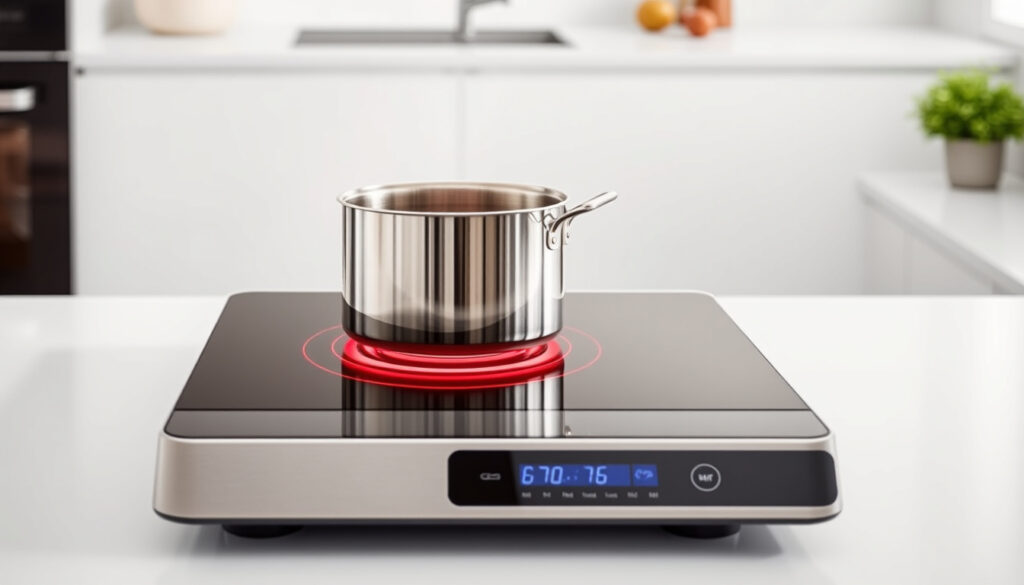
Portable Induction Cooktop NZ: Complete Buying Guide
You’re standing in a cramped kitchen with one gas burner and a pile of pots — or you’re looking at your first campervan galley and wondering how to cook a proper meal without a full suite of appliances, but for many New Zealanders, a portable induction cooktop has become the quiet hero of small-space cooking, reaching an efficiency around 84% according to the Energy Efficiency and Conservation Authority (EECA – NZ government energy agency). This guide compares the top models available in NZ, explains which pans work (and which don’t), and helps you decide between 1200W, 1600W, and 2400W options.
Average price range (NZ): NZD 80–250 ·
Typical power output: 1200–2400 watts ·
Common number of zones: 1 or 2 ·
Energy efficiency vs gas: ~84% vs ~40% ·
Popular brands in NZ: Westinghouse, Everdure, Breville, Anko
Quick snapshot
- Induction cooktops are more energy efficient than gas or radiant electric (EECA)
- Portable induction cooktops require magnetic cookware (Consumer NZ)
- Cast iron pans work on induction if flat-bottomed (Smeg)
- Portable induction cooktops are increasingly used in small kitchens, campervans, boats, and baches (Consumer NZ)
- Expect more models with smart features and higher power options as induction adoption grows (EECA)
The numbers that matter most are in this table.
| Specification | Value |
|---|---|
| Energy efficiency | 84% vs 40% for gas (EECA) |
| Boil time (1 litre water) | ~4 minutes (1800W) vs ~7 minutes (gas) (Consumer NZ) |
| Average price NZ | NZD 80–250 (CHOICE) |
| Popular NZ models | Westinghouse 2400W, Everdure 30cm, Breville Quick Cook, Anko Induction Cooker (Consumer NZ) |
| Cookware requirement | Ferromagnetic base (magnet sticks) (Smeg) |
Are portable induction cooktops any good?
Anyone who has tried cooking on a single gas ring or a dodgy hotplate in a small flat already knows the frustration. Portable induction cooktops solve many of those pain points, but they come with trade-offs.
Pros and cons of portable induction cooktops
- Pro: Energy efficient – induction uses around 80–90% of energy to heat the pan, compared to ~40% for gas (EECA).
- Pro: Fast heating – a litre of water boils in about 4 minutes on an 1800W model (Consumer NZ).
- Pro: Safety – no open flame, cool cooking surface, auto shut-off, child lock, and anti-slip feet (Consumer NZ).
- Con: You may need new cookware – only ferromagnetic pots and pans work (Smeg).
- Con: Fan noise while cooking – some portable models produce a noticeable hum (CHOICE).
How portable induction compares to gas and radiant
The real test is how induction stacks up against the two common alternatives in NZ kitchens. Five points tell the story:
- Energy use: Induction is twice as efficient as gas and about 30% more efficient than radiant electric (EECA).
- Speed: Induction boils water in roughly half the time of gas (Consumer NZ).
- Safety: No open flame, and the cooking surface stays cool enough to touch a few seconds after the pan is removed (Consumer NZ).
- Control: Instant temperature response – similar to gas – but without the lag of radiant (CHOICE).
- Cost: Portable induction units cost as little as $55, while built-in induction ranges from $600 to $6000 (CHOICE).
Bottom line: Portable induction is not better in every way – it excels in efficiency and safety but demands compatible cookware and a tolerance for fan noise. For Kiwis in small kitchens or on the road, the upsides clearly outweigh the downsides.
A portable induction cooktop can save the average NZ household about $17 per year in energy costs, according to EECA. That’s not life-changing – but the real savings come from avoiding a gas bottle refill or a sparky call-out for a new circuit.
Which portable induction cooktop is best?
Top models available in NZ come from brands like Westinghouse, Everdure, Breville, and Anko. One pattern emerges: the higher the wattage, the faster the boil, but not every kitchen can handle 2400W.
Top models available in NZ: Westinghouse, Everdure, Breville, Anko
- Westinghouse 2400W double induction portable cooktop – powerful dual-zone, around NZD 180–220 at Harvey Norman. For store locations, see our Harvey Norman Mt Roskill guide.
- Everdure 30cm portable induction cooktop – single zone, compact, ~NZD 120–160 at Bunnings.
- Breville the Quick Cook – 1800W single zone, ~NZD 130–170, tested by Consumer NZ.
- Anko induction cooker – budget option ~NZD 80–100 at Kmart NZ, also reviewed by Consumer NZ.
- IKEA TILLREDA portable induction hob – 2000W single zone, ~NZD 115 at IKEA NZ.
Key specs to compare: wattage, number of zones, size, price
Five models, five different trade-offs. The table below lines up the specs that matter most for NZ buyers.
| Model | Wattage | Zones | Size (approx) | Price NZD |
|---|---|---|---|---|
| Westinghouse 2400W | 2400W | 2 | 56 x 36 x 6 cm | ~200 |
| Everdure 30cm | 1800W | 1 | 30 x 26 x 5 cm | ~140 |
| Breville Quick Cook | 1800W | 1 | 34 x 28 x 6 cm | ~150 |
| Anko Induction Cooker | 1200W | 1 | 30 x 25 x 5 cm | ~90 |
| IKEA TILLREDA | 2000W | 1 | 33 x 27 x 6 cm | ~115 |
Bottom line: The Westinghouse 2400W is the best bet for power users and frequent cooking, but it needs a circuit that can handle the load. For most Kiwi households with standard 10A circuits, a 1800W–2000W single-zone model like the Breville or IKEA TILLREDA strikes the sweet spot.
What cannot be cooked on induction?
Induction cooktops heat the pan directly, which means the pan itself must be magnetic. That rules out a lot of common kitchenware.
Cookware compatibility: what works and what doesn’t
- Works: Cast iron, enameled cast iron, most stainless steel with a ferromagnetic base, carbon steel, and some aluminium pans with a magnetic plate (Smeg).
- Doesn’t work: Pure aluminium, copper, glass, ceramic, most non-stick pans (unless specifically marked induction-compatible), and round-bottomed woks (CHOICE).
Why some pans fail the magnet test
Induction generates a magnetic field that induces eddy currents in the pan’s bottom, producing heat. If a fridge magnet doesn’t stick to the base, the pan won’t heat. Smeg’s guide advises testing every pan before assuming compatibility.
The catch: Even if a pan is “stainless steel,” some stainless alloys are non-magnetic (e.g., 18/10). A quick magnet check costs nothing and saves frustration.
Don’t ignore pan size: using a small pan on a large zone wastes energy and slows cooking. Matching your cookware to the zone improves efficiency and reduces energy waste (CHOICE).
The takeaway: check your pans before you buy.
What is the downside to induction cooktops?
For all their advantages, portable induction cooktops have real drawbacks that Kiwi buyers should factor in before buying.
Common complaints: noise, cookware cost, learning curve
- Fan noise: The internal cooling fan runs constantly during cooking and can be distracting in a quiet kitchen (CHOICE).
- Cookware cost: If your existing pots aren’t magnetic, you’ll need to buy new induction-compatible pans – a set can cost $100–400 (Smeg).
- Learning curve: Induction responds instantly, so familiar recipes may cook faster or need lower settings. Consumer NZ recommends starting on lower power levels.
Power limitations of portable models
Portable induction cooktops plug into standard wall outlets, but maximum power is limited by NZ household circuits. A 10A circuit can theoretically supply up to 2400W, but running a 2400W unit on the same circuit as other appliances may trip the breaker (EECA).
The implication: If you plan to use a high-wattage double zone, check your circuit breaker rating and consider a dedicated circuit. For most portable models under 2000W, a standard power point is fine.
Which induction is better, 1200 watt or 1600 watt?
Power is the single biggest variable in portable induction performance. The difference between 1200W and 1600W is not just a number – it changes what you can cook and how fast.
Power differences and cooking performance
- 1200W: Slower to boil, better for simmering sauces and stews. Lower energy draw – safe on almost any circuit. Good for light use and budget buyers (CHOICE).
- 1600W: Boils water about 30% faster than 1200W. Handles searing and stir-frying without struggling. Still within standard 10A circuit limits (EECA).
- 1800–2400W: Fastest boiling, suitable for serious cooking. May trip breakers if shared with other high-draw appliances (Consumer NZ).
Suitability for different cooking tasks
Six cooking tasks, one decision tree:
- Simmering rice or soup: 1200W works fine – lower wattage gives finer temperature control (CHOICE).
- Boiling pasta water: 1600W+ cuts wait time significantly (Consumer NZ).
- Searing steak: 1600W delivers the high heat needed for a good crust (CHOICE).
- Stir-frying: 1800W+ is recommended for wok-style cooking (EECA).
- Deep frying: 1600W maintains oil temperature better (CHOICE).
- Slow cooking: 1200W is plenty – and more efficient than gas (EECA).
Bottom line: 1600W is the sweet spot for the average NZ cook – fast enough for searing and boiling, yet low enough draw to run on any standard power point. 1200W only makes sense for light, occasional use or if you’re on a very tight budget.
For a typical NZ household using induction instead of gas, the EECA estimates annual savings of about $17 – but the real benefit is convenience and speed, not dollars.
So choose your power level based on your cooking needs and circuit capacity.
Comparison: Portable induction vs gas vs radiant
One decision, three technologies. Here’s how they stack up for NZ homes.
| Feature | Portable induction | Gas (portable or fixed) | Radiant electric |
|---|---|---|---|
| Efficiency | 80–90% (EECA) | ~40% (EECA) | ~74% (US DOE) |
| Boil time 1L water | ~4 min (1800W) | ~7 min | ~5 min |
| Safety | No flame, cool surface, child lock (Consumer NZ) | Open flame, gas leak risk | Hot surface remains hot for minutes |
| Cookware | Magnetic only | Any | Any |
| Price (portable) | $55–$250 (CHOICE) | $40–$150 (portable gas hotplate) | $60–$200 (portable radiant) |
| Installation | Plug in | Gas connection or refill bottle | Plug in |
| Noise | Fan noise | No fan, burner hiss | Silent |
The pattern: Induction wins on efficiency and safety, gas wins on cookware flexibility, and radiant is the cheapest entry – but induction’s speed and control often justify the premium for serious cooks.
Specifications: Top portable induction cooktops in NZ
Five models, six specs that separate the workhorses from the also-rans.
| Spec | Westinghouse 2400W | Everdure 30cm | Breville Quick Cook | Anko Induction | IKEA TILLREDA |
|---|---|---|---|---|---|
| Wattage | 2400W | 1800W | 1800W | 1200W | 2000W |
| Zones | 2 | 1 | 1 | 1 | 1 |
| Dimensions (cm) | 56 x 36 x 6 | 30 x 26 x 5 | 34 x 28 x 6 | 30 x 25 x 5 | 33 x 27 x 6 |
| Weight | ~3.2 kg | ~2.1 kg | ~2.4 kg | ~1.8 kg | ~2.2 kg |
| Safety features | Child lock, auto shut-off, overheat protection | Auto shut-off, hot surface indicator | Child lock, anti-slip feet | Auto shut-off, overheat protection | Child lock, auto shut-off |
| Price (NZD) | ~200 | ~140 | ~150 | ~90 | ~115 |
What this means: The Westinghouse is the only dual-zone model – ideal for families or anyone who needs two burners. The Breville and IKEA offer the best power-to-price ratio for single-zone needs. The Anko is cheapest but slowest.
Upsides and downsides of portable induction cooktops
Upsides
- Highly energy efficient – up to 90% (EECA)
- Fast boiling and precise temperature control (Consumer NZ)
- Safer than gas or radiant – no flame, cool surface, auto shut-off (Consumer NZ)
- Portable and easy to store – even double-burner models often fit in a cupboard (Consumer NZ)
- Low purchase cost compared to built-in induction (CHOICE)
Downsides
- Requires magnetic cookware – existing pans may be useless (Smeg)
- Fan noise can be distracting during cooking (CHOICE)
- Surface can scratch if pans slide roughly (Consumer NZ)
- Power limitations on standard NZ circuits for high-wattage models (EECA)
- Lower max power than built-in models – not ideal for heavy-duty cooking (CHOICE)
These trade-offs help decide if portable induction is right for you.
Confirmed facts and what remains unclear
- Confirmed: Induction cooktops are more energy efficient than gas or radiant (EECA).
- Confirmed: Portable induction cooktops require magnetic cookware (Consumer NZ).
- Confirmed: Cast iron pans work on induction if flat-bottomed (Smeg).
- Confirmed: 1200W models heat slower than 1600W models (CHOICE).
- Confirmed: Induction cooktops typically last about 15 years (EECA).
- Unclear: Long-term durability of budget portable induction cooktops – few long-term reviews exist (CHOICE).
- Unclear: Exact energy savings in NZ homes – depends heavily on cooking habits and tariff structure (EECA).
- Unclear: Whether all NZ homes have adequate circuit capacity for 2400W models – professional assessment is recommended (Consumer NZ).
These facts and uncertainties should guide your purchase.
Expert perspectives
“If you have a small kitchen or want an extra burner, portable induction cooktops can be a good option. They’re also handy for trying induction before you buy a built-in hob, or for use in a campervan, boat, or bach.”
Consumer NZ (NZ consumer advocacy group)
“Portable induction cooktops can be useful for small spaces or trialling induction before buying a full-size cooktop, but some models have significant drawbacks – particularly noisy fans and limited pan size compatibility.”
CHOICE (Australian consumer testing organisation)
“Induction cooktops are the most energy efficient cooking option on the market and among the safest, healthiest, and fastest cooking technologies available.”
Energy Efficiency and Conservation Authority (EECA – NZ government energy agency)
For NZ buyers, the consensus is clear: portable induction works brilliantly for small kitchens, campers, and supplementary cooking, but check your power supply and be ready to replace non-magnetic pans.
consumer.org.nz, reddit.com, harveynorman.co.nz, ikea.com, epicurious.com, reddit.com, youtube.com, youtube.com, simplyhospitality.co.nz
Frequently asked questions
Can I use a portable induction cooktop on a wooden bench?
Yes, but ensure proper ventilation underneath – the cooktop generates heat from the pan and the cooling fan needs airflow. Consumer NZ advises keeping at least 10cm clearance on all sides.
Do portable induction cooktops work with all stainless steel pans?
No. Only stainless steel with a ferromagnetic base works – test with a magnet. Many 18/10 stainless alloys are non-magnetic and will not heat (Smeg).
How do I clean a portable induction cooktop?
Unplug and let it cool completely. Wipe with a damp cloth and mild detergent. Avoid abrasive cleaners – the glass surface can scratch (Consumer NZ).
Is it safe to leave a portable induction cooktop unattended?
Most models have auto shut-off timers, but Consumer NZ recommends never leaving any cooking appliance unattended for long periods.
Can I use a portable induction cooktop outdoors?
Yes, as long as it’s sheltered from rain and plugged into a suitable outdoor power point. Induction is safer than gas for outdoor use because there’s no open flame (CHOICE).
What is the best portable induction cooktop for camping in NZ?
A compact 1200W–1800W single-zone model, such as the Anko or Breville, is lightweight and runs on standard campsite power. Avoid 2400W models for camping – they may trip campsite circuit breakers (EECA).
How long do portable induction cooktops last?
The EECA estimates induction cooktops last about 15 years. Budget portable models may have shorter lifespans due to lower-quality cooling fans and electronics.
For other kitchen appliance manuals, see our Fisher & Paykel Oven Manual.
For Kiwis weighing up their options, the choice boils down to this: if you cook seriously and have magnetic pans, a 1600–2000W portable induction cooktop from Breville, IKEA, or Westinghouse will serve you well. If your kitchen is already cramped or you’re outfitting a campervan, the space-saving and safety benefits make it a no‑brainer. The catch? Check your circuit, check your pots, and don’t expect absolute silence while it’s running.
More related posts
 Best Cleanser for Oily Skin: Top Picks and Reviews
 Best French Bakeries Near Me: Dublin & Ireland’s Top Pâtisseries
 Cheapest Car Insurance Under 21: 2026 Guide for US & Ireland
 Inventory Management Software for Hospitals: Guide 2025
 Dame Karen Poutasi Cause of Death – Obituary and Legacy
 Phivolcs Aftershocks Cebu Earthquake – Latest Updates and Key Facts
 Best Cooling Fans NZ – Expert Picks for Hot Kiwi Summers
 SpinBet Free Spins Code Hack: Verified Bonuses & How to Claim
