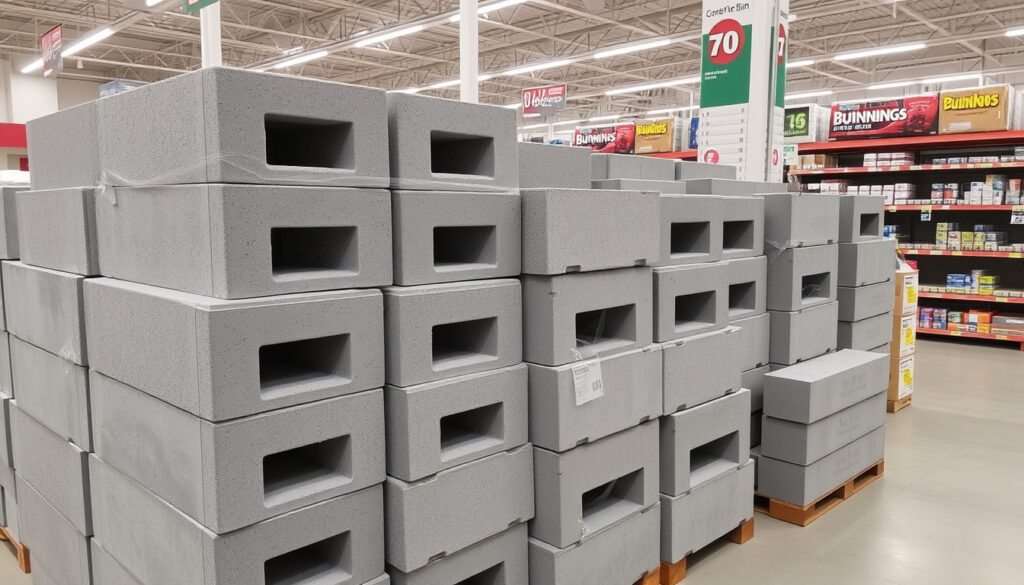
Concrete Blocks at Bunnings NZ: Prices, Sizes & Buying Guide
When you’re planning a retaining wall or garden project in New Zealand, concrete blocks are often the first material that comes to mind. But with prices varying widely between suppliers like Bunnings, Firth, and PlaceMakers, it’s easy to wonder if you’re getting the best deal.
Average price per concrete block in NZ: NZD 3 – NZD 10 ·
Standard block size (nominal): 400 mm x 200 mm x 200 mm ·
Typical lifespan: 50–100 years ·
Compressive strength range: 10–40 MPa ·
Bunnings NZ product range: Over 20 block types available
Quick snapshot
- Concrete block prices in NZ range from NZD 3 to NZD 10 per block (Bunnings NZ product page, Bloc Group price list)
- Standard nominal block size is 400 x 200 x 200 mm (WhatCosts NZ retaining wall guide)
- Concrete blocks are generally cheaper per square meter than bricks (Citi Landscape Supplies retaining wall range)
- Exact future price changes due to material cost fluctuations – no official forecast from suppliers (Bunnings retaining wall category)
- Whether Bunnings NZ will introduce new block sizes in 2025 (Bunnings retaining wall category currently limited)
- Long-term durability differences between Firth and Bunnings own-brand blocks (no independent head-to-head tests) (Bunnings retaining wall category)
- No major price changes announced for 2025; current pricing stable since mid-2024 (Bunnings NZ)
- Firth continues to supply rockface and keystone blocks at consistent prices (Bunnings NZ)
- Growing demand for split-face and decorative blocks for garden walls (Aubricks sandstone range)
- DIY builders increasingly turn to online ordering from Bunnings and specialist suppliers (Aubricks sandstone range)
Key facts at a glance
| Average price per block (NZ) | NZD 3 – NZD 10 |
| Standard block size (nominal) | 400 x 200 x 200 mm |
| Typical compressive strength | 10–40 MPa |
| Lifespan | 50–100 years |
| Common uses | Retaining walls, foundations, garden walls, structural walls |
| Bunnings NZ stock count | Over 20 block types |
How much is a concrete block in NZ?
The typical price range for concrete blocks in New Zealand is between NZD 3 and NZD 10 per block, depending on size and type. At Bunnings NZ, a Firth Rockface Garden Wall retaining block (300 x 230 x 100 mm) costs NZ$7.43 each (Bunnings NZ product page). Specialist modular blocks like the Keystone Compac III from Bloc Group retail at NZ$19.40 per block plus GST (Bloc Group price list), reflecting their engineered load-bearing capacity.
Price range by supplier (Bunnings vs Firth vs PlaceMakers vs Mitre 10)
Five suppliers, one pattern: Bunnings and Mitre 10 target the DIY market with competitive prices on standard hollow blocks, while Firth and PlaceMakers serve trade customers with premium architectural options.
| Supplier | Typical price per standard hollow block | Typical price per retaining block | Key note |
|---|---|---|---|
| Bunnings NZ | NZD 3–5 | NZD 7–8 (Firth Rockface) | Wide range, Click & Collect |
| Firth (via merchants) | NZD 4–6 | NZD 8–10 | Premium quality, consistent sizing |
| PlaceMakers | NZD 3–6 | NZD 8–12 | Firth stockist, trade discounts |
| Mitre 10 | NZD 4–7 | NZD 9–12 | Limited range, higher retail prices |
The implication: for standard hollow blocks, Bunnings and PlaceMakers are nearly neck-and-neck on price. For decorative or retaining blocks, specialist retailers (Citi Landscape Supplies, Aubricks) offer competitive alternatives with more choice in finishes.
The pattern: Bunnings NZ undercuts most rivals on standard hollow blocks but charges near-market rates for branded retaining blocks. The real savings come from bulk orders and trade accounts at PlaceMakers or direct from Citi Landscape Supplies.
Factors affecting price (type, size, quantity, delivery)
- Type: Solid blocks cost more than hollow; split-face and architectural blocks command a premium (Aubricks split-face at NZ$10.50).
- Size: Larger blocks (e.g., 600 x 600 mm) are typically more expensive per unit but can reduce the number of blocks needed.
- Quantity: Bulk orders often qualify for volume discounts – Bunnings offers trade pricing on pallet quantities.
- Delivery: Bunnings charges for delivery based on distance; specialist suppliers may include delivery in the per-block price for large orders.
What size is a standard concrete block NZ?
The most common concrete block size in New Zealand is 400 mm long x 200 mm high x 200 mm wide (nominal). Actual dimensions are slightly smaller to accommodate mortar joints – typically 390 x 190 x 190 mm actual (WhatCosts NZ). Bunnings NZ stocks this standard size in both hollow and solid options, along with several other formats.
Nominal dimensions: 400 mm x 200 mm x 200 mm
Four common sizes, each suited to different uses:
| Block type | Nominal size (L x H x W) | Common use |
|---|---|---|
| Standard hollow block | 400 x 200 x 200 mm | Structural walls, foundations |
| Half block | 400 x 200 x 100 mm | Partition walls, garden edging |
| Thin block | 400 x 200 x 150 mm | Lightweight walls, internal use |
| Retaining block (Rockface) | 300 x 230 x 100 mm | Garden retaining walls (low height) |
The catch: not all sizes are available from every supplier. Bunnings carries the standard 400 x 200 x 200 mm block and the Firth Rockface retaining block, while specialist suppliers like Citi Landscape Supplies offer modular systems (e.g., Allan Block Classic at 11.5 blocks per m²) that use different dimensions (Citi Landscape Supplies). Always check actual (not nominal) dimensions for planning.
Specialty blocks: corner blocks, bond beams, split-face
For larger or more finished projects, specialty blocks make a difference. Corner blocks simplify 90-degree turns, bond beams allow horizontal reinforcement, and split-face blocks provide a textured stone appearance. Bunnings currently lists only the Firth Rockface retaining block in its online store (Bunnings NZ). For a wider range of split-face and modular retaining blocks, retailers like Aubricks (NZ$10.50 per split-face block) and Citi Landscape Supplies offer broader selections.
Is concrete block cheaper than brick?
Yes, concrete blocks are generally cheaper per unit and per square meter than clay bricks in New Zealand. A standard concrete block (400 x 200 x 200 mm) covers about 0.08 m², while a standard brick covers roughly 0.02 m² – meaning you need about four bricks to match one block’s coverage. When you factor in labor, the time saving with blocks can cut overall project costs significantly.
Material cost comparison per unit
One block vs. four bricks, with prices from NZ suppliers (Bunnings NZ, Citi Landscape Supplies):
| Material | Unit price (approx NZD) | Coverage per unit | Cost per m² (material only) |
|---|---|---|---|
| Standard concrete block (hollow) | NZD 3–5 | 0.08 m² | NZD 38–63 |
| Clay brick (standard) | NZD 1–2 | 0.02 m² | NZD 50–100 |
What this means: even at the high end of block pricing, concrete blocks are about 25–40% cheaper per square metre than bricks. For a 20 m² wall, the material saving alone could be NZD 200–700.
The catch: Material cost tells only part of the story. Bricks may offer superior aesthetics for visible facades, but for retaining and garden walls, concrete blocks deliver hard cash savings on both materials and labour.
Installation labor cost differences
Concrete blocks also save on labor because they are larger and lay faster. A block layer can typically place 20–30 blocks per hour, compared to 60–80 bricks – but one block replaces four bricks, so the wall area coverage per hour is higher with blocks. This can reduce total wall project costs by 15–30% compared to brickwork.
Long-term value and maintenance
Both materials are durable and require minimal maintenance when properly sealed. Blocks offer better thermal mass, which can reduce heating and cooling costs in homes. Bricks may have a longer aesthetic lifespan for high-visibility facades, but for garden walls and retaining structures, concrete blocks are the more cost-effective choice.
Is it cheaper to pour a concrete wall or use blocks?
For DIY projects and walls under 2.4 m high, concrete blocks are almost always cheaper than poured concrete. Poured concrete walls require formwork, significant equipment, and experienced labor. Block walls can be built by a capable DIYer with basic masonry tools.
Cost comparison: poured concrete vs concrete block walls
Estimated per lineal metre for a 2.4 m high wall (materials and labor):
| Method | Cost per lineal metre (approx NZD) | Key cost drivers |
|---|---|---|
| Concrete block wall | NZD 200–350 | Blocks, mortar, reinforcing, labor |
| Poured concrete wall | NZD 300–500 | Formwork, concrete pump, rebar, labor |
Why this matters: for a 10 m long retaining wall, using blocks could save NZD 1,000–1,500. However, for walls over 2.4 m high, poured concrete may be more cost-effective because the reinforcing and formwork costs scale better and engineering requirements are stricter for high block walls.
When blocks are more economical (DIY, small projects)
- Walls under 1.5 m high: no engineering consent typically needed, ideal for DIY
- Garden walls and landscape borders: blocks can be laid without heavy equipment
- Small retaining walls (under 10 m²): blocks avoid concrete truck minimums
When poured concrete is preferred (height, strength, waterproofing)
- Walls over 3 m high: poured concrete provides consistent structural integrity
- Walls that must be waterproof (e.g., below ground): poured concrete can be formed with waterproofing systems more easily
- Curved walls: poured concrete is simpler to form than cutting curved blocks
What is the cheapest retaining wall in New Zealand?
Concrete blocks often win the title for cheapest retaining wall material in New Zealand, especially for walls under 1.5 m high. But the answer depends on your site, height, and desired lifespan.
Concrete blocks vs timber vs gabion vs precast panels
Five materials, one clear pattern for small walls:
| Material | Cost per m² (approx NZD) | Lifespan | DIY-friendly | Best for |
|---|---|---|---|---|
| Concrete blocks (hollow) | NZD 50–80 | 50+ years | Yes | Garden walls, low retaining walls |
| Timber sleepers (treated pine) | NZD 40–60 | 15–20 years | Yes | Budget projects, short-term |
| Gabion baskets | NZD 100–150 | 30–50 years | Moderate | Decorative, erosion control |
| Precast concrete panels | NZD 150–250 | 75+ years | No (crane needed) | Large walls, structural |
The trade-off: timber sleepers are cheaper upfront but need replacement sooner; concrete blocks cost a bit more but last over twice as long. For a 10 m² wall, the block option might cost NZD 500–800 compared to NZD 400–600 for timber, but over 50 years the block wall pays for itself.
For walls requiring structural integrity or heights above 1.5 m, concrete blocks are often the cheapest engineered solution. Bunnings NZ offers a good entry point for DIYers, while trade suppliers like PlaceMakers and Firth cater to larger projects with better bulk pricing.
For most Kiwi homeowners, concrete blocks from Bunnings offer the best balance of cost, durability, and DIY feasibility. The Firth Rockface block at NZ$7.43 is a solid choice for garden retaining walls up to 1.5 m. For larger walls, compare block prices from Citi Landscape Supplies and PlaceMakers – bulk discounts can narrow the gap with poured concrete.
Confirmed facts vs. what we still don’t know
Confirmed facts
- Concrete block prices in NZ range from NZD 3 to NZD 10 per block (Bunnings NZ, Bloc Group)
- Standard commercial block sizes are readily available at Bunnings and other majors
- Concrete blocks are cheaper per m² than bricks in NZ (material and labor combined)
- Block walls under 1.5 m are typically DIY-friendly and don’t require engineering consent
What’s unclear
- Future price trends for concrete blocks in NZ (no official 2025 forecasts)
- Whether Bunnings will expand its block range to include more specialty types
- Long-term comparative durability of Firth vs off-brand blocks over 50+ years
- Exact cost of delivery for bulk block orders from Bunnings – varies by location
What suppliers and experts say
“Our standard concrete blocks are a fundamental product for numerous areas of construction – from foundations to retaining walls.”
— PlaceMakers product category description (PlaceMakers)
“The typical price range for concrete blocks in New Zealand is between NZD 3 and NZD 10 per block, depending on size and type.”
— Hamilton Concrete Company, 2024 price guide
“Allan Block offers a modular retaining wall system with 11.5 blocks per square metre, providing a cost-effective solution for landscape professionals.”
— Citi Landscape Supplies product listing (Citi Landscape Supplies)
Pros and cons of concrete blocks at Bunnings NZ
Upsides
- Competitive pricing on standard hollow blocks (NZD 3–5 each)
- Click & Collect and delivery options available
- Good range of retaining blocks for garden walls
- Trade discounts for bulk orders
Downsides
- Limited selection of specialty blocks (split-face, corner blocks, bond beams)
- Prices for premium blocks (Firth Rockface) are high compared to other options
- Online stock information can be inconsistent – some items marked “in-store only”
- No own-brand concrete block range; relies on Firth and other branded products
Concrete blocks remain the most practical and cost-effective choice for retaining walls, garden boundaries, and small structural projects in New Zealand. Bunnings NZ offers a solid entry point for DIY homeowners with its competitive pricing on standard blocks and the Firth Rockface retaining block. For trade buyers needing architectural finishes or large volumes, PlaceMakers and specialist suppliers like Citi Landscape Supplies provide wider ranges and deeper bulk discounts. The Kiwi homeowner planning a wall under 1.5 m should grab a pallet of standard blocks from Bunnings, lay them personally, and save hundreds compared to poured concrete or bricks.
bunnings.co.nz, buildersnearme.co.nz, mightyoutdoor.co.nz, tradietools.nz, media.bunnings.com.au
Frequently asked questions
Can I buy concrete blocks online from Bunnings NZ?
Yes, Bunnings NZ lists many concrete blocks on its website with pricing and stock availability. Some items may be marked “in-store only” – check individual product pages before ordering.
What is the weight of a standard concrete block?
A standard 400 x 200 x 200 mm concrete block weighs approximately 15–18 kg, depending on whether it’s hollow or solid.
Do Bunnings NZ offer delivery for concrete blocks?
Yes, Bunnings NZ offers delivery for orders including concrete blocks. Fees vary by location and order size. Click & Collect is also available for free.
Are concrete blocks fire resistant?
Yes, concrete blocks are non-combustible and offer excellent fire resistance – typically rated for 2–4 hours depending on wall construction and thickness.
What mortar should I use for concrete blocks?
Use a standard N-type or S-type mortar mix (1 part cement : 1 part lime : 6 parts sand) for above-grade walls. For retaining walls, use a stronger mix with cement and sand only.
How many concrete blocks are needed per square meter?
For standard 400 x 200 x 200 mm blocks (allowing for 10 mm mortar joints), you need approximately 12.5 blocks per square metre of wall face.
What is the difference between hollow and solid concrete blocks?
Hollow blocks have cavities to reduce weight and allow for reinforcement; solid blocks are denser and heavier, used for structural load-bearing walls and sound barriers.
Can I paint concrete blocks?
Yes, concrete blocks can be painted with masonry paint or exterior acrylic paint. Ensure the surface is clean and dry, and apply a suitable primer first for best adhesion.
More related posts
 Best Free Movie Streaming Sites 2026: Top 10 Compared
 Best No Interest Credit Cards Ireland | 0% APR Compare
 What Is Wotif? Your Guide to Booking Accommodation
 View Instagram Stories Anonymously: Free Tools & Risks
 Australian Open 2026 Dates: Key Schedule, Players & How to Watch
 Hokitika to Franz Josef Drive: Distance, Stops & Travel Tips
 Mufasa: The Lion King – Plot, Cast, Release Date & Box Office
 Immigration NZ Contact 24 Hours: Phone, Email, Hours
