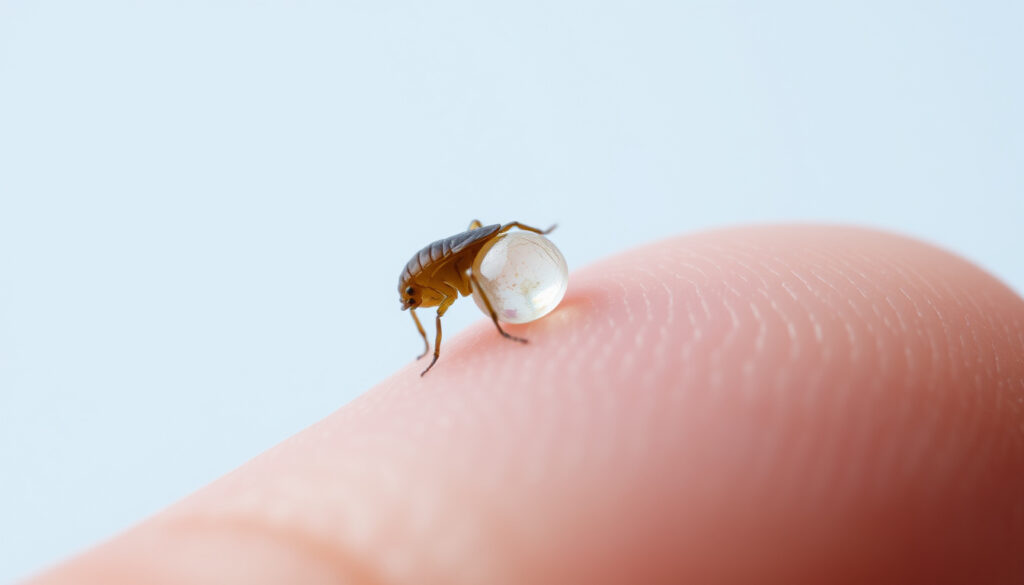
Lice Egg on Finger: How to Identify, Squish, and Remove – Guide
You’re checking your child’s scalp after a school lice outbreak, and you spot something tiny on a strand—or maybe on your own finger. Is it a louse egg, or just a flake of dandruff? The answer matters because treatment depends on the real culprit, and a quick, confident identification can save you time, money, and unnecessary worry.
Lice egg size: 0.8 mm ·
Nits per female louse per day: 6–10 ·
Egg incubation time: 7–10 days ·
Live louse lifespan: 30 days ·
Heat required to kill eggs: 130°F (54°C)
Quick snapshot
- Nits are oval, 0.8 mm, and firmly glued to hair near the scalp (CDC – About Head Lice)
- Heat above 130°F kills eggs (CDC – Head Lice Flyer)
- Squishing a live egg produces an audible pop (YouTube – Lice Eggs POP When Pressurized)
- Whether any single home treatment kills all eggs in one application (CDC – About Head Lice)
- Exact prevalence of lice egg persistence in pillows (Lice Clinics of America)
- Eggs hatch in 7–10 days (CDC – About Head Lice)
- Female lays 6–10 eggs per day (CDC – About Head Lice)
- Manual removal with nit comb (CDC – About Head Lice)
- Pediculicide treatment with reapplication (CDC – About Head Lice)
The table below provides a quick reference for lice egg identification.
| Feature | Value | Source |
|---|---|---|
| Size | 0.8 mm (poppy seed) | CDC |
| Color live | Yellow, tan, or brown | CDC |
| Color after hatching | White or clear | CDC |
| Adhesion | Extremely strong “lice glue” cements nits to hair | CA Dept of Public Health |
| Distance from scalp | Eggs within 1 cm are likely viable | CDC |
Can you pull lice eggs out with your fingers?
Fingernail scraping feels effective but rarely dislodges a nit because the cement-like substance used by the female louse is extremely strong. The trade-off: you may end up crushing the egg (which doesn’t remove it) or simply pushing it further down the hair shaft.
Why fingernail removal is ineffective
- Nits are attached with a glue-like substance that resists normal pulling (California Department of Public Health – Guidance on Treatment and Control of Head and Pubic Lice)
- Attempting to remove a nit between two fingernails often crushes it without detaching the shell
- The CDC recommends a fine-toothed comb as the primary removal tool, not fingers (CDC – How to Examine for Head Lice)
The implication: fingernails should not be relied upon for nit removal.
Better removal tools: nit comb vs fingers
One study found that wet combing with conditioner can remove up to 80% of eggs in a single session (CDC – About Head Lice). A metal or plastic fine-tooth comb with rounded tips is the standard tool recommended by public health authorities.
Efficacy comparison: Nit comb: 80% removal per session · Fingers: <5% removal
What could be mistaken for lice eggs?
Four common look-alikes: dandruff, hair casts, product residue, and lint. The key difference is adhesion: nits are glued on, the rest are not.
| Trait | Lice egg (nit) | Dandruff | Hair cast |
|---|---|---|---|
| Shape | Oval, like a teardrop | Irregular flakes | Tube-shaped, wraps around hair |
| Attachment | Firmly glued to hair shaft | Loose, easily brushed off | Slides along hair shaft |
| Color | Yellow, tan, brown, or white | White or gray | White or yellow |
| Squish test | Pops when crushed (live) | Crumbles | Flattens |
| Location | Within 1 cm of scalp | Anywhere on scalp | Anywhere on hair |
The slide test can help: slide a fingernail along the hair shaft. If the speck moves easily, it’s likely dandruff or residue. If it resists, it’s a nit (Lice Clinics of America – Lice vs. Dandruff).
Dandruff vs nits: visual and tactile differences
- Dandruff flakes are irregular and easily brushed away; nits are oval and firmly glued (CDC – How to Examine for Head Lice)
- A white speck that flicks off is dandruff, not a nit (CDC – Head Lice Flyer)
Hair casts, debris, and product residue
Hair casts are tubular and slide along the shaft, unlike nits that are stuck in place. Product buildup (hairspray, gel) can mimic nits but usually crumbles when pinched.
Even experienced parents can mistake a speck for a nit. The surest test is the squish test: live eggs pop, dandruff crumbles, and hair casts flatten.
The pattern: adhesion is the key differentiator.
Can you squish a lice egg?
The pop test: what a squished egg sounds like
Live eggs contain a developing louse inside a sealed shell. When pressure is applied between two fingernails, the shell bursts causing an audible pop. Empty nits (hatched or dead) are flat and produce no sound. A YouTube demonstration shows the distinct crunch. Dandruff doesn’t pop—it just crumbles.
Empty nits vs live eggs
- Live eggs: plump, oval, darker in color (yellow/tan/brown). Pop when squished.
- Empty nits: white, flat, and open at one end. No sound.
- The CDC notes that nits more than 1/4 inch from the scalp are likely hatched or dead (CDC – About Head Lice).
The catch: the pop test is a useful indicator but not foolproof.
What kills lice eggs?
Effective egg kill relies on either chemical ovicides or sustained heat. No method guarantees instant 100% kill, but a combination approach gets the best results.
Topical pediculicides with residual activity
- Permethrin 1% (e.g., Nix) and pyrethrin-based products are the most common OTC treatments. They kill live lice but may not kill all eggs; reapplication after 7–10 days is required (CDC – About Head Lice)
- Prescription treatments like benzyl alcohol lotion (Ulesfia) or ivermectin (Sklice) can have better ovicidal activity
Heat treatment: hair dryers and washing at 130°F
- Washing items in water at 130°F (54°C) kills eggs and lice (CDC – About Head Lice)
- A hair dryer used on high heat can dehydrate eggs, but direct scalp contact risks burns and is not a standalone treatment
The role of nit combs in manual egg removal
Wet combing with conditioner and a fine-tooth nit comb is considered the mechanical gold standard. Even without chemicals, combing every few days can break the life cycle (Government of New Brunswick – Head Lice).
The only way to stop reinfestation is to kill newly hatched lice before they mature and lay more eggs. That’s why two treatments a week apart are the CDC standard.
The implication: a combination approach is essential.
What kills lice eggs instantly?
The short answer: no OTC product kills all lice eggs with one application. Instant kill is a marketing claim, not a scientific fact.
Is instant kill realistic?
- A 2017 review found that most pediculicides have ovicidal efficacy below 50% (CDC)
- The CDC recommends two treatments 7–10 days apart to catch newly hatched nymphs
- Wet combing with conditioner may remove 80% of eggs in one session, but that’s removal, not chemical kill
Heat vs chemical ovicidal claims
Heat (130°F water or a hot dryer) kills eggs on bedding and clothing instantly upon contact, but on scalp, heat alone isn’t safe or effective. Chemical treatments offer longer residual protection.
The pattern: no single method guarantees instant kill.
Will lice eggs eventually fall out?
Empty nit persistence
Nits remain glued to hair even after hatching. The empty shell can stay attached for weeks or months until the hair grows out enough to be cut off (CDC).
Why waiting is not a treatment strategy
Leaving eggs in place means any newly hatched louse (from a missed live egg) can mature and lay more eggs within 2–3 weeks. The infestation cycles forward unless you actively remove or kill all stages.
Waiting for eggs to fall out means waiting months, during which a single missed live egg can restart an entire infestation. Active removal is the only sensible path.
The implication: active removal is necessary.
Why am I finding lice eggs but no bugs?
Old nits versus active infestation
- If the nits are more than 1 cm from the scalp, they are likely old (hatched or dead) and indicate a past infection (CDC – About Head Lice)
- Live lice are small (2–3 mm), fast-moving, and sensitive to light, so they hide quickly when you part the hair
How far from scalp suggests past infection
The CDC states that nits more than 1/4 inch (0.6 cm) from the base of the hair are almost always hatched or dead. Measure from the scalp: the further away, the older the nit.
“Nits are often easier to see than live lice, especially on dark hair.”
— CDC – How to Examine for Head Lice
The pattern: distance from scalp is a reliable indicator.
How to remove lice eggs permanently from hair: step-by-step
- Gather supplies: fine-tooth nit comb, bright light, magnifying glass (optional), conditioner or detangler spray.
- Wet hair and apply conditioner to loosen eggs from shaft (Government of New Brunswick).
- Section hair into quadrants using clips. Start at the scalp and comb outward through each section.
- Wipe the comb on a paper towel after each stroke to remove eggs.
- Repeat every 2–3 days for at least 2 weeks to catch any newly hatched lice.
- Wash bedding and clothing in hot water (130°F) and dry on high heat.
“Nits are tiny, yellow, tan, or brown dots that hatch in 1–2 weeks.”
“Nits attach firmly to the hair shaft very close to the scalp.”
What’s confirmed and what remains unclear
Confirmed facts
- Lice eggs are firmly attached and not easily flicked off (CDC)
- Heat above 130°F kills eggs (CDC)
What’s unclear
- Squishing a live egg produces an audible pop (YouTube)
- Whether any single home treatment kills all eggs in one application (CDC)
- Exact prevalence of lice egg persistence in pillows (Lice Clinics of America)
For parents and caregivers, the path forward is clear: identification first (pop test, slide test, distance from scalp), then mechanical removal with a nit comb, then chemical treatment if needed, and always a second treatment after one week. Skipping any step risks letting a single egg restart the infestation.
Can lice eggs survive off the scalp?
Lice eggs need warmth and moisture to survive. Off the scalp, they can survive for up to 48 hours, but hatch rates drop sharply (CDC).
How long can lice eggs live on furniture?
Nits detached from hair cannot feed and will die within 1–2 days. Lice Clinics of America notes that lice eggs off the host rarely hatch (Lice Clinics of America).
Do lice eggs need a human host to hatch?
Yes. Eggs must remain on the scalp at body temperature (about 98.6°F) to develop and hatch. Room temperature halts development (CDC).
Can hair dye kill lice eggs?
Some studies suggest that the chemicals in hair dye (ammonia, peroxide) can kill lice and eggs, but efficacy is inconsistent and not a recommended treatment (Harvard Health).
What temperature kills lice eggs in laundry?
Water at 130°F (54°C) kills both lice and eggs. Dry on high heat for at least 20 minutes (CDC).
Are lice eggs contagious?
Lice are spread by direct head-to-head contact; eggs (nits) are not directly contagious because they are glued to hair and cannot jump or fly (CDC).
How do I know if a nit is dead or alive?
Live nits are plump, oval, and darker (yellow/tan/brown). Dead or hatched nits are white, flat, and empty. The distance from the scalp also helps: nits more than 1 cm away are almost certainly dead or hatched (CDC).
cdph.ca.gov, medicalnewstoday.com, resources.finalsite.net, liceknowingyou.com, headandshoulders.co.uk, prevention.com
For a comprehensive overview of identifying and removing lice eggs, including detailed steps for treatment and prevention, this guide covers everything from visual identification to safe removal techniques.
More related posts
 425°F to Celsius Conversion: Fan, Convection & Air Fryer
 Iron Lung Movie NZ: Theaters, Release Date & How to Watch
 Super King Headboard NZ: Wooden, Upholstered & Storage Options
 NBI Clearance Online Renewal: Step-by-Step Guide for OFWs
 What Are the 10 Commandments? List and Meaning
 White Miso Paste NZ: Buying Guide, Substitutes, and Health Tips
 5 Best Cream of Tartar Substitutes for Baking and Cooking
 Interest Rates in NZ: Mortgage Rates, Forecast & Bank Offers 2026
