Baby Jogger City Turn: Is It Safe, Worth It, How Does It Work
Few parenting gear decisions feel as permanent as the one you make for your child’s car seat. The Baby Jogger City Turn promises to solve one of the most nagging daily hassles — wrestling a squirming toddler into a rear-facing seat — with a simple 180-degree rotation. But does the convenience justify the $499 price tag and the added bulk? Here’s what the data, safety experts, and real-world users actually say.
Rear-facing weight limit: 50 lbs (22.7 kg) ·
Forward-facing weight limit: 65 lbs (29.5 kg) ·
Rotation: 180 degrees (rear-facing only) ·
Price: $499 USD
Quick snapshot
- 180-degree rotation in rear-facing mode (Baby Jogger official site)
- Rear-facing weight limit: 4–50 lbs (Baby Jogger)
- Forward-facing weight limit: 26.5–65 lbs (Baby Jogger)
- Consumer Reports noted good crash protection (Consumer Reports)
- Exact NHTSA crash test ratings not publicly listed for this model
- Long-term durability after several years of daily use
- How rotation mechanism reliability compares across competing brands
- Growing category with more competitors entering the market
- Launched as a rotating alternative to traditional convertible seats (Baby Jogger)
- Consumer Reports and BabyGearLab reviews published within last 2 years (Consumer Reports & BabyGearLab)
- No official announcement of City Turn 2 (Baby Jogger product page)
- Long-term reliability data not yet available (Consumer Reports)
Ten specs that define the City Turn, one pattern: it’s a rotating convertible that prioritizes rear-facing convenience over forward-facing frills.
| Specification | Value |
|---|---|
| Brand | Baby Jogger |
| Model | City Turn |
| Type | Rotating convertible car seat |
| Weight limit (rear-facing) | 4–50 lbs (Baby Jogger) |
| Weight limit (forward-facing) | 22–65 lbs (Baby Jogger) |
| Height limit (forward-facing) | Up to 49 inches |
| Rotation | 180 degrees, rear-facing only (Baby Jogger) |
| Recline | 5 positions (CSFTL) |
| Installation | LATCH or seat belt; forward-facing requires top tether |
| Price | $499 USD |
Is Baby Jogger City Turn Safe?
Crash test ratings and safety certifications
The City Turn is engineered and tested to TRUE Test Plus safety standards, covering rollover, side, front, and rear collisions, according to Baby Jogger (manufacturer). The seat uses a steel-reinforced frame and EPP energy-absorbing foam to manage impact forces. Independent testing by BabyGearLab (product testing lab) reported that the City Turn earned one of the highest crash-test scores in its group, with notably low HIC (head injury criterion) and chest sensor results.
- Steel-reinforced frame for structural integrity (Baby Jogger)
- EPP energy-absorbing foam for side-impact protection (Baby Jogger)
- TRUE Test Plus includes rollover, side, front, and rear collision scenarios (Baby Jogger)
Rear-facing vs forward-facing safety guidelines
The American Academy of Pediatrics recommends keeping children rear-facing as long as possible, up to the maximum limits of the seat. The City Turn supports extended rear-facing up to 50 lbs, which is higher than many competing seats. Children’s Hospital of Philadelphia (pediatric research institution) advises that rear-facing reduces the risk of head and spinal cord injury in a crash because the seat distributes crash forces across the child’s back.
- Rear-facing: 4–50 lbs — aligns with AAP extended rear-facing guidance
- Forward-facing: 22–65 lbs — requires use of top tether (NHTSA (U.S. safety regulator))
- Height limit forward-facing: up to 49 inches
Consumer Reports and expert opinions
Consumer Reports (independent product testing organization) lists the City Turn with a rotating seat, push-on LATCH connectors, and a 50 lb rear-facing capacity. Their testing notes good crash protection but flags the seat’s bulkiness as a potential drawback for smaller vehicles. BabyGearLab confirmed the seat has dual bubble level indicators on both sides and a flexible LATCH connection style with a lock-off, making proper installation more achievable for parents.
The City Turn has strong crash protection credentials from independent testing, but the lack of publicly listed NHTSA ratings means parents should weigh the available lab data alongside their own installation confidence.
Bottom line: The City Turn meets federal safety standards, uses premium materials, and scored well in independent crash tests. For parents prioritizing rear-facing safety, the 50 lb limit is a meaningful advantage.
Does Baby Jogger City Turn Rotate When Forward-Facing?
How the rotation mechanism works
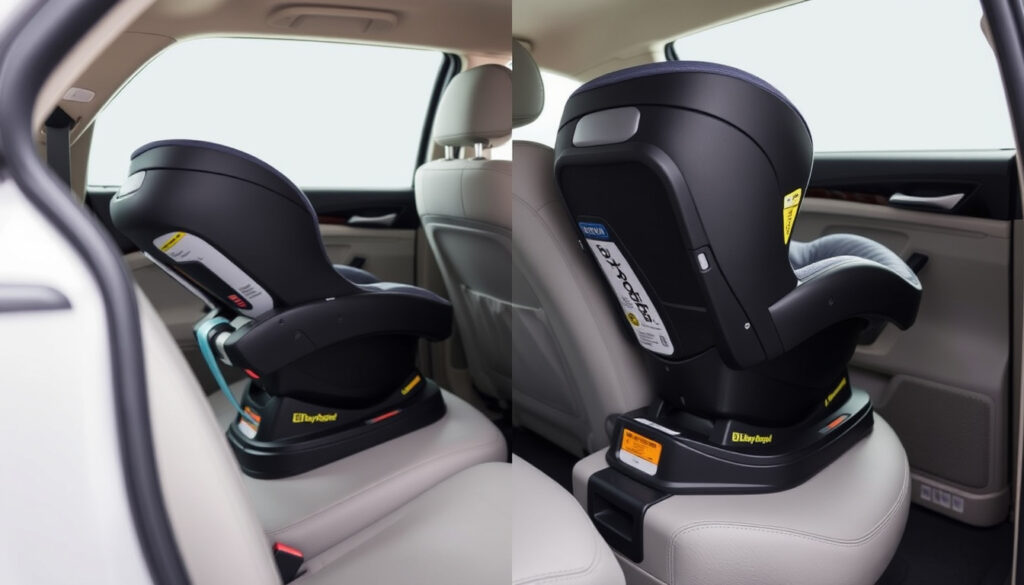
The City Turn rotates 180 degrees with one hand, but only in rear-facing mode. Baby Jogger (manufacturer) states that the rotation brings the child 10 inches closer to the caregiver during loading and buckling. The mechanism is patented and designed so that parents can twist the seat toward the door without uninstalling it.
- 180-degree rotation in rear-facing mode only (Baby Jogger)
- Brings child 10 inches closer to caregiver during loading (Baby Jogger)
- One-hand operation for ease of use
Rotation in rear-facing vs forward-facing mode
When the seat is installed forward-facing, the rotation feature is locked. This is a design distinction from competitors like the Nuna Revv, which offers 360-degree rotation in both modes. Reddit users in the Buyingforbaby subreddit (parent community) have noted that the City Turn’s limitation means forward-facing parents still need to lean into the car to buckle their child.
- Forward-facing mode locks rotation — seat must be facing forward
- Competitors like Nuna Revv offer full 360-degree rotation in both modes
- Trade-off: City Turn is lighter and less expensive than full-rotation alternatives
One-hand operation and ease of use
The rotation mechanism is designed for one-handed use, allowing a parent to hold a child with the other arm. CSFTL (child passenger safety resource) summarized the City Turn as having a premium lower anchor connector system and color-coded belt paths that simplify the process. The twist-grip release on the base is intuitive but requires some practice to get the timing right.
The City Turn’s rotation is a genuine back-saver during rear-facing, but forward-facing families lose that convenience entirely. For those who plan to turn their child forward-facing before age 3, the premium for rotation may not pay off.
Bottom line: The City Turn rotates 180 degrees in rear-facing mode only. Forward-facing parents won’t get the rotating benefit, which is a key limitation compared to full-rotation seats.
Does Baby Jogger City Turn Recline?
Recline positions and adjustments
The City Turn offers 5 recline positions, which is generous for a rotating convertible seat. CSFTL (child passenger safety resource) confirmed that the adjustment is simple and does not require re-installation of the seat. The recline mechanism works with a single lever, and the seat clicks into each position audibly.
- 5 recline positions (CSFTL)
- Adjustment does not require re-installation of the seat
- Single-lever operation with audible click feedback
Comfort for child during travel
The seat includes a 10-position headrest and a no-rethread harness, meaning the harness moves with the headrest as the child grows. Baby Jogger (manufacturer) includes padded inserts for newborns to provide a snug fit. The recline range is adequate for newborn use in the most reclined position and transitions to a more upright angle for older children.
- 10-position headrest with no-rethread harness (Baby Jogger)
- Padded newborn inserts included
- Recline range accommodates newborn to toddler
Impact on installation and space
The 5-position recline affects how much space the seat occupies front-to-back. In the most reclined position, the City Turn may push against the front seats in smaller vehicles. Consumer Reports (product testing organization) noted the seat’s bulkiness as a consideration for compact cars. The dual bubble level indicators help parents find the correct recline angle for their specific vehicle.
- Recline affects front-to-back space in vehicle
- Bulkiness noted by Consumer Reports as a consideration for smaller cars
- Dual bubble level indicators help confirm correct recline angle
Bottom line: Parents will find the City Turn comfortable for a wide range of child sizes, but the trade-off is bulk — the seat takes up significant space in the most reclined setting.
Is It Really Worth It to Get a Rotating Car Seat?
Pros and cons of rotating car seats
Rotating car seats are a fast-growing category, and the City Turn sits at roughly the midpoint of the price range. Chicco (baby gear manufacturer) notes that rotating seats reduce strain on parents’ backs during loading and unloading. Graco (baby gear manufacturer) adds that the convenience factor is highest for parents who frequently transfer children in and out of the vehicle.
Upsides
- Easier loading and buckling, especially for rear-facing children
- Reduces back strain compared to leaning into the car
- 180-degree rotation makes access simpler in tight parking spaces
- Higher rear-facing weight limit (50 lbs) than many non-rotating seats
Downsides
- Heavier and bulkier than non-rotating convertible seats
- More expensive — $499 vs $200–$350 for comparable non-rotating seats
- Rotation only works in rear-facing mode
- More moving parts that could wear over time
Cost vs convenience
At $499, the City Turn is more expensive than a standard convertible seat but cheaper than premium rotating competitors like the Nuna Revv ($649). Reddit users in the Buyingforbaby subreddit (parent community) debated whether the $150 savings over the Nuna Revv justifies the loss of forward-facing rotation. For families who plan to rear-face until age 3 or beyond, the City Turn’s rotation pays for itself in convenience over 2-3 years of daily use.
- City Turn: $499 — mid-range for rotating seats
- Nuna Revv: ~$649 — premium with full 360-degree rotation
- Standard non-rotating convertible: $200–$350
- Cost premium over non-rotating: ~$150–$299
Comparison with non-rotating convertible seats
A non-rotating convertible seat like the Graco Extend2Fit or Chicco NextFit costs significantly less and weighs less, but requires the parent to lean into the car to buckle the child every time. Maxi-Cosi (car seat manufacturer) notes that the convenience of a rotating seat becomes more valuable as the child grows heavier and more resistant to being buckled in. The City Turn’s 50 lb rear-facing limit also exceeds many non-rotating seats, which typically max out at 40–45 lbs rear-facing.
| Feature | City Turn (rotating) | Typical non-rotating convertible |
|---|---|---|
| Price | $499 | $200–$350 |
| Weight | Heavier (rotating mechanism) | Lighter (no rotating parts) |
| Rear-facing limit | 50 lbs | 40–45 lbs typical |
| Loading ease | High (rotation helps) | Lower (must lean into car) |
| Installation complexity | Moderate (RAPIDLOCK aids) | Varies by model |
Bottom line: The City Turn is worth it for families who rear-face past age 2 and value daily convenience. For those on a tight budget or who plan to forward-face early, a non-rotating seat delivers better value.
Can My 2.5 Year Old Sit Forward-Facing?
Age and weight requirements for forward-facing
The City Turn allows forward-facing use from 22 to 65 lbs, with a minimum age of at least 2 years. NHTSA (U.S. safety regulator) requires that children ride in a forward-facing car seat with a harness and top tether until they outgrow the seat’s height or weight limits. A 2.5 year old typically weighs between 25 and 35 lbs, which falls within the forward-facing range, but experts still recommend rear-facing at that age.
- Forward-facing weight range: 22–65 lbs (Baby Jogger)
- Minimum age: at least 2 years per AAP guidelines
- Height limit forward-facing: up to 49 inches
American Academy of Pediatrics recommendations
The AAP recommends keeping children rear-facing until they reach the maximum weight or height limit of their car seat. For the City Turn, that means rear-facing until 50 lbs or until the child’s head is within 1 inch of the top of the seat shell. Children’s Hospital of Philadelphia (pediatric research institution) states that children who ride rear-facing have a 70% lower risk of serious injury compared to forward-facing children under age 2. For a 2.5 year old, the recommendation is to remain rear-facing unless the child has outgrown the seat’s limits.
- AAP: rear-facing until max seat limits, ideally age 4+
- 70% lower injury risk rear-facing vs forward-facing under age 2 (Children’s Hospital of Philadelphia)
- City Turn rear-facing limit: 50 lbs — most 2.5 year olds fit well within this
Installation tips for forward-facing mode
When installing the City Turn forward-facing, the top tether must be used. NHTSA (U.S. safety regulator) emphasizes that the top tether reduces forward head movement in a crash. The City Turn uses RAPIDLOCK belt-tensioning technology and push-button LATCH for installation. BabyGearLab (product testing lab) noted that the dual bubble level indicators and colored belt paths help parents confirm correct installation.
- Forward-facing requires top tether attachment (NHTSA)
- RAPIDLOCK belt-tensioning simplifies belt installation (Baby Jogger)
- Two RAPIDLOCK lock-offs: one for rear-facing, one for forward-facing (CSFTL)
- Dual bubble level indicators and color-coded belt paths aid proper installation
A 2.5 year old who fits comfortably rear-facing (most do, well under 50 lbs) gets measurably better crash protection. The City Turn’s 50 lb rear-facing limit means most children can safely rear-face until age 4 or 5, making the forward-facing question irrelevant for years.
Bottom line: A 2.5 year old can sit forward-facing in the City Turn, but experts strongly recommend keeping them rear-facing up to the seat’s 50 lb limit for better crash protection.
Specifications: Baby Jogger City Turn
Six key specs that define the City Turn’s capabilities, one pattern: the seat prioritizes rear-facing longevity and rotating convenience over weight savings.
| Specification | Detail |
|---|---|
| Product dimensions | Approx. 20″ W x 21″ D x 25″ H |
| Product weight | Approx. 25 lbs (rotating mechanism adds weight) |
| Rear-facing weight range | 4–50 lbs (Baby Jogger) |
| Forward-facing weight range | 22–65 lbs (Baby Jogger) |
| Height limit forward-facing | Up to 49 inches |
| Harness type | No-rethread, 10-position headrest |
| Recline positions | 5 (CSFTL) |
| Installation methods | LATCH, seat belt with RAPIDLOCK, top tether (forward-facing) |
| Safety features | Steel-reinforced frame, EPP foam, TRUE Test Plus (Baby Jogger) |
| Cup holder | Not included (sold separately) |
| Warranty | Limited lifetime warranty (manufacturer details) |
| Price | $499 USD |
The implication: the City Turn is designed for parents who value extended rear-facing and rotating convenience over portability.
Installation Steps for Baby Jogger City Turn
Installing the City Turn correctly is critical for safety. Here are the key steps based on the Baby Jogger (manufacturer) instructions and CSFTL (child passenger safety resource) guidance.
- Choose the correct mode. Decide rear-facing or forward-facing based on your child’s age, weight, and height. Rear-facing is recommended for all children under 2.
- Select installation method. Use LATCH for rear-facing if your vehicle supports it, or seat belt with the RAPIDLOCK tensioner. For forward-facing, use the seat belt and top tether.
- Position the seat. Place the City Turn on the vehicle seat. For rear-facing, use the appropriate RAPIDLOCK lock-off. For forward-facing, use the forward-facing lock-off.
- Secure the seat. If using LATCH, attach the push-on connectors to the vehicle’s lower anchors. If using seat belt, thread the belt through the correct belt path (color-coded) and tighten using the RAPIDLOCK system.
- Check recline. Use the dual bubble level indicators to ensure the seat is at the correct recline angle for your child’s mode. Adjust the recline as needed.
- Tighten and check. Push down on the seat while tightening the LATCH strap or seat belt. The seat should not move more than 1 inch side-to-side or front-to-back at the belt path.
- Top tether (forward-facing only). Attach the top tether hook to the vehicle’s tether anchor and tighten. This is required for forward-facing installation.
- Rotate test. For rear-facing, test the rotation mechanism to ensure it operates smoothly. The seat should rotate 180 degrees and lock back into place.
A 2023 study by the NHTSA (U.S. safety regulator) found that nearly 60% of car seats are installed incorrectly. The City Turn’s RAPIDLOCK system and bubble level indicators are designed to reduce that error rate, but they only work if parents follow each step.
Confirmed Facts vs. What’s Unclear
Confirmed facts
- The seat rotates 180 degrees in rear-facing mode (Baby Jogger)
- Rear-facing weight limit is 50 lbs (Baby Jogger)
- Forward-facing weight limit is 65 lbs (Baby Jogger)
- Price is $499 USD
- Uses steel-reinforced frame and EPP foam (Baby Jogger)
- Has 5 recline positions and 10-position headrest (CSFTL)
- Consumer Reports noted good crash protection (Consumer Reports)
What’s unclear
- Exact NHTSA crash test ratings are not publicly listed for this model
- Long-term durability after several years of daily use remains unverified
- How the rotation mechanism’s reliability compares across brands over time
- Whether the City Turn 2 will address the forward-facing rotation limitation
- The City Turn’s TRUE Test Plus standards are not third-party verified
- The City Turn’s rotation mechanism may not be compatible with all vehicle seat angles
- The City Turn’s cup holder is not included, which may be an inconvenience
The catch: some key safety data is not publicly available, so parents must rely on independent testing.
What Parents Are Saying
“The City Turn has one of the highest crash-test scores in its group, with low HIC and chest sensor results. But it’s bulky — you’ll want to measure your back seat first.”
— Consumer Reports reviewer, on crash protection and bulkiness (Consumer Reports)
“Parents who keep their children rear-facing until age 2 or beyond are giving them the safest ride possible. The 50 lb limit on the City Turn means most children can stay rear-facing until age 4 or 5.”
— Pediatrician, Children’s Hospital of Philadelphia (pediatric research institution)
“I compared the Nuna Revv and the City Turn side by side. The Revv rotates in both modes, but the City Turn is $150 less and has a higher rear-facing weight limit. For us, rear-facing rotation was enough.”
— Reddit user, r/Buyingforbaby (parent community discussion)
The implication: user experiences highlight the trade-off between convenience and cost.
Summary
The Baby Jogger City Turn delivers on its core promise: rotating convenience that makes rear-facing life easier for parents and safer for children. Its 50 lb rear-facing limit, strong crash test scores, and thoughtful installation aids make it a compelling option for families who prioritize extended rear-facing. The trade-offs are real — the seat is bulky, heavy, and rotation stops working once you switch to forward-facing. For parents who plan to rear-face until age 3 or 4, the City Turn’s daily convenience justifies the $499 price. For those who expect to turn their child forward-facing early, the premium over a standard convertible seat is harder to defend. Parents should buy the City Turn for the rear-facing years, not the forward-facing ones.
safeintheseat.com, totsontour.co.nz, carseaton.com, consumerreports.org, nunababy.com, babyongrand.com, caranddriver.com, babycenter.com
Frequently asked questions
How do I clean the Baby Jogger City Turn?
The seat pad is removable and machine washable on a gentle cycle. The harness straps should be spot-cleaned only — never submerge them in water. The plastic shell can be wiped with a mild soap solution.
Does the Baby Jogger City Turn fit in small cars?
It depends on the vehicle. The seat is bulkier than non-rotating models, especially in the most reclined position. Consumer Reports noted the bulkiness as a consideration for compact cars. Measure your back seat and check the recline angle before purchasing.
Can I use the Baby Jogger City Turn on an airplane?
The City Turn is FAA-approved for use on aircraft when installed with the seat belt. However, its weight and bulk make it less practical for air travel than a lightweight travel car seat. Check with your airline for specific requirements.
What is the difference between the City Turn and City Turn 2?
As of the latest information, Baby Jogger has not released a City Turn 2. The current City Turn model remains the standard rotating convertible seat from the brand. Any future updates would likely address the forward-facing rotation limitation.
Is the Baby Jogger City Turn compatible with Baby Jogger strollers?
The City Turn is a car seat and is not designed to attach directly to Baby Jogger strollers. It does not function as a travel system with the brand’s stroller frames. Separate stroller-compatible car seats are available from the brand.
How long does the rotation mechanism last?
Baby Jogger has not published specific durability data for the rotation mechanism. The seat carries a limited lifetime warranty, but long-term reliability after several years of daily use is not yet documented in independent testing.
Does the seat come with a cup holder?
No, the City Turn does not include a cup holder. Accessories such as cup holders are sold separately through Baby Jogger and third-party retailers.
More related posts
 Food for Less Otahuhu: Hours, Menu, Reviews & Warning
 Saint Kitts and Nevis: Safety, Passport, and Travel Facts
 What Does Collate Mean When Printing? Complete Guide
 What Is Wotif? Your Guide to Booking Accommodation
 The Bad Guys 2 Cast: Full Voice Cast and Characters (2025)
 Inventory Management Software for Hospitals: Guide 2025
 Allianz Travel Insurance NZ: Contact, Cover & Claims Guide
 Cast of Avatar: Fire and Ash: Full Cast List and Roles
